Malaysia’s TikTok skincare boom is real — but most brands that win there are built for one channel only. The constraint that decides whether a brand can move into pharmacy, cooperative or export channels is set on the day it chooses a production line.
Written & researched by Creaton Poh, industry researcher · Technical input by ORIZI Group R&D Team · Fact-checked by ORIZI Group Editorial · Published by ORIZI Group · Last reviewed September 2026
Disclosure: This article is published by ORIZI Group and refers to our own manufacturing experience and capabilities. Market figures are reported in aggregate; no individual brand is identified.
Quick answer: what decides whether a TikTok brand can scale
A skincare brand can launch on TikTok Shop Malaysia without halal certification, because certification is voluntary for cosmetics sold domestically. It cannot enter most pharmacy chains, cooperative channels or Indonesian and Gulf export markets without it. Certification attaches to the manufacturing line, not to the brand — so a brand that launches on an uncertified or overseas line has to change factory to qualify later, which means new stability testing and a notification update.
Key takeaways
- Halal certification is still the exception. In our September 2026 review of Malaysian-owned skincare brands on TikTok Shop, roughly one in five held JAKIM certification.
- It is bought for the second channel, not the first. Certified and uncertified brands sit at effectively the same price point online — the value appears at retail, cooperative and export gates.
- A “Malaysian brand” is not automatically made in Malaysia, and an overseas line cannot carry JAKIM certification.
- Switching factory later is the expensive part — not the certificate. Reformulation, revalidation and re-notification usually take longer than the original launch.
- The decision is timing, not principle: how soon do you need the second channel?
Three numbers from the September 2026 market snapshot
We reviewed Malaysian-owned skincare brands with recorded sales on TikTok Shop Malaysia, captured 15 September 2026, and cross-checked them against Malaysian cosmetic notification and halal certification records. Reported in aggregate:
| Indicator | September 2026 snapshot |
|---|---|
| Malaysian-owned skincare brands trading on the platform | 46 |
| Share holding JAKIM halal certification | About 1 in 5 |
| Median entry price | RM40 |
The full brand-level dataset, including the notification and certification cross-check, sits in our internal research file and is not published here. What follows is the part that affects a brand owner’s decision.
Why halal certification is a channel decision, not a marketing one
JAKIM halal certification is issued in Malaysia by the Department of Islamic Development Malaysia and certifies the manufacturing premises, process and ingredients — it is not a label a brand can adopt on its own. That single fact drives everything below.
Online, certification is not gating sales: uncertified brands sell at the same prices as certified ones. The gate appears later, and it appears suddenly — at the first modern-trade listing meeting, the first cooperative tender, the first Indonesian distributor conversation. A brand that has spent 18 months building demand then discovers the qualification sits with its factory, not with its marketing. Our halal OEM manufacturing page sets out what a certified line actually has to demonstrate.
What changing factory actually costs
Based on ORIZI Group’s manufacturing experience, brand owners consistently underestimate this step, because the certificate fee is visible and the requalification work is not. Moving an existing product to a certified line typically requires:
- Reformulation or ingredient substitution where the original raw materials have no halal-certified equivalent from the incumbent supplier.
- New stability and compatibility testing, because a formula made on a different line in different packaging is, for regulatory purposes, a different product.
- A notification update with the National Pharmaceutical Regulatory Agency (NPRA) when the manufacturer or holder company changes.
- Packaging re-sourcing, since component minimums and lead times rarely transfer between suppliers.
In practice this sequence runs longer than the original launch did — and it lands exactly when the brand has retail demand waiting.
Two launch routes, and when each one is right
There is no universally correct answer. There is a correct answer for a stated time horizon.
| Fast validation route | Certified-line route | |
|---|---|---|
| Right when | You are testing whether the concept sells at all | You expect retail, cooperative or export within about two years |
| Typical minimum order | From 50 units on a ready formula | From 500–1,000 units for custom formulation and packaging |
| Typical launch time | 1–2 weeks on a ready formula | Longer — certification, testing and notification run in parallel with development |
| Unit cost | Lowest | Slightly higher |
| Second-channel readiness | Requalification needed | Already qualified |
Figures describe ORIZI Group’s own manufacturing routes, not a market average. The fast validation route is available through our R2B launch packages; brands building for short-form video can review our viral and TikTok product manufacturing capability.
The ORIZI perspective
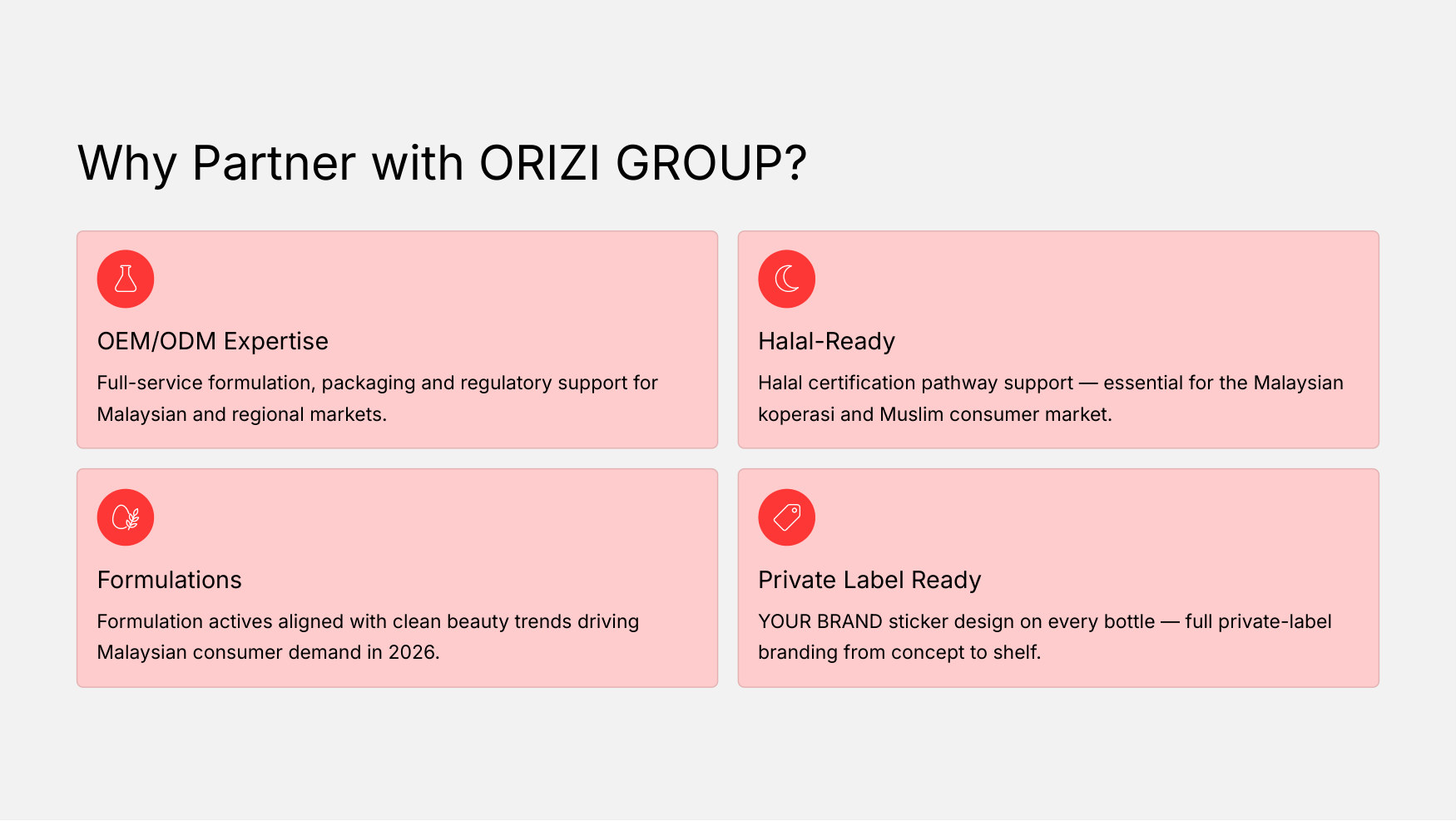
The pattern we see is that brands optimise for the launch, not for the second channel — which is rational when cash is tight and the concept is unproven. The mistake is not choosing speed. The mistake is choosing speed without knowing what it will cost to change course, and then discovering the cost when a buyer is already waiting.
The practical middle path: validate fast on a small ready-formula run, but check before you start whether the same formula family can be produced on a certified line later. When it can, the later move is a transfer rather than a restart. When it cannot, that is worth knowing in month one rather than month eighteen.
Limitations
- The snapshot covers TikTok Shop only — not Shopee, Lazada, pharmacy retail or direct sales — so it is not a measure of total brand size.
- Platform sales figures come from a third-party analytics source and are estimates, not audited sales.
- Certification and notification records reflect a snapshot taken in September 2026; newer records will not appear in it.
- Rankings on TikTok Shop move quickly. Treat any capture older than three months as indicative only.
Frequently asked questions
Do I need JAKIM halal certification to sell skincare in Malaysia?
No. Halal certification is voluntary for cosmetics sold in Malaysia; the mandatory step is cosmetic notification with the NPRA. Certification becomes a practical requirement when you enter modern-trade retail, cooperative and government-linked channels, or export to Indonesia and the Gulf.
Can I add halal certification to a product that is already selling?
Only if it is produced on a certified line. Certification applies to the manufacturing premises, process and ingredients, not to the brand. If your product is currently made on an uncertified or overseas line, adding certification means moving production — which usually triggers new stability testing and a notification update.
What minimum order quantity does a TikTok-first skincare launch need?
It depends on format and packaging rather than on the sales channel. Ready-formula launches can start from 50 units under an R2B package, while custom formulation and custom packaging typically start from 500 to 1,000 units because of component minimums.
Is manufacturing in Malaysia more expensive than importing?
Per unit, often slightly. Across a product lifecycle, frequently not — local manufacturing shortens restock cycles, keeps the notification holder structure stable, and keeps halal certification available. The comparison only makes sense against the channels a brand expects to be in within two years.
How long does halal certification take to obtain?
Timelines depend on the applicant, the facility and the completeness of ingredient documentation, so we do not quote a fixed figure. The faster route for a new brand is to produce on a line that already holds certification, which removes the application from the critical path entirely.
Sources
- Halal Malaysia Official Portal, Department of Islamic Development Malaysia (JAKIM) — halal certification scope and requirements.
- NPRA Quest3+ product search, National Pharmaceutical Regulatory Agency, Ministry of Health Malaysia — cosmetic notification records.
- ORIZI Group internal market snapshot, TikTok Shop Malaysia skincare, captured 15 September 2026. Aggregate figures only.
Related reading: choosing content-friendly product formats for TikTok brands and why licensed products need compliance.
Update history
16 September 2026 — first publication. Market snapshot captured 15 September 2026.
Deciding between speed and certification?
Tell us your product concept, target channels and timeline, and our team will tell you which route the numbers actually support — including whether your formula family can transfer to a certified line later. Talk to ORIZI Group.