Own-brand skincare in Malaysia is still built one SKU at a time, while consumers increasingly buy routines. Five categories sit in genuine white space — and each one is a system, not a product.
Written & researched by Creaton Poh, industry researcher · Technical input by ORIZI Group R&D Team · Fact-checked by ORIZI Group Editorial · Published by ORIZI Group · Last reviewed September 2026
Disclosure: This article is published by ORIZI Group and refers to our own manufacturing experience and capabilities. Category assessments are our own analysis, reported without naming individual retailers or brands.
Quick answer: what is an innovation platform in own-brand skincare?
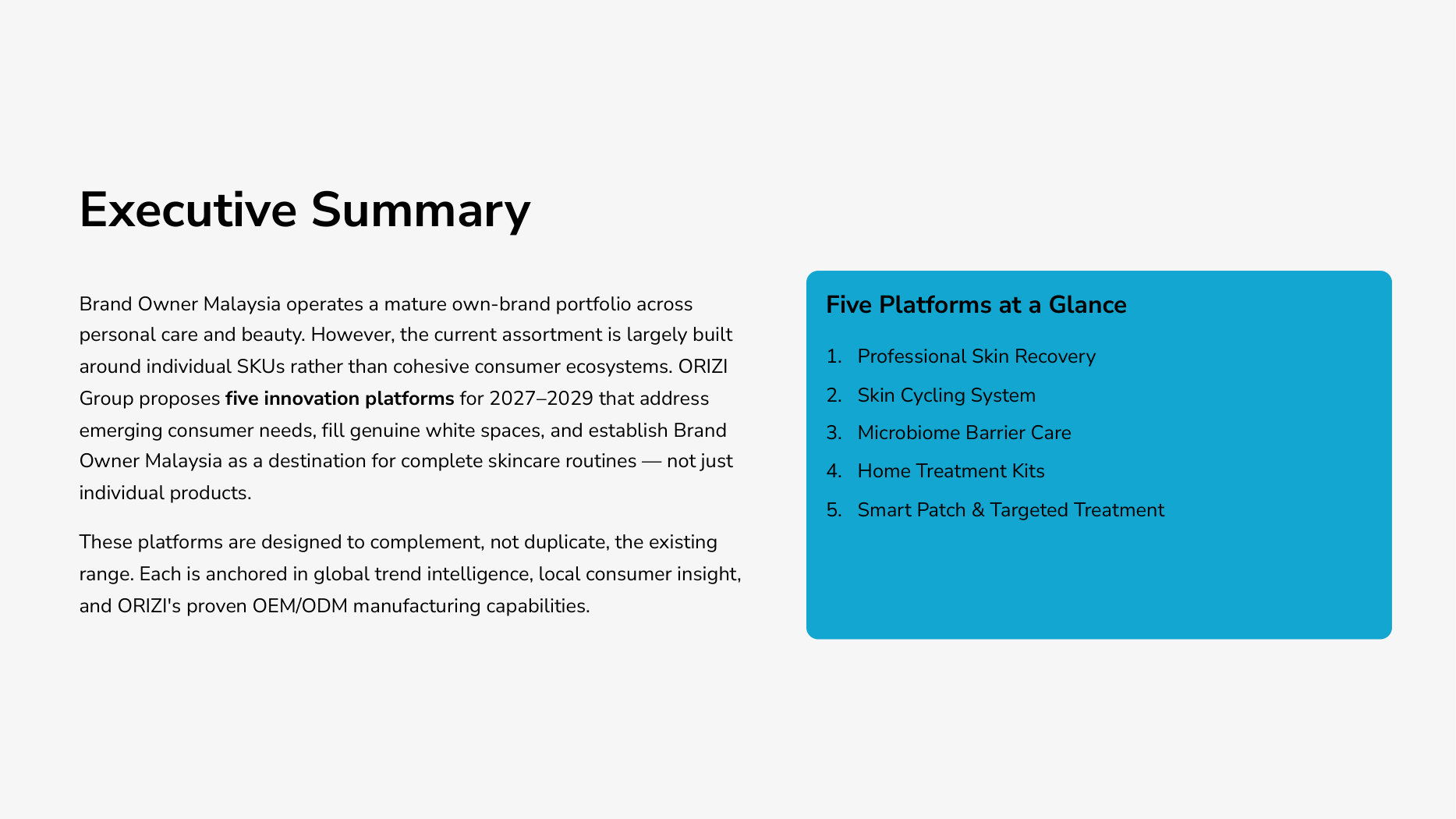
An innovation platform is a group of products designed to be bought and used together to solve one defined need — a recovery protocol, a weekly routine, a barrier reset — rather than a single SKU competing on its own. Platforms matter because shoppers now follow structured routines: they buy systems, and whoever sells the system captures the whole basket. ORIZI Group has mapped five platforms for 2027–2029 that sit in genuine white space in the Malaysian own-brand market.
Key takeaways
- Routine-led buying beats product-led buying. The basket, not the SKU, is the unit of competition.
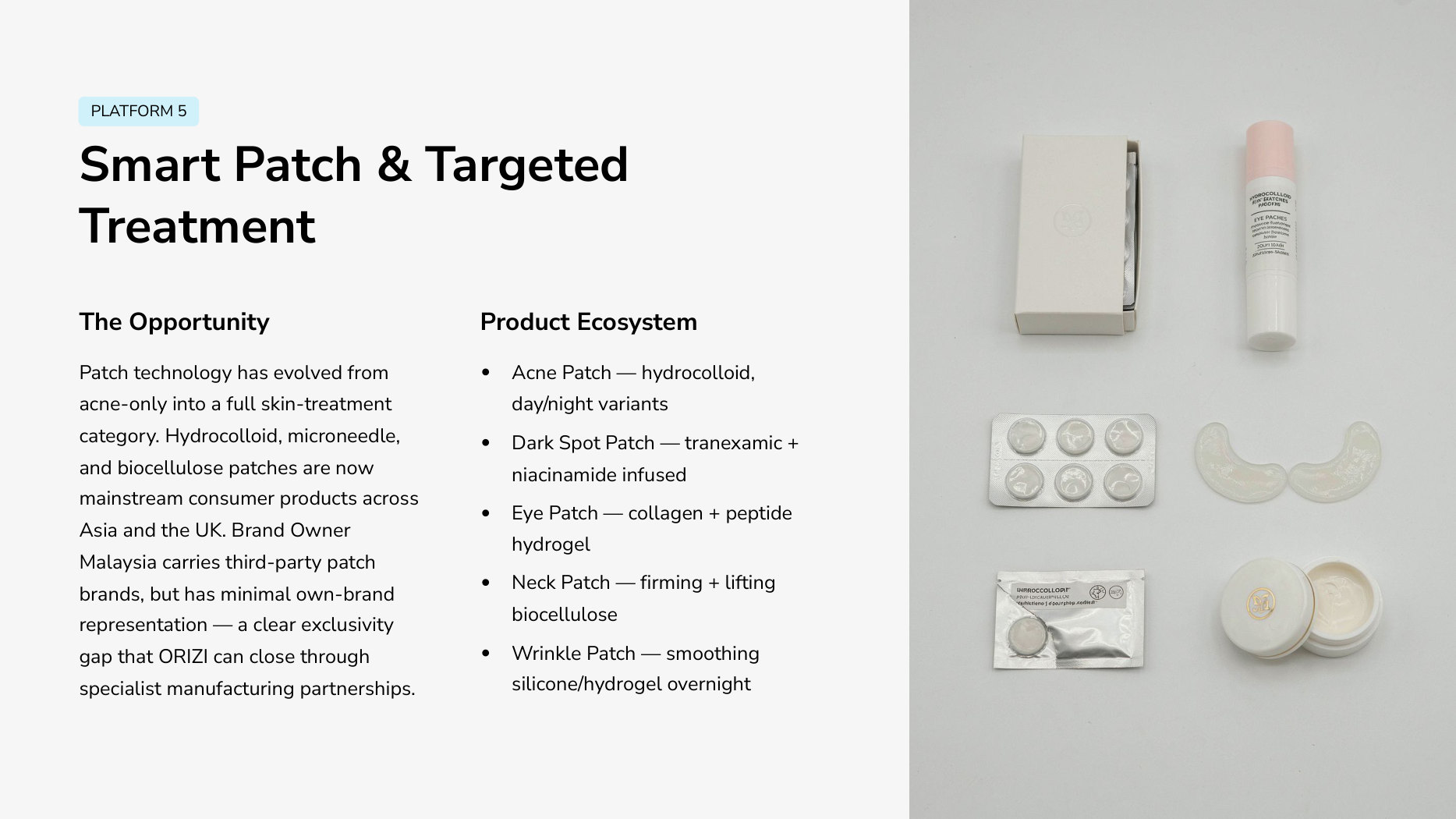
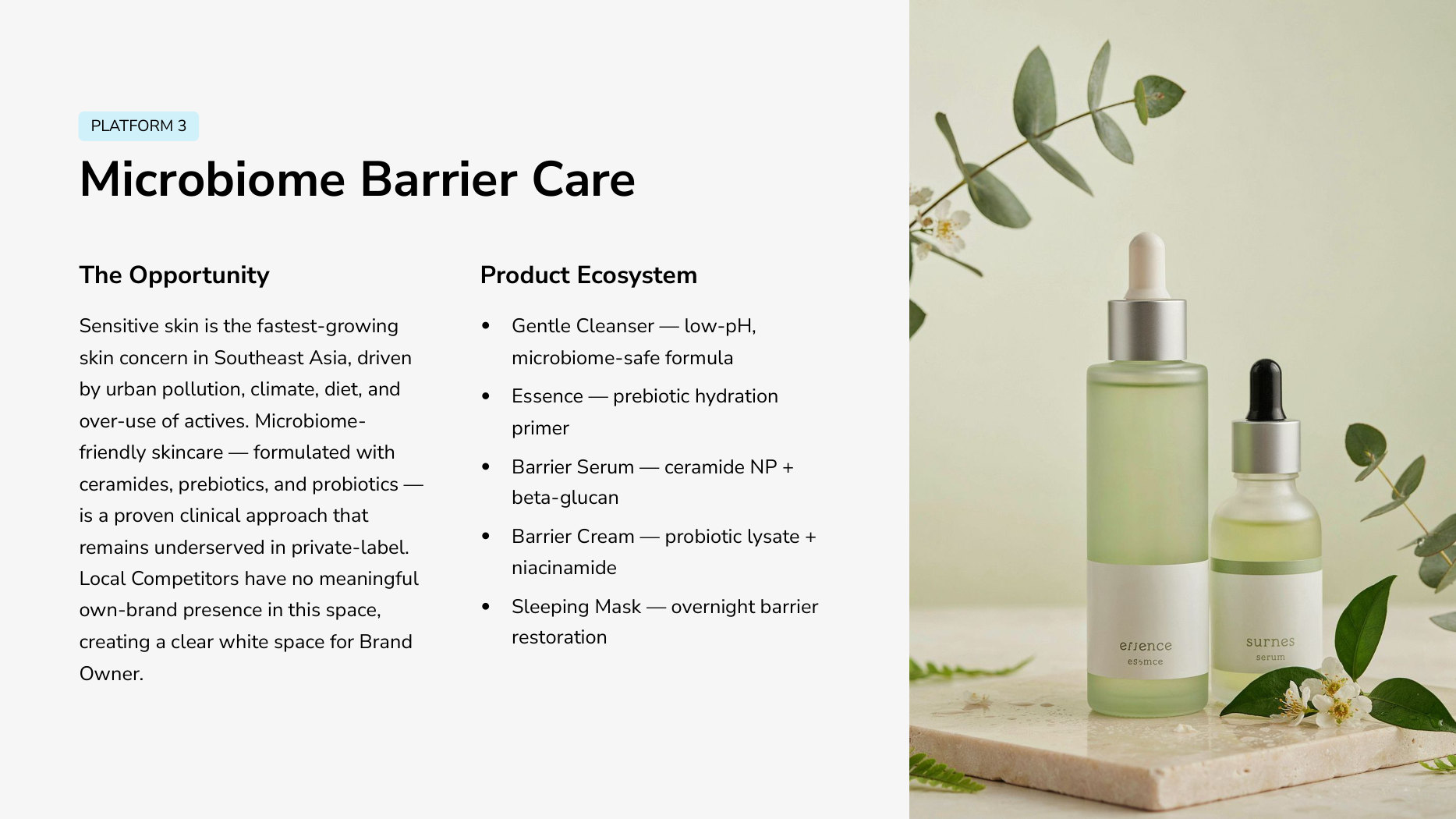
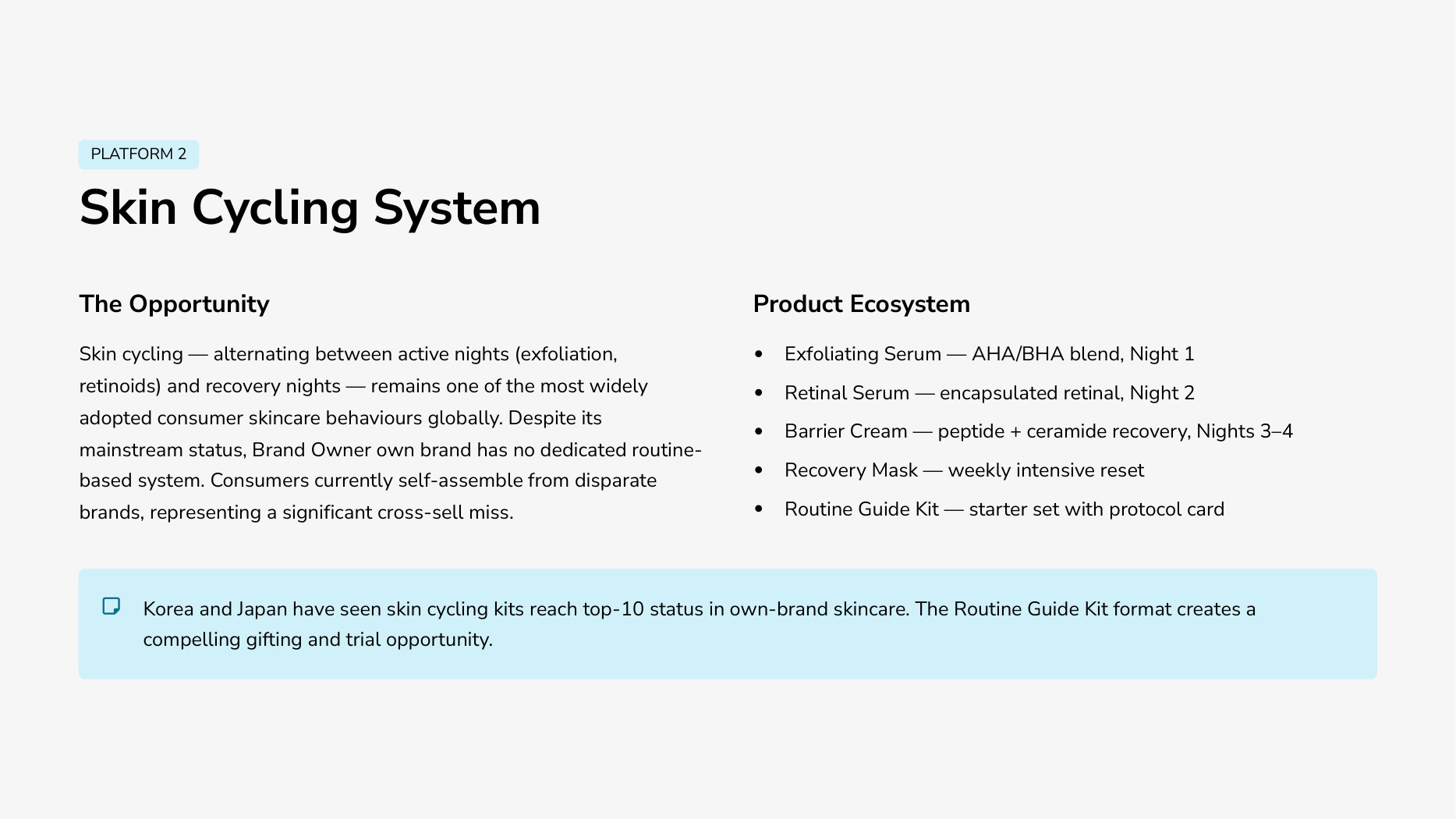
- Five platforms, all currently underserved in own brand: post-procedure recovery, skin cycling, microbiome barrier care, home treatment kits and smart patches.
- Microbiome care and patches show the widest gaps on our assessment; kits show the narrowest.
- Each platform needs a different manufacturing capability — hydrogel, encapsulation, patch substrate, kit pack-out — so the supplier decision follows the platform choice.
- Platforms defend margin because a system is harder to copy and harder to price-compare than a single cream.
Why platforms rather than individual SKUs
Three shifts drive this. Younger shoppers follow structured AM/PM regimens and treatment schedules rather than buying products one at a time. Ingredient literacy has risen, so shoppers search for actives — retinal, ceramides, prebiotics — and expect a coherent set around them. And most own-brand ranges are still assembled SKU by SKU, which leaves complete, exclusive systems unclaimed.
The commercial consequence is simple: a consumer following a five-step protocol buys five products. The same consumer buying products individually buys one, compares it on price, and may not come back.
The five platforms
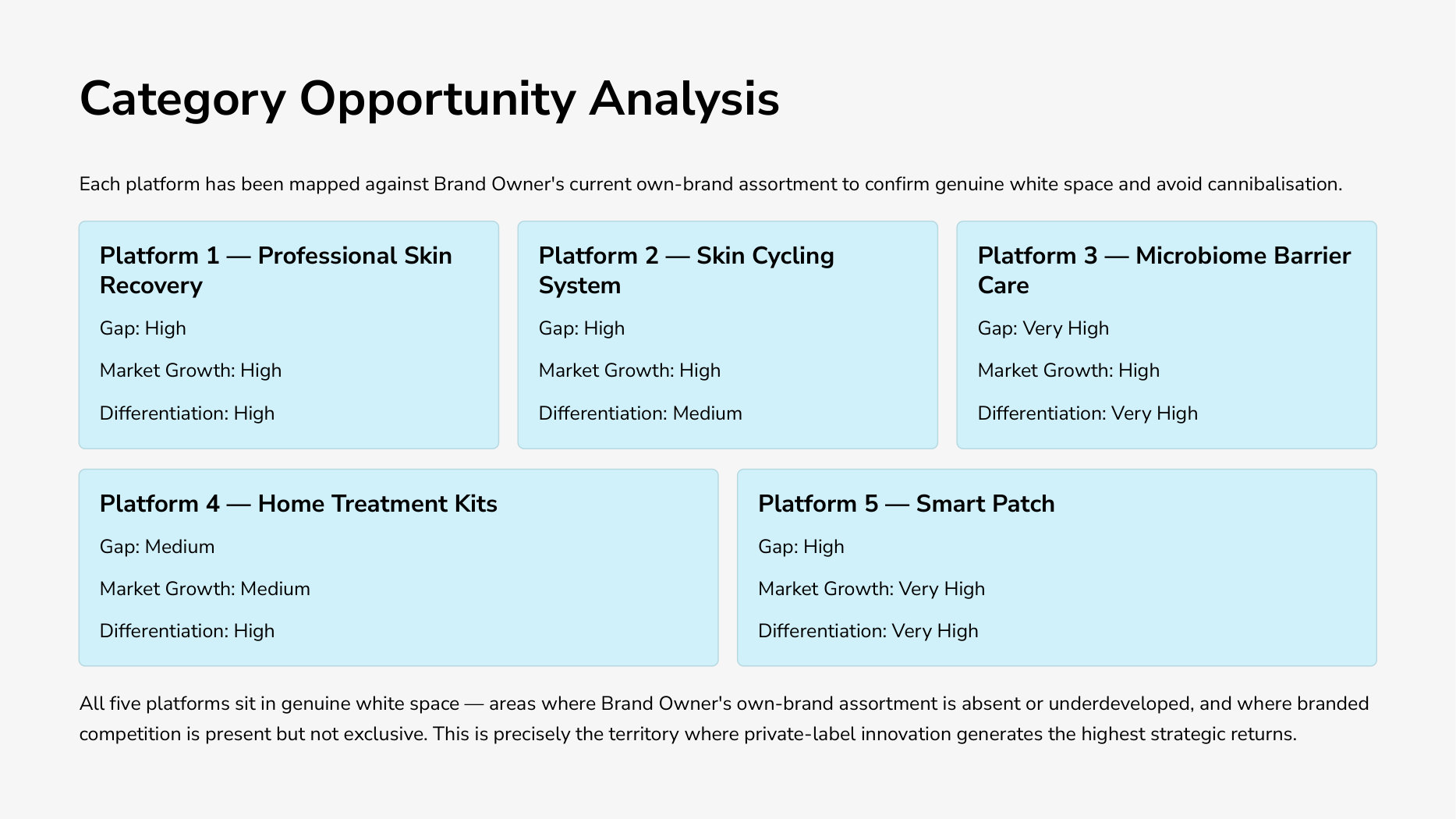
| Platform | Core consumer need | Gap in own brand | Differentiation potential |
|---|---|---|---|
| Professional skin recovery | Aftercare following aesthetic treatments | High | High |
| Skin cycling system | A structured four-night routine | High | Medium |
| Microbiome barrier care | Reactive and sensitised skin | Very high | Very high |
| Home treatment kits | A defined course with a clear outcome | Medium | High |
| Smart patch and targeted treatment | Spot treatment in a visible, consumable format | High | Very high |
Gap, growth and differentiation ratings are ORIZI Group’s own assessment of the Malaysian own-brand market as at September 2026, not third-party market research.
Who these platforms are designed for
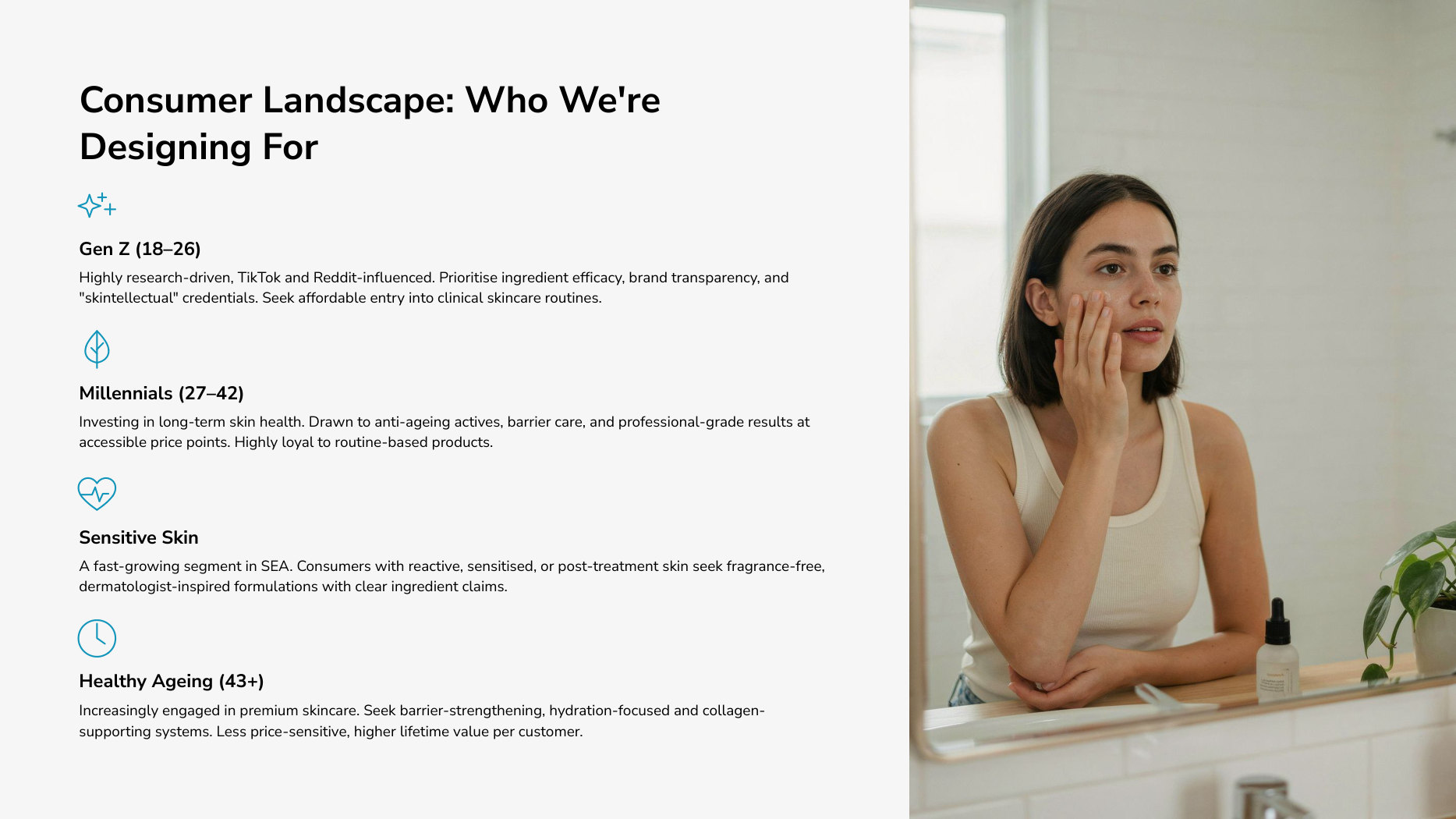
The four consumer groups below are where the demand concentrates. Most platforms serve more than one, which is what makes them worth building.
- Gen Z (18–26) — research-driven and ingredient-literate, looking for an affordable entry into clinical-feeling routines.
- Millennials (27–42) — investing in long-term skin health; the most loyal group to routine-based ranges.
- Sensitive skin — a fast-growing segment across Southeast Asia, seeking fragrance-free, clearly labelled formulations.
- Healthy ageing (43+) — less price-sensitive, focused on barrier strength and hydration, with the highest lifetime value.
Choosing which platform to build first
A practical order of questions:
- Which channel are you selling into within two years? Pharmacy and modern trade favour recovery and microbiome ranges; social commerce favours patches and kits.
- What retail price can your shelf carry? Encapsulated actives and specialist substrates set a floor under unit cost.
- Do you have the working capital for a system? Every platform means several minimums at once, not one.
- Which manufacturing capability does it need? Hydrogel, encapsulation, patch substrate and kit pack-out are different capabilities, and not every supplier has them.
The ORIZI perspective
Based on ORIZI Group’s manufacturing experience, the most common mistake is launching one product from a platform to “test the water”. A single recovery cream or one patch SKU tests nothing except whether that product sells — it cannot show whether the system works, because the system is the proposition.
The lower-risk version of caution is a smaller system, not a fragment: three products with matched sizes and a clear protocol will tell you more than five disconnected launches. For brands supplying retail and FMCG channels, our enterprise, FMCG and pharmacy manufacturing team works the channel requirements backwards into the platform brief.
Limitations
- Gap and differentiation ratings are ORIZI Group’s analysis of the Malaysian own-brand market, not independent market research.
- Platform economics assume a system is launched and merchandised together; partial launches behave differently.
- Regulatory routing differs by format. Patches and treatment-adjacent products need classification confirmed at concept stage.
Frequently asked questions
How many SKUs make a platform?
Three is the practical minimum for a system that a consumer can follow; five is common for a full protocol. Below three, the products are usually bought individually and the platform advantage disappears.
Can a new brand start with a platform, or is this only for large retailers?
New brands can, at smaller scale. Ready formulas allow a three-product system to launch from 50 units per SKU, which is how several smaller brands enter before committing to custom development.
Which platform has the lowest technical barrier?
Home treatment kits, because they can be built largely from proven formulas — the work moves to sizing, components and pack-out. Patches have the highest barrier because the substrate is specialist.
Do these platforms conflict with an existing skincare range?
They are designed not to. Each addresses a need the typical own-brand range leaves unserved, which is the point of mapping white space before development rather than after.
Sources
- ORIZI Group internal own-brand platform analysis, 2026 — category gaps, consumer segments and system design.
- National Pharmaceutical Regulatory Agency (NPRA), Ministry of Health Malaysia — cosmetic notification scope and claim requirements.
Update history
16 September 2026 — first publication.
Deciding where to start?
Tell us your channel, your target retail price and your launch window, and our team will tell you which of the five platforms your numbers actually support. Talk to ORIZI Group.