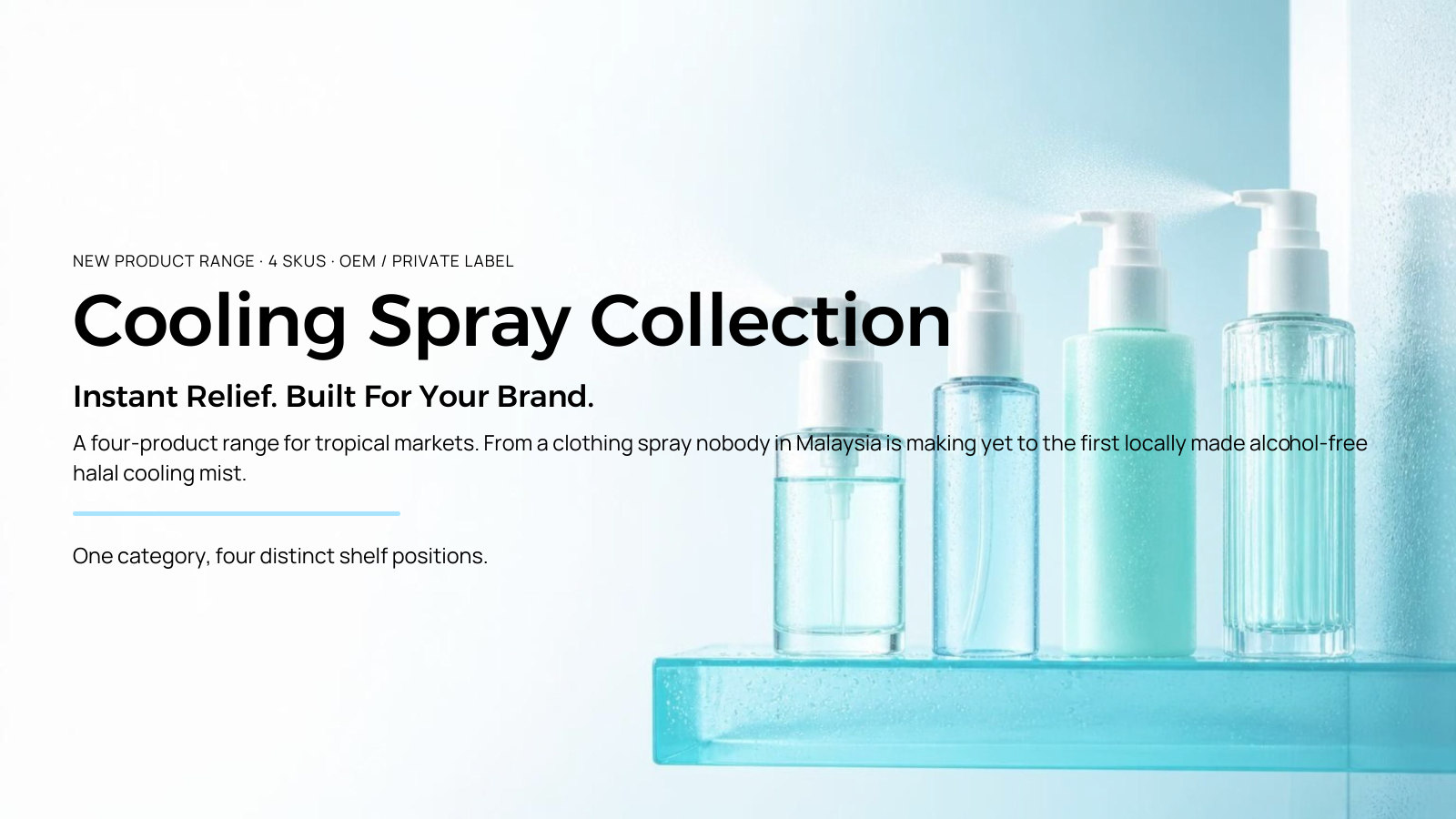
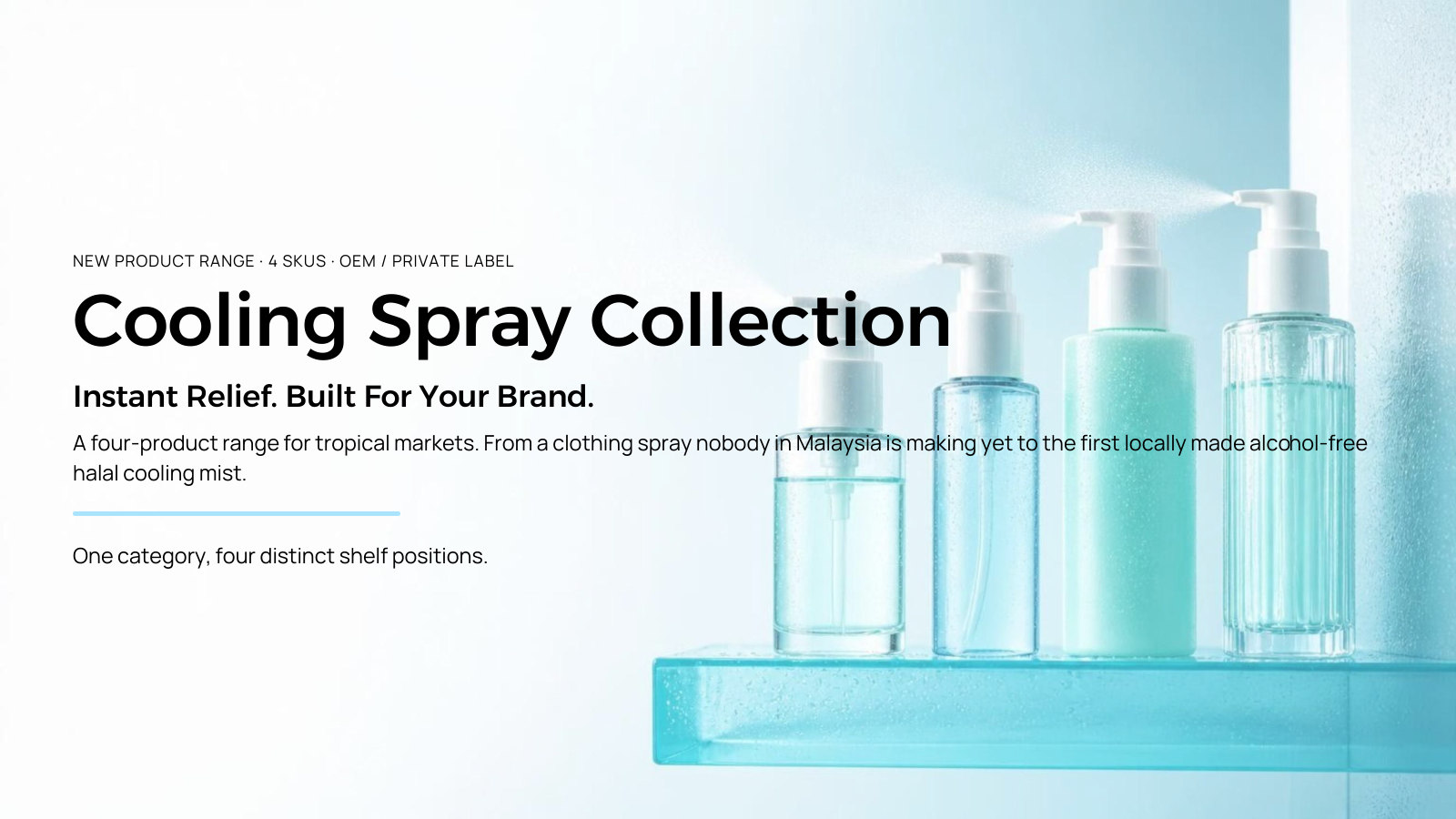
Four cooling spray concepts for tropical markets — walked through page by page, from the clothing spray nobody in Malaysia is making yet to the alcohol-free Halal mist that is the hardest one to copy.
Written & researched by Creaton Poh, brand and launch strategy contributor · Technical input by ORIZI Group R&D Team · Fact-checked by ORIZI Group Editorial · Published by ORIZI Group · Last reviewed October 2026
Disclosure: This article is published by ORIZI Group and refers to our own manufacturing experience, services and capabilities. Every item shown is a development concept, not a registered product. External factual claims are supported by cited sources.
Quick answer
This catalogue covers four cooling spray concepts developed for year-round tropical demand: a clothing and fabric cooling spray, a body cooling mist, an alcohol-free Halal cooling mist, and a cooling sun protection mist. All four are formulated for the NPRA cosmetic notification route, in pump formats from 30ml to 150ml, with cooling agents dosed at roughly 0.05% to 0.5%. Each can be built scented or completely fragrance-free, and each can carry an added benefit layer.
Key takeaways
- Cooling is two separate effects — the immediate hit and the long tail — and they are tuned independently.
- The cooling agent you pick decides how the product smells, which makes it a formulation decision rather than a marketing one.
- An alcohol-free cooling mist is not a substitution: removing ethanol changes the solvent system, which is exactly why it is hard to copy.
- A sensory cooling claim stays a cosmetic; a pain-relief claim moves the same bottle into a different registration entirely.
- Malaysia is hot twelve months a year, so cooling here is an everyday category, not a three-month summer one.
Why cooling, and why now
Cooling products are one of the clearest heat-driven growth stories in personal care right now, and the signals are consistent across markets.
| Signal | Figure | Source type |
|---|---|---|
| UK searches for “cooling sunscreen”, May 2026 | +30% | Google Trends, reported by trade press |
| Seasonality in a northern market | Busiest month runs 34.8× the quietest | Third-party marketplace tracker |
| Global cooling spray category, 2025 | USD 1 to 2 billion | Several commercial forecasts, ranges differ |
| Annual growth | 6% to 8.5% | Several commercial forecasts |
| Adjacent body cool mist category | About USD 3.8 billion | Commercial forecast, wider definition |
Trendier named Cooling Care one of the top K-beauty trends of 2026 from an analysis across more than 30 e-commerce channels, attributing it directly to rising temperatures, and Japanese retailers describe cooling formulas as one of the biggest trends of the year.
The Malaysian picture is different in one important way. In seasonal markets cooling is a summer product with a short selling window. Here the heat does not stop, so the same product sells all twelve months. That is a structural advantage for a brand built locally, and it is the reason this range exists.
Market figures above are drawn from third-party commercial forecasts whose definitions and totals differ; treat them as directional rather than precise.
The range at a glance
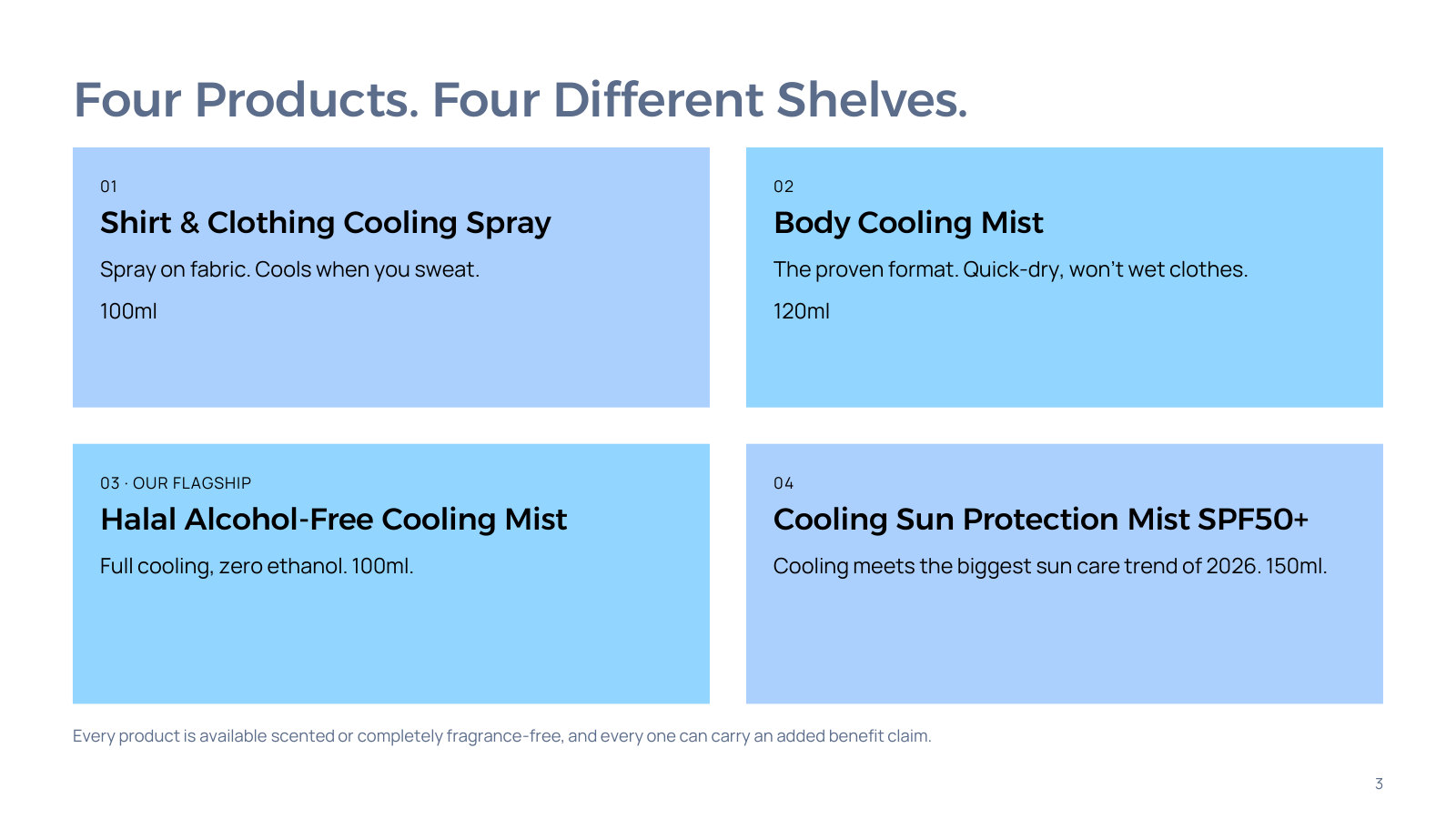
| # | Concept | What it is | Pack |
|---|---|---|---|
| 01 | Shirt & Clothing Cooling Spray | Sprayed on fabric; cools when the wearer perspires | 100ml |
| 02 | Body Cooling Mist | The proven format: quick-dry, does not wet clothing | 120ml |
| 03 | Halal Alcohol-Free Cooling Mist | Full cooling sensation, zero ethanol | 100ml |
| 04 | Cooling Sun Protection Mist SPF50+ | Cooling meets the biggest sun care trend of 2026 | 150ml |
Every one is available scented or completely fragrance-free, and every one can carry an added benefit claim.
Chapter 1 — Everyday cooling
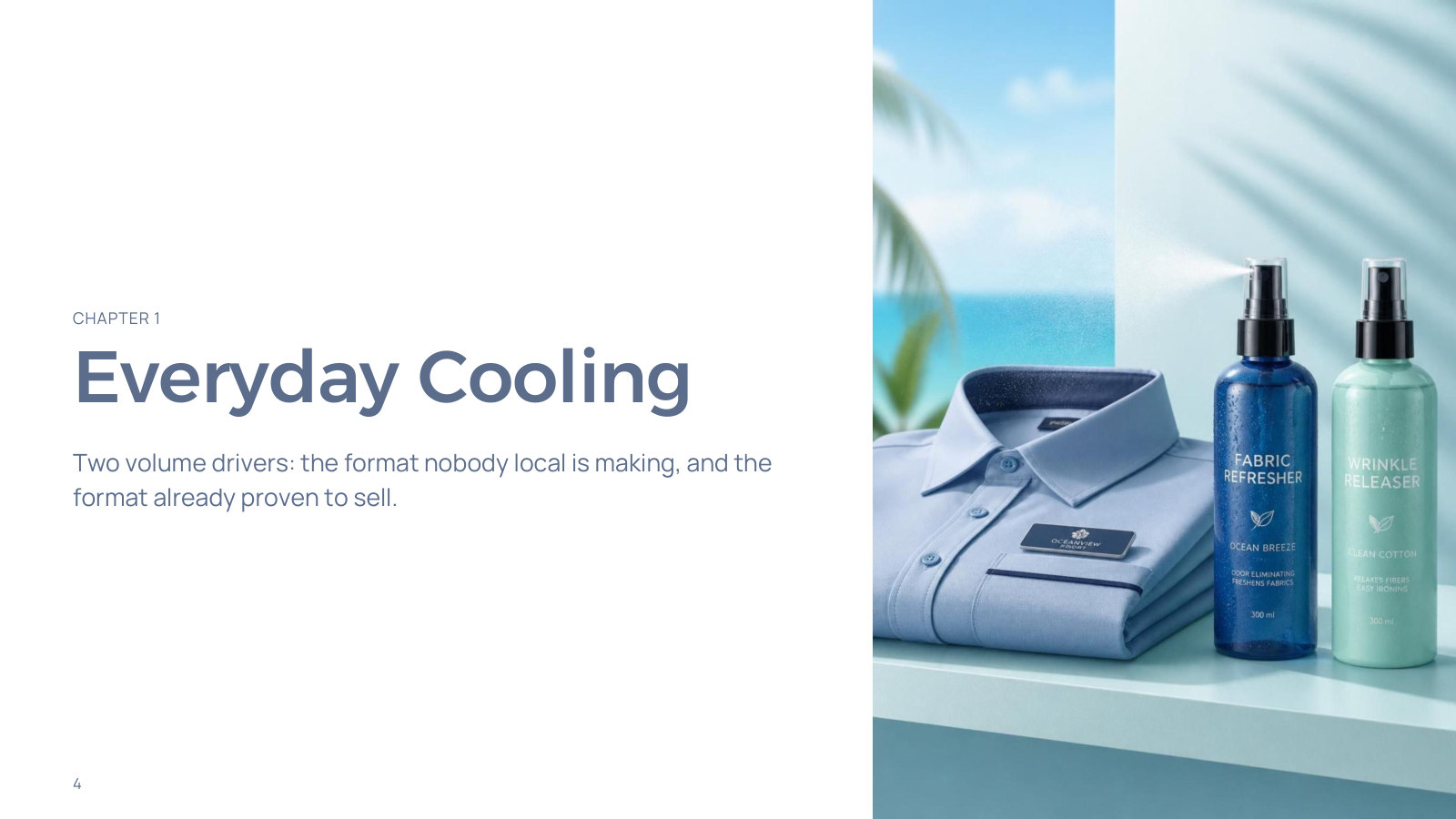
Two volume drivers: the format nobody local is making, and the format already proven to sell.
01 — Shirt & Clothing Cooling Spray
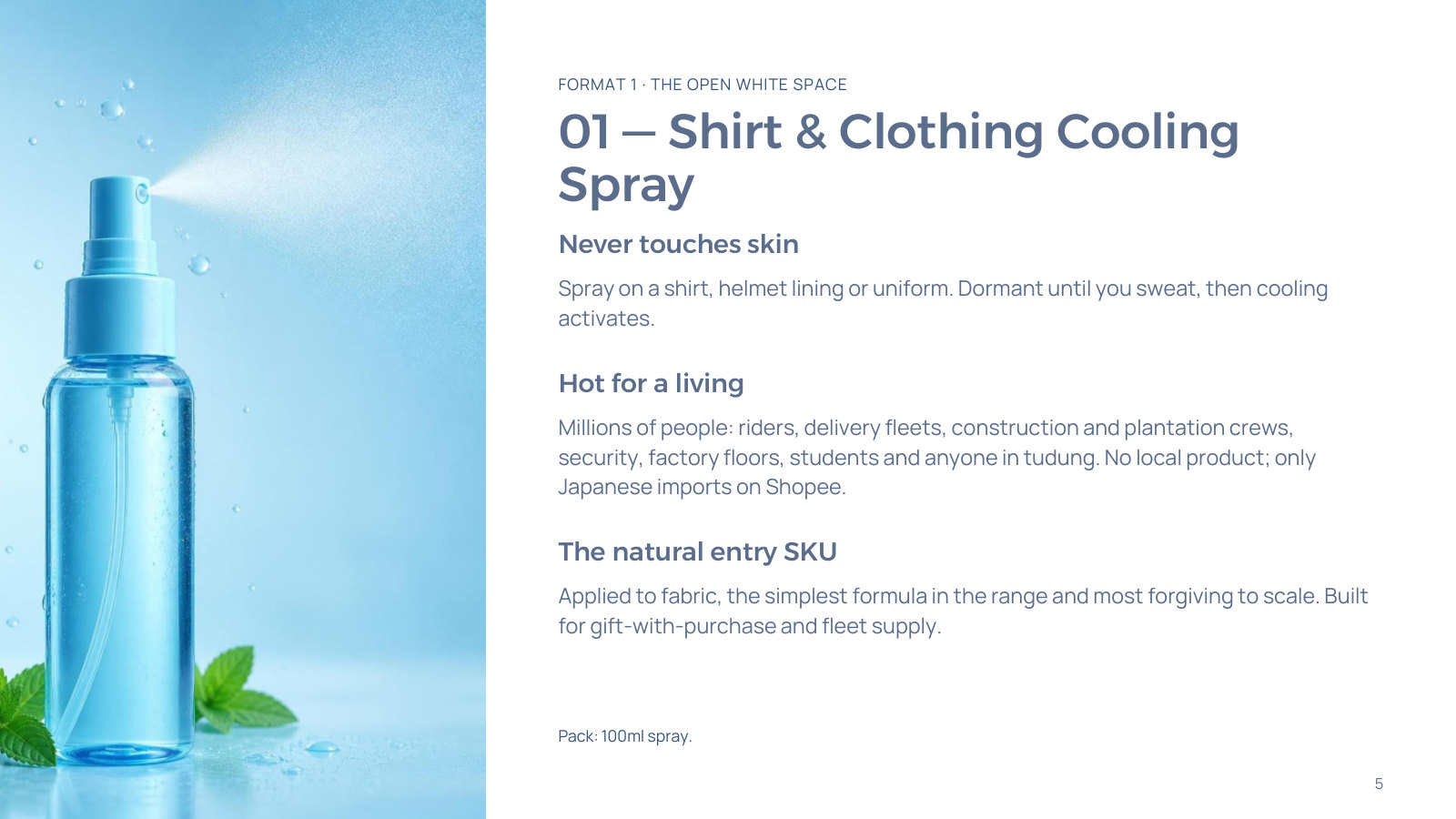
This one never touches skin. It is sprayed onto a shirt, a helmet lining or a uniform, and stays dormant until the wearer perspires. The moment moisture reaches the fabric, the cooling activates.
Because it is applied to fabric rather than skin, it is the simplest formula in the range to produce and the most forgiving to scale, which makes it a natural entry concept for a new brand and a natural gift-with-purchase or fleet-supply line for an established one. The buyer group is large and underserved: riders, delivery fleets, construction and plantation crews, security and enforcement, factory floors, students in full uniform, and anyone wearing tudung through a hot afternoon.
Pack: 100ml. Starting point: Linen & Fabric Spray 156ml.
02 — Body Cooling Mist
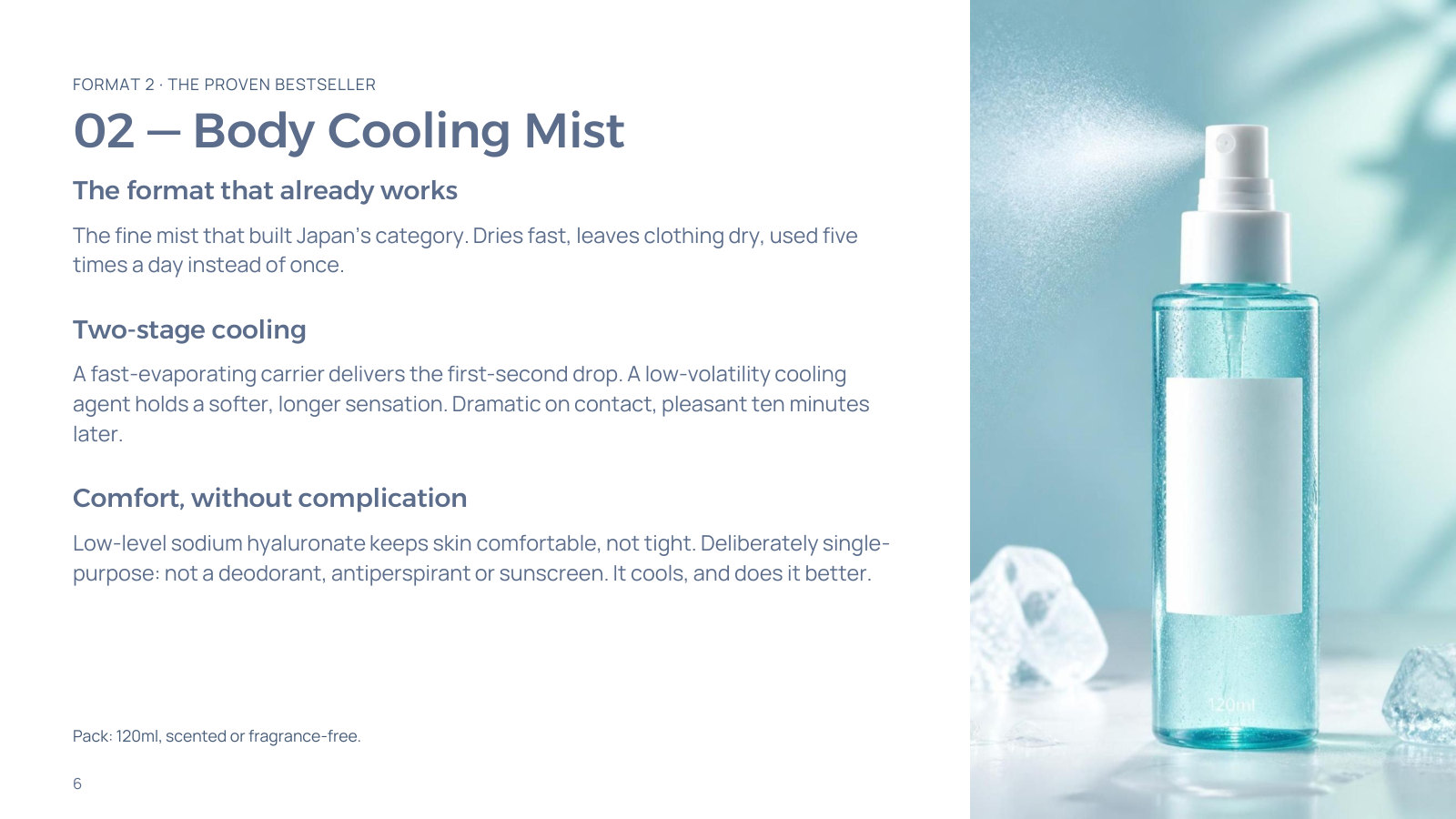
The format that built the category in Japan: a fine mist sprayed straight onto arms, neck, chest and the back of the knees. It dries fast and does not leave clothing damp, which is exactly why it travels in a handbag and gets used several times a day instead of once.
A fast-evaporating carrier delivers the drop felt in the first second; a low-volatility cooling agent then holds a softer sensation after that first hit has passed. Low-level sodium hyaluronate keeps skin comfortable rather than tight. It is deliberately single-purpose: not a deodorant, not an antiperspirant, not a sunscreen.
Pack: 120ml, scented or fragrance-free.
Chapter 2 — The differentiators
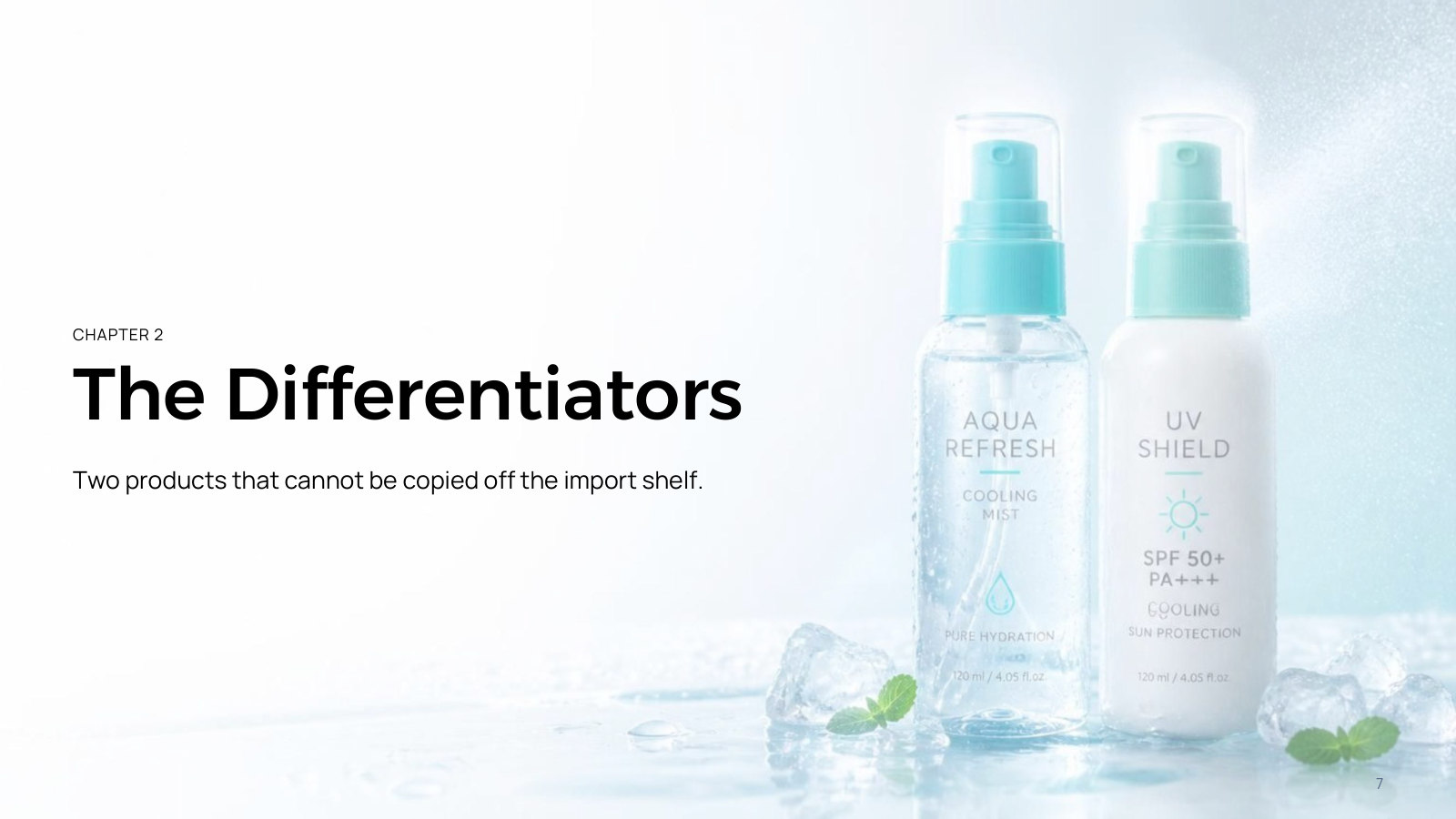
Two concepts that cannot be copied off an import shelf.
03 — Halal Alcohol-Free Cooling Mist
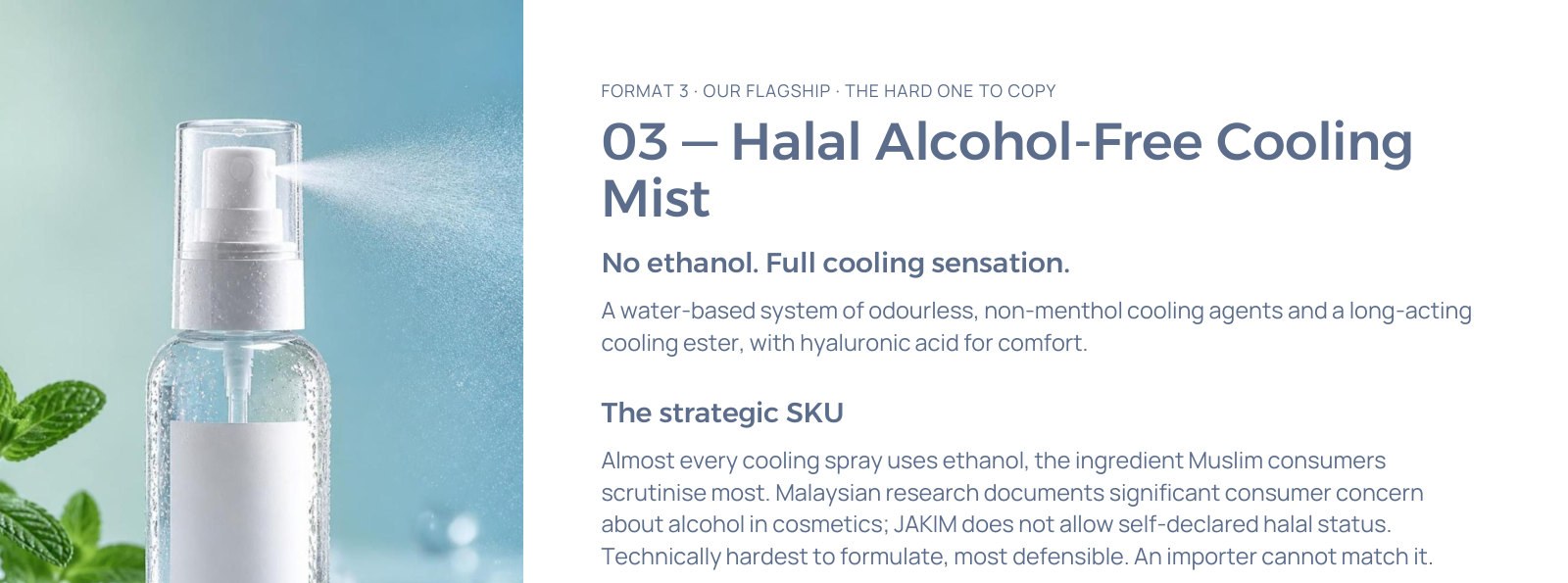
Almost every cooling spray on the market cools using ethanol, because ethanol evaporates quickly and carries a large part of the sensation. Ethanol is also the ingredient Muslim consumers scrutinise most closely, and under Malaysian rules Halal status cannot be self-declared — certification is issued by JAKIM.
This concept replaces the ethanol carrier with a water-based system and rebuilds the sensation using odourless, non-menthol cooling agents together with a long-acting cooling ester, with hyaluronic acid for comfort. The technical work sits in the solubilisation: several cooling agents that dissolve freely in high-strength ethanol drop out of a water-based system, so the solvent system has to be designed rather than copied. That is precisely why it is defensible — an importer cannot match it, and a competitor cannot reverse-engineer it off a label.
Pack: 100ml.
04 — Cooling Sun Protection Mist SPF50+
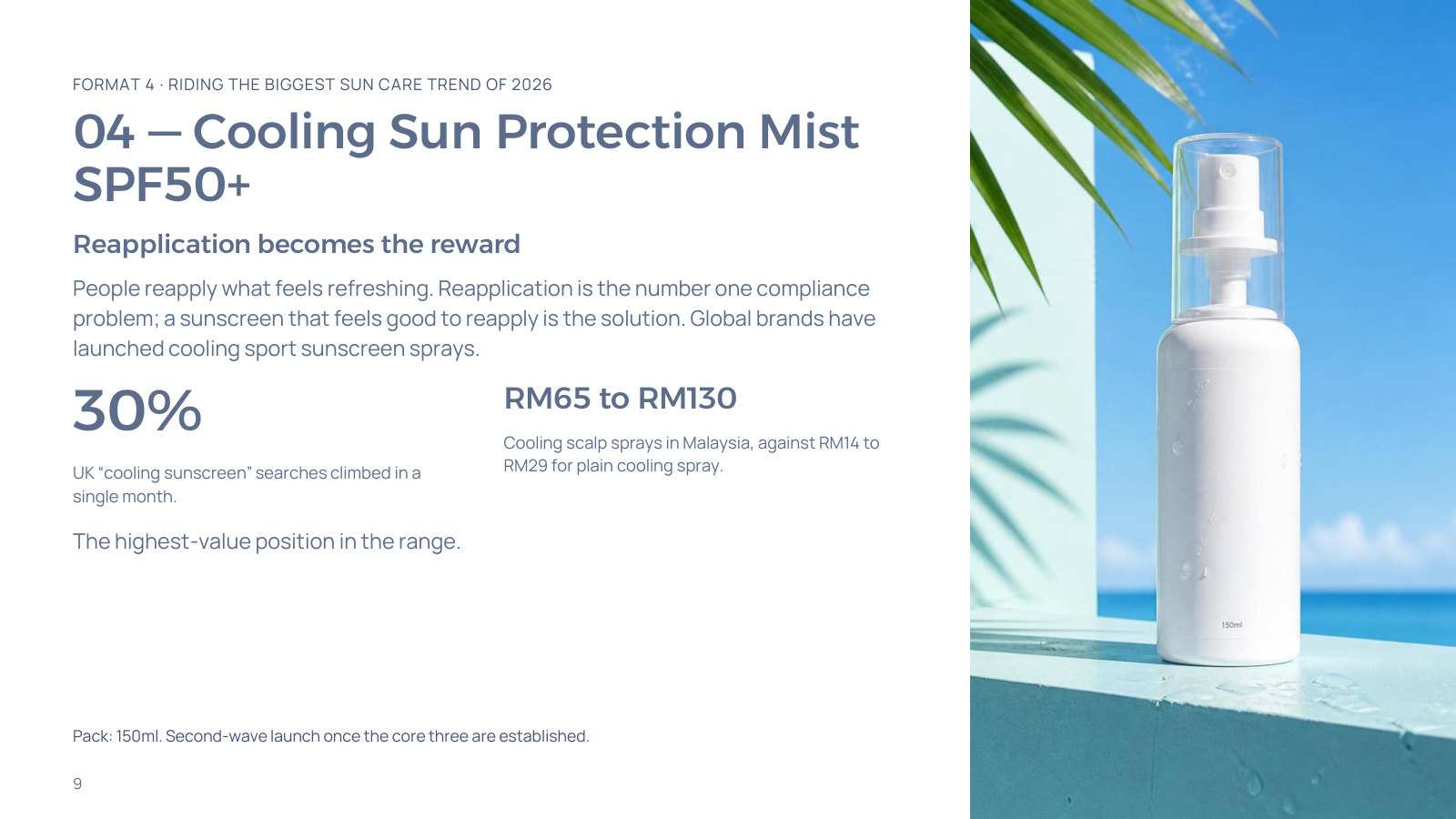
Reapplication is the number one compliance problem in sun care: people simply do not reapply often enough. A sunscreen that feels good to reapply is not a gimmick, it is the answer to that problem — cooling turns the chore into the reward. Global brands have already launched cooling sport sunscreen sprays, and UK searches for “cooling sunscreen” climbed 30% in a single month in 2026.
This is the highest-value position in the range, and we recommend it as a second-wave launch once the core three are established.
Pack: 150ml.
How the sensation is built
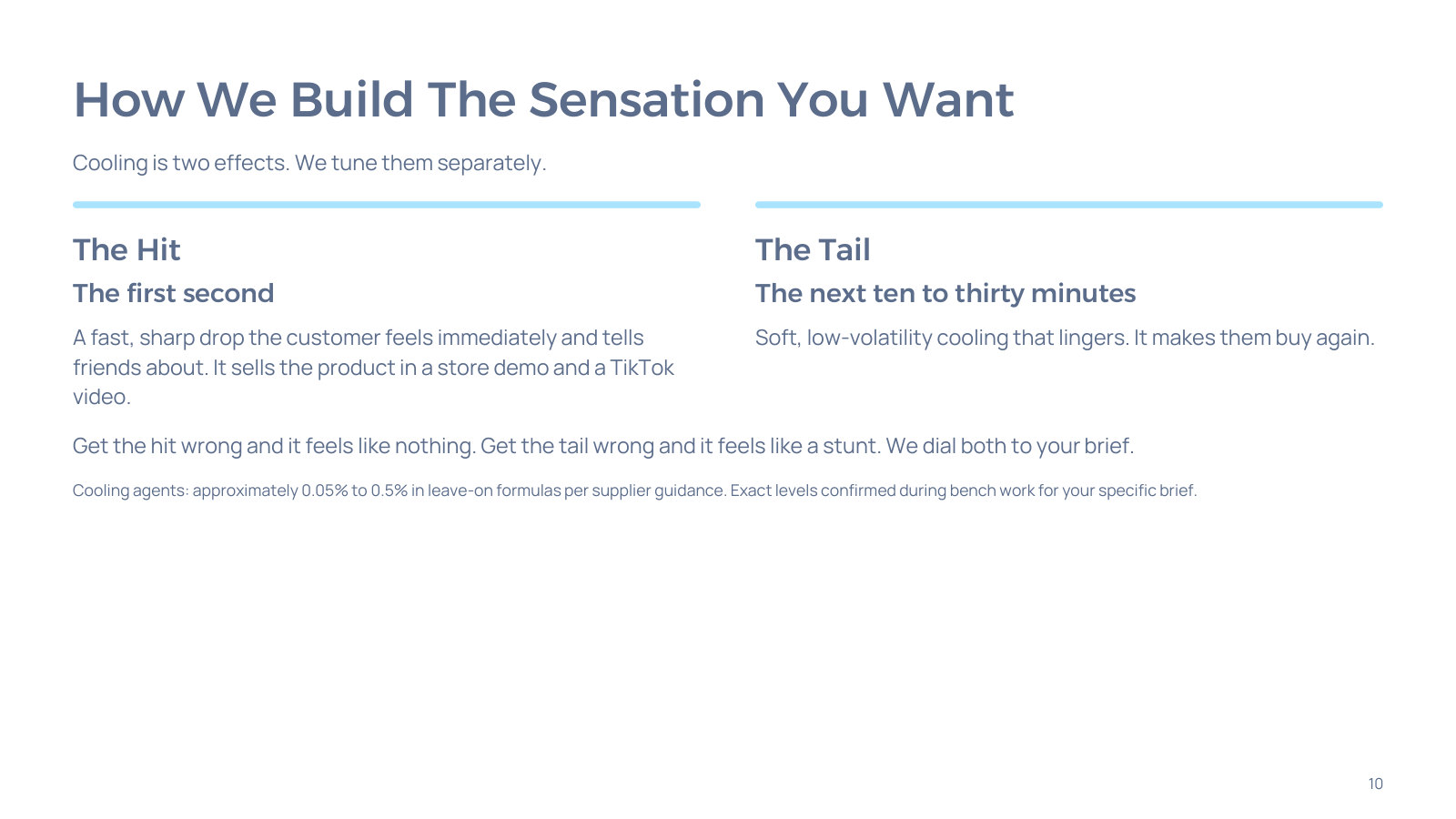
Cooling is not one effect. It is two, and they are tuned separately.
The hit is the sharp drop felt in the first second, from the carrier evaporating and from fast, volatile cooling agents. This is what sells the product in a store demo and in a short-form video. The tail is the softer sensation over the next ten to thirty minutes, from low-volatility cooling esters and amides that stay on the skin. This is what makes somebody buy it again.
Get the hit wrong and the product feels like nothing. Get the tail wrong and it feels like a stunt. Both are set to the brief and confirmed on a sensory panel before a formula is signed off.
The cooling agent menu
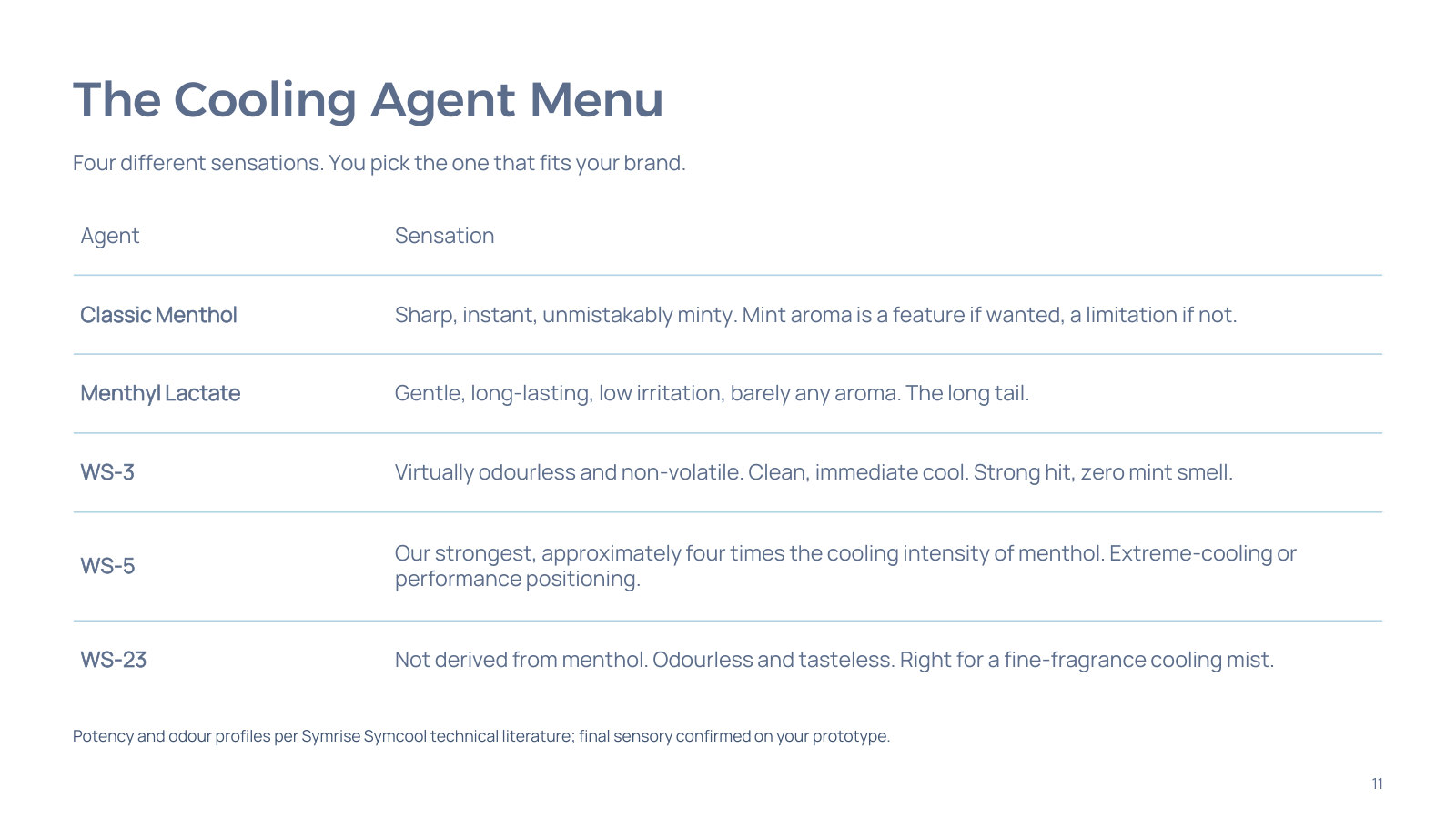
| Cooling agent | Character | Odour | Best used for |
|---|---|---|---|
| l-Menthol | Sharp, immediate, unmistakable | Distinctly minty | Classic cooling where a mint signal is wanted |
| Menthyl lactate | Gentle, long-lasting, low irritation | Very mild | The tail of the sensation; sensitive-skin positioning |
| WS-3 | Clean, immediate, non-volatile | Virtually none | A strong hit with no mint smell |
| WS-5 | Roughly four times the cooling intensity of menthol | Virtually none | Extreme-cooling and performance positioning |
| WS-23 | Not a menthol derivative at all | Odourless and tasteless | Fine-fragrance cooling mists where mint would ruin the scent |
Cooling agents are used at roughly 0.05% to 0.5% in leave-on formulations, per supplier technical guidance for creams and lotions. The exact level for a spray is confirmed during bench work, because the carrier system changes how much of the sensation actually reaches the skin. Potency and odour profiles above follow Symrise Symcool technical literature; final sensory is confirmed on the prototype.
Cold only, or cold and beautiful
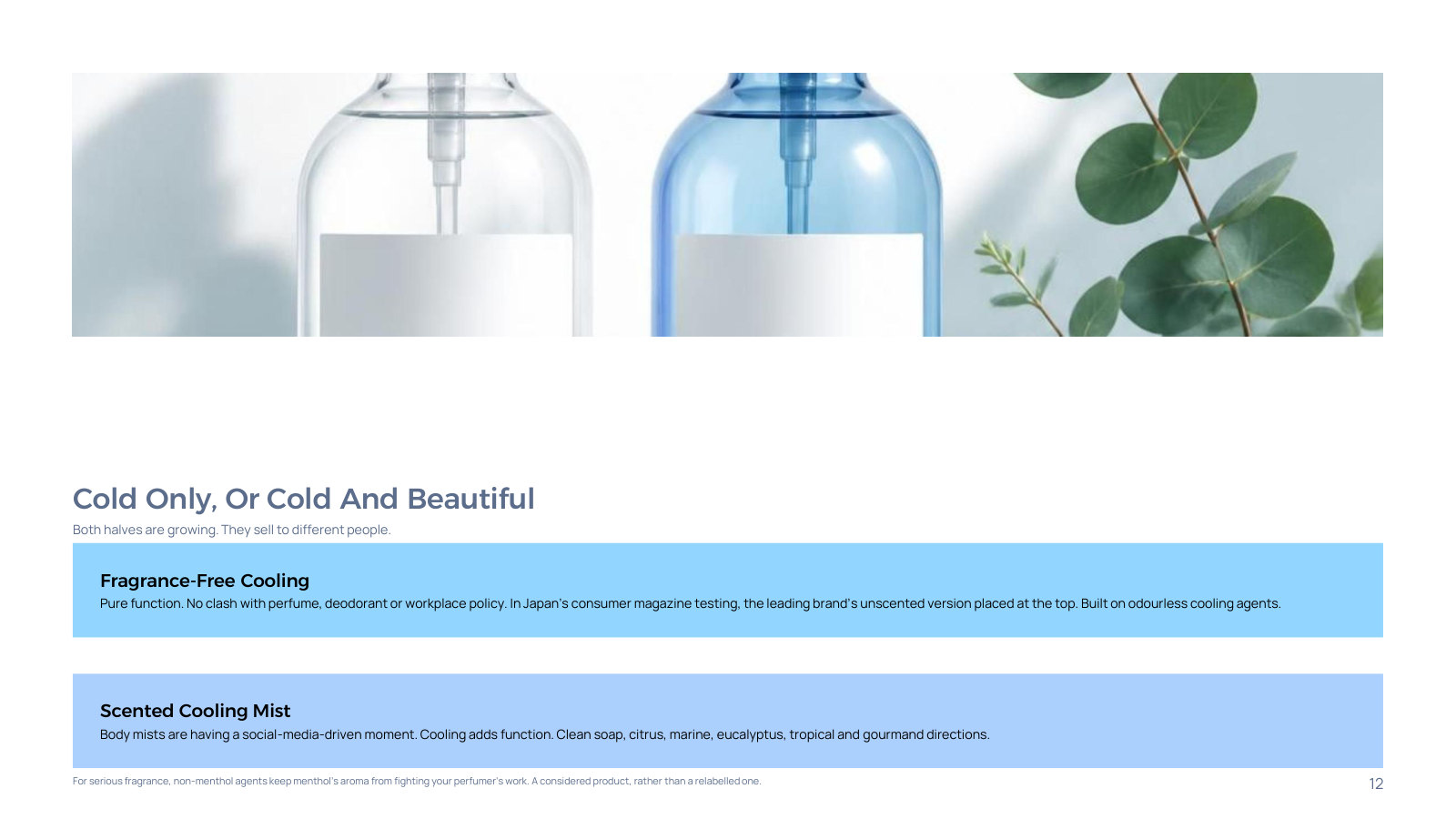
Both halves of this market are growing, and they sell to different people. Fragrance-free cooling is pure function, with nothing to clash with a perfume, a deodorant or a workplace policy; built on odourless cooling agents, there is genuinely nothing to smell. In independent Japanese consumer-magazine testing, the unscented version of the leading brand placed at the top of the ranking. Scented cooling mist gives a mist a functional reason to exist beyond the fragrance, across clean soap, citrus, marine, eucalyptus, tropical and gourmand directions.
The technical point worth knowing: if the fragrance is the hero, the cooling is built on non-menthol agents, because menthol has its own aroma and will fight the perfumer’s work.
One base, many positions
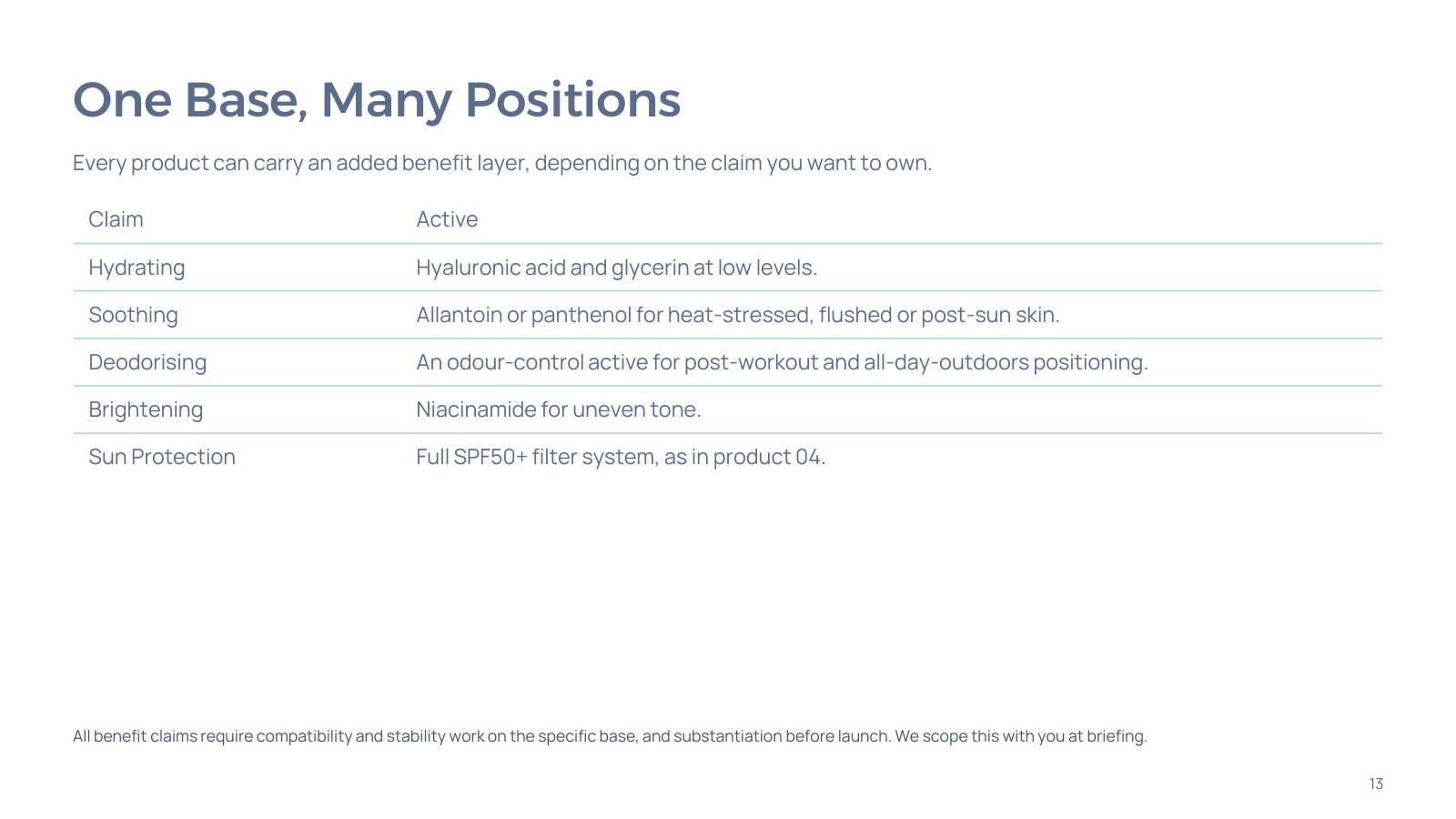
| Claim | Typical active |
|---|---|
| Hydrating | Hyaluronic acid and glycerin at low levels |
| Soothing | Allantoin or panthenol for heat-stressed skin |
| Deodorising | An odour-control active for post-workout positioning |
| Brightening | Niacinamide for uneven tone |
| Sun protection | A full SPF50+ filter system, as in concept 04 |
All benefit claims require compatibility and stability work on the specific base, and substantiation before launch.
Pack architecture
The 100ml to 120ml size matches what the category leaders sell and fits a handbag or a toolbag, which is what drives repeat use. The 30ml to 50ml size moves fastest in hotel amenity, corporate gifting, event sampling and social-commerce bundles. Finishes are available in clear, frosted and opaque PET, with fine-mist, continuous-spray and trigger actuators.
Staying on the right side of the line
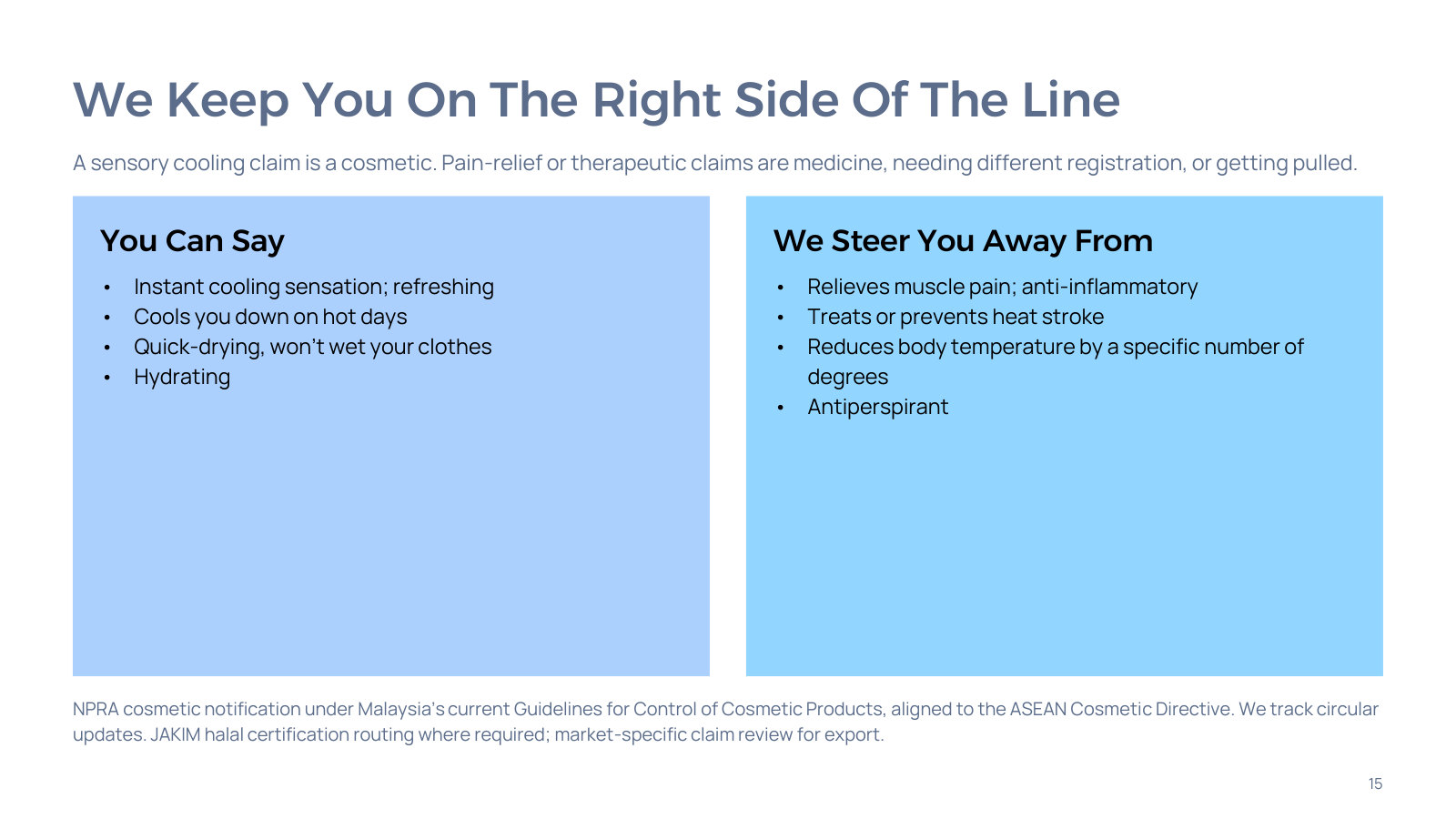
| You can say | We steer you away from |
|---|---|
| Instant cooling sensation; refreshing | Relieves muscle pain |
| Cools you down on hot days | Anti-inflammatory |
| Quick-drying, will not wet your clothes | Treats or prevents heat stroke |
| Hydrating, where humectants are present | Reduces body temperature by a stated number of degrees |
| Alcohol-free, where the formula contains no ethanol | Antiperspirant |
A sensory cooling claim is a cosmetic. A pain-relief or therapeutic claim is a medicine, needing a different registration. Cross that line and the product is on a different timeline at a different cost.
ORIZI perspective
We already run cooling chemistry: our pain relief and cooling gel line uses the same raw-material family. Moving that family into a spray taught us where the real difficulty sits, and it is not where most briefs assume.
Brands tend to arrive worried about cooling intensity. Intensity is the easy part — there is an agent roughly four times the strength of menthol available off the shelf. What actually stalls a project is the low-alcohol solvent system. One of the cleanest, most odourless cooling agents dissolves readily in high-strength ethanol but becomes almost insoluble once the alcohol level drops, which is the exact direction an alcohol-free Halal brief pushes you in. Teams that treat alcohol-free as a late substitution discover this after the sensory work is already signed off, and have to start the solvent system again. We now settle the alcohol question at briefing, before any sensory direction is agreed.
Limitations and claim notes
- Every item in this catalogue is a development concept, not a registered product. Formulas are confirmed at bench stage against your pack, fill and market.
- Perceived cooling varies between individuals. Leading brands carry this caveat on their own packaging, and so should yours.
- Published skin-temperature figures vary widely and many are supplier or brand statements rather than independent measurements. We do not put a temperature number on a label unless the finished product has been measured.
- Cooling agent use levels cited here come from supplier guidance for leave-on creams and lotions; a spray carrier behaves differently and is confirmed in the lab.
- Ingredient restrictions must be checked against the current regulatory annexes rather than an older copy.
Frequently asked questions
Which concept should a new brand start with?
The clothing spray or the body mist. Both are straightforward to produce, and the clothing spray in particular has very little local competition. The alcohol-free mist is the strategic product but carries more formulation work, so it suits a brand that can wait for the bench stage.
What is the minimum order quantity?
MOQs are tiered. Ready formulas start from 50 units for a first run; a custom formulation carries a higher minimum because of raw-material and packaging commitments. The figure is confirmed against your pack and fill size at quotation.
Ready formula or custom formulation?
A ready formula in stock packaging is the fastest route to shelf. A custom cooling system takes longer because the sensation has to be tuned and confirmed on a panel, and stability demonstrated in the chosen pack. Many brands launch on a ready formula and develop a custom hero in parallel.
Can a cooling spray be certified Halal?
Halal certification in Malaysia is issued by JAKIM and cannot be self-declared. An alcohol-free formulation removes the ethanol question entirely, which is the point most often raised by Muslim consumers, but certification remains a separate process with its own documentation.
Can I claim the product lowers body temperature?
No, not without your own measurement on the finished product, and even then the wording has to stay inside cosmetic claim boundaries. A cooling spray produces a strong sensation; any actual temperature change is small, local and short-lived.
Will the product smell of mint?
Only if you want it to. Menthol carries a distinct mint aroma, while WS-3 and WS-23 are effectively odourless, so a cooling mist can be built with a clean fragrance of your choosing or with no scent at all.
Can these be exported?
Yes, subject to the destination market’s own cosmetic rules and ingredient annexes. Claim wording is reviewed per market, because a phrase that is acceptable on the cosmetic route here may not be elsewhere.
Built here, for here
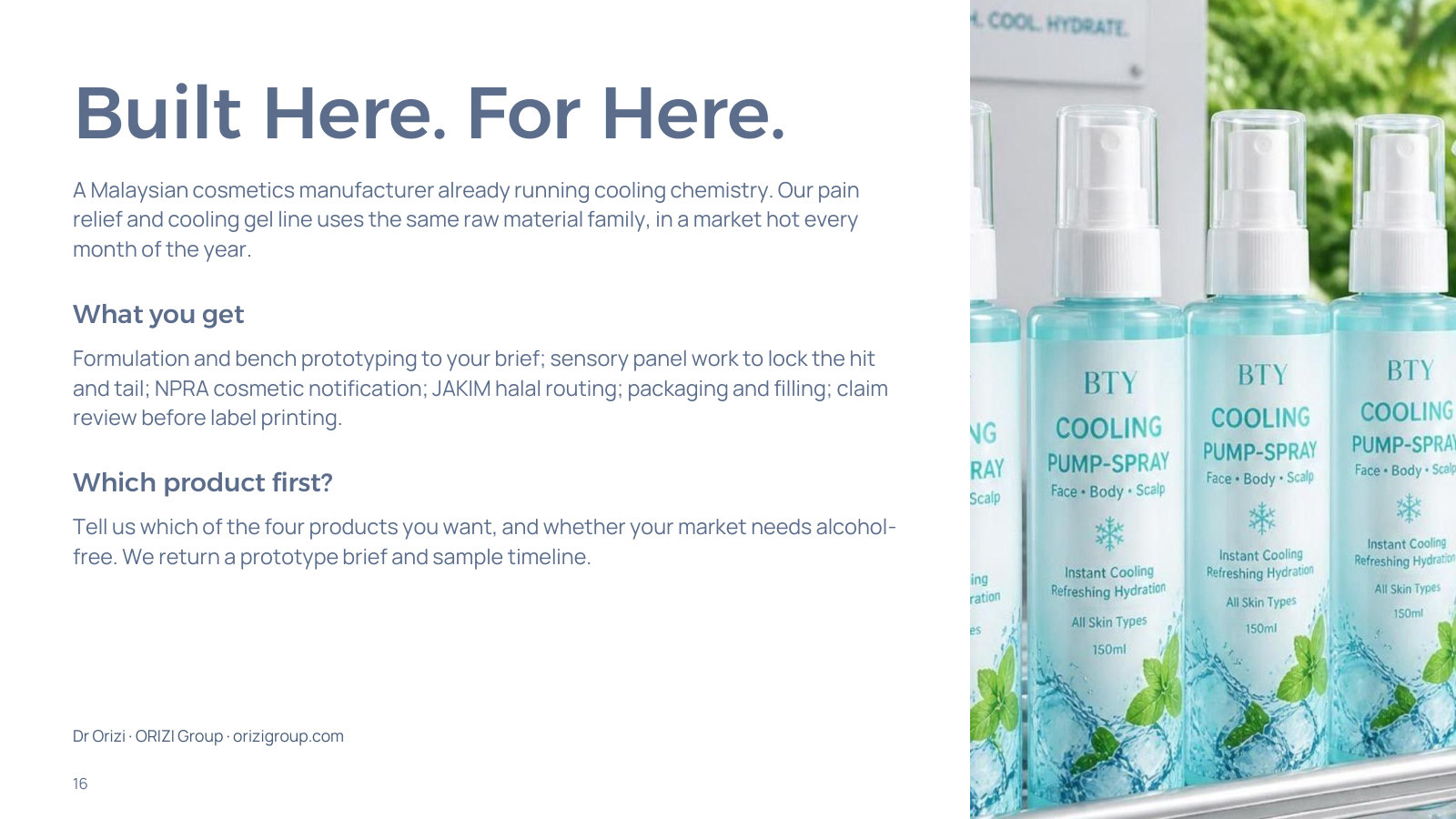
Formulation and bench prototyping to your brief; sensory panel work to lock the hit and the tail; NPRA cosmetic notification; JAKIM Halal routing; packaging and filling; and claim review before a single label is printed.
The full product detail, formats and regulatory routing live on the OEM cooling spray manufacturer page.
Sources
- National Pharmaceutical Regulatory Agency (NPRA) — Guidelines for Control of Cosmetic Products in Malaysia, adapted from the ASEAN Cosmetic Directive.
- Medical Device Authority (MDA) — products achieving their effect by physical means.
- JAKIM — Halal certification in Malaysia.
- Symrise Symcool technical literature — cooling agent profiles, solubility and recommended use levels.
- Third-party market forecasts for the cooling spray and body cool mist categories; figures differ by provider and are treated as directional.
Update history
31 October 2026 — first publication of the cooling spray concept catalogue.
Tell us the sensation you want, whether your market needs alcohol-free, and how the product should smell — we will come back with a formulation brief and a sample timeline. Talk to ORIZI Group.