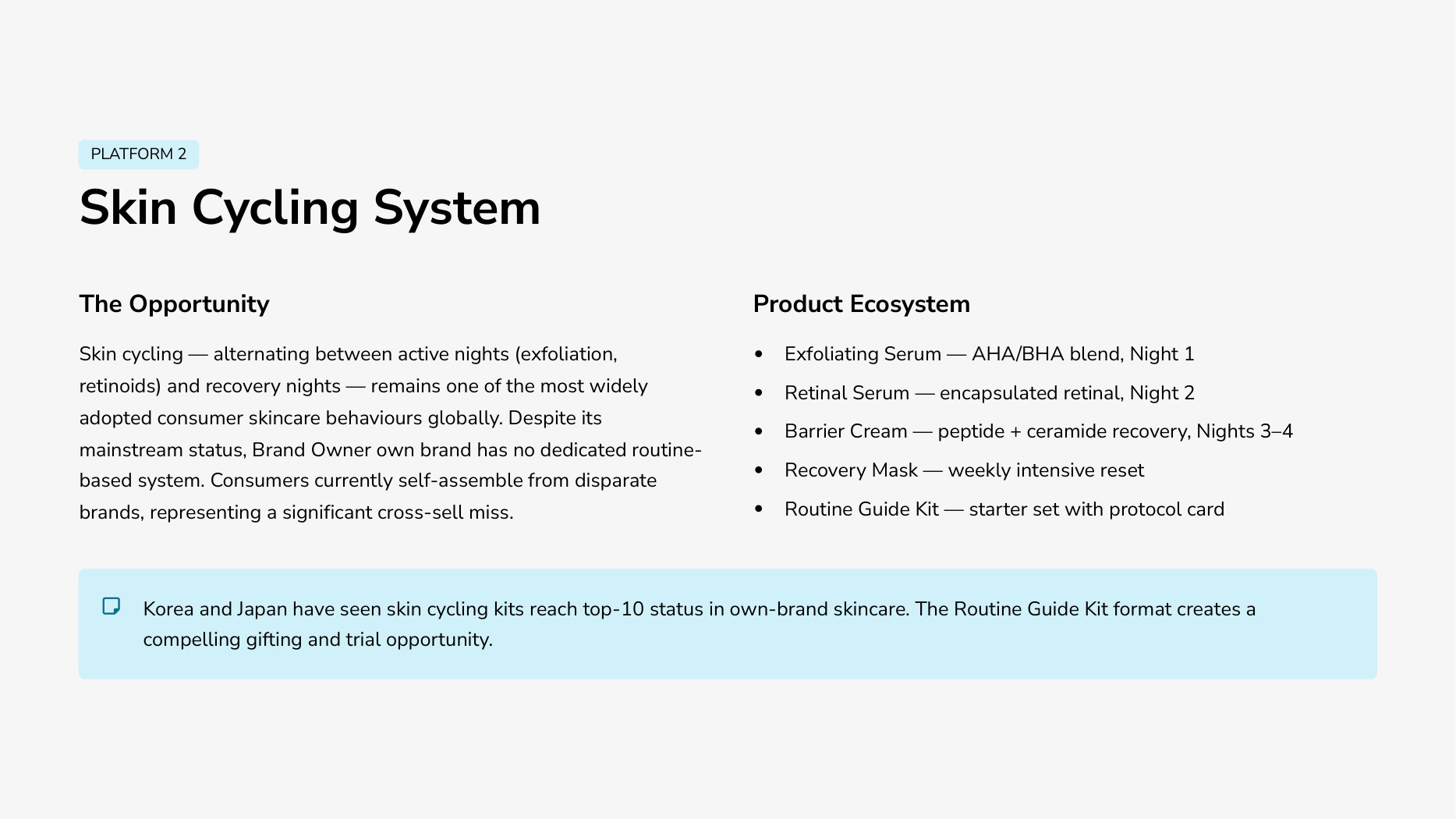
Sensitive skin is the fastest-growing skin concern in Southeast Asia, and the products that address it properly are still largely branded imports. In own-brand ranges, microbiome barrier care is close to empty shelf.
Written & researched by Creaton Poh, industry researcher · Technical input by ORIZI Group R&D Team · Fact-checked by ORIZI Group Editorial · Published by ORIZI Group · Last reviewed September 2026
Disclosure: This article is published by ORIZI Group and refers to our own manufacturing experience and capabilities. Ingredient descriptions are general and not medical advice.
Quick answer: what is microbiome barrier care?
Microbiome barrier care is skincare formulated to support the skin’s own microbial balance and lipid barrier rather than to strip or treat it — typically low-pH cleansers, prebiotic hydration steps and ceramide-rich creams, with fragrance and harsh surfactants removed. It targets sensitised, reactive and over-exfoliated skin, which is the fastest-growing skin concern in Southeast Asia. In Malaysia the category is dominated by imported brands; own-brand presence is minimal.
Key takeaways
- The consumer is already looking for it — often after over-using actives — and currently finds only imported options.
- “Microbiome-friendly” is a formulation discipline, not an ingredient you add. pH, preservative choice and surfactant system decide it.
- Prebiotics are the practical route; live probiotics bring stability and claim complications that most retail ranges do not need.
- Claims must stay cosmetic. Anything implying treatment of eczema or dermatitis leaves the cosmetic route in Malaysia.
- It is the widest white space of the five platforms we mapped, on both gap and differentiation.
Why sensitive skin keeps growing in this region
Four pressures stack up in urban Malaysia: pollution, year-round heat and humidity, diet, and the over-use of active ingredients that social media encourages. The result is a large group of consumers whose skin is not diseased but is reactive — stinging, flushing, breaking down after a new product.
These consumers are unusually loyal once something works, because the cost of experimenting is discomfort. That is what makes the category worth owning rather than renting from a branded supplier.
What a microbiome-friendly range actually requires
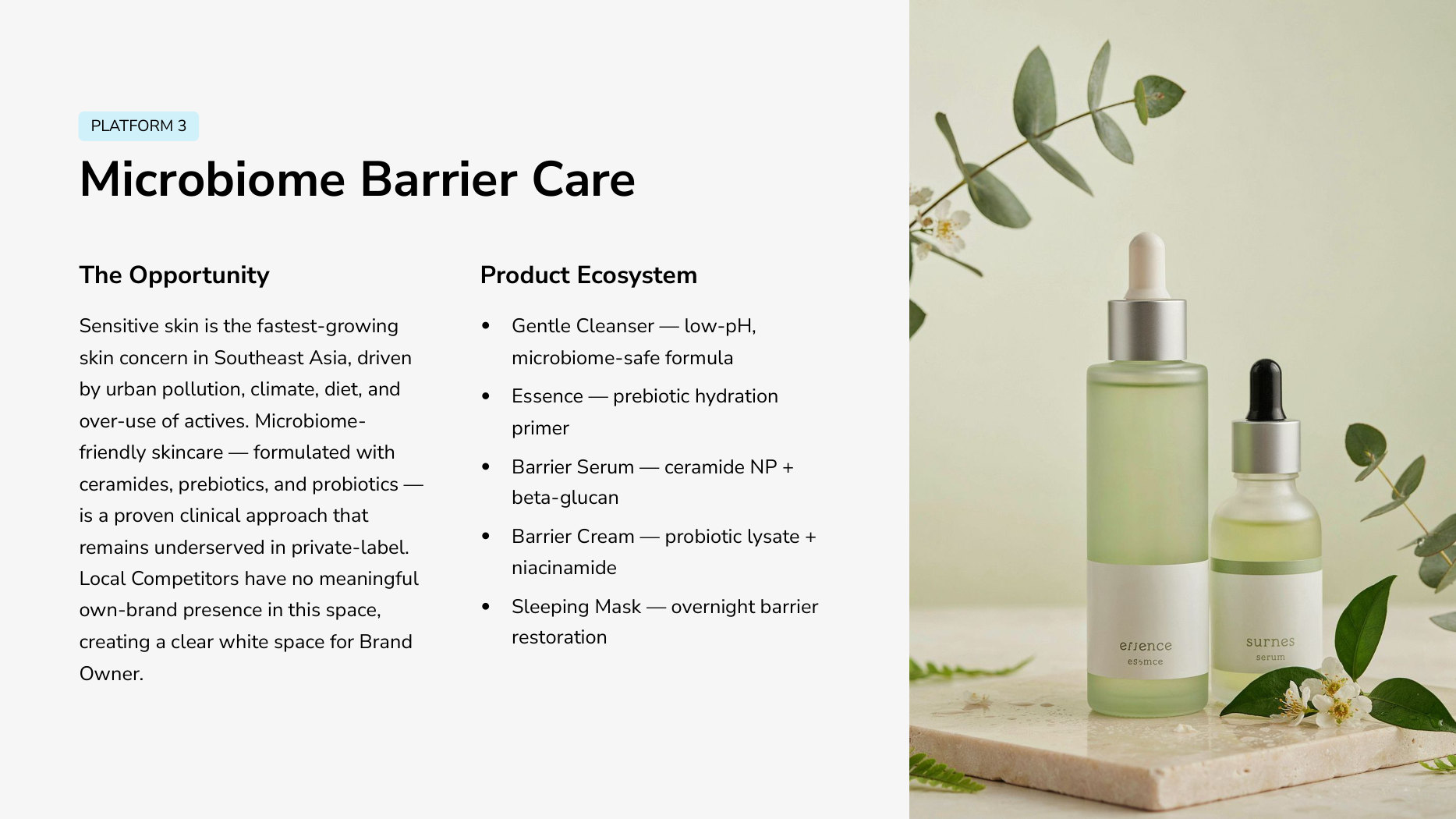
| Step | Product | The formulation constraint |
|---|---|---|
| Cleanse | Low-pH gentle cleanser | pH close to skin’s own; mild surfactant system that does not strip lipids |
| Hydrate | Prebiotic essence | Prebiotic actives that survive the preservative system |
| Repair | Ceramide barrier cream | Lipid ratio and texture suited to humidity, not lifted from a temperate-market formula |
| Protect | Fragrance-free daily moisturiser | Low-irritant filter and emollient choices; no masking fragrance |
The hardest constraint is the preservative system. Sensitised skin reacts to some common preservatives, but a prebiotic, low-pH product still has to be microbiologically safe in a hot climate. That tension — not the marketing claim — is where these projects succeed or fail.
Prebiotic or probiotic?
Prebiotics are ingredients that support the skin’s existing microbial balance; probiotics introduce live cultures. For a retail own-brand range, prebiotics are almost always the right answer: they are stable in normal cosmetic bases, survive standard preservation, and do not require the cold chain or claim substantiation that live cultures invite. Probiotic-derived ferments and lysates sit between the two and are a reasonable middle path.
The ORIZI perspective
Based on ORIZI Group’s manufacturing experience, brands routinely underestimate how much of this category is subtraction rather than addition. The brief arrives asking for prebiotics, ceramides, cica and five more actives. The product that performs is usually the one with the shortest list, the right pH and a preservative system chosen for reactive skin.
We also watch for one specific failure: a fragrance added in the final sampling round because the base smells “flat”. It is the single most common way a sensitive-skin range stops being a sensitive-skin range. Our sensitive skin OEM solutions line is set up to hold that line during development.
On our assessment, microbiome barrier care shows the widest gap of the five own-brand platforms we mapped for 2027–2029.
Limitations
- “Microbiome-friendly” has no single regulatory definition in Malaysia; substantiation depends on how the claim is worded.
- Products for reactive skin are cosmetics, not treatments for diagnosed skin conditions.
- Testing adds time: irritation and compatibility work should be planned into the schedule, not bolted on.
Frequently asked questions
Can I claim my product is “microbiome-friendly” in Malaysia?
Descriptive claims about supporting the skin’s natural balance are generally workable as cosmetic claims, but the wording matters and should be reviewed against the notification route before packaging is printed. Claims that imply treating a skin disease are not cosmetic claims.
Do prebiotic ingredients survive normal preservation?
Most common prebiotic actives do, which is one reason they are preferred over live cultures for retail ranges. Compatibility still has to be confirmed in the finished base rather than assumed from the raw material data sheet.
Is fragrance-free mandatory for this category?
Not legally, but commercially it is close to mandatory. The target consumer reads the ingredient list, and a fragrance entry undermines the proposition regardless of how gentle the fragrance is.
What MOQ does a four-step sensitive-skin range need?
Plan for four separate minimums. Ready formulas start from 50 units per SKU; custom formulation with custom packaging typically starts at 500 to 1,000 units per SKU.
Sources
- National Pharmaceutical Regulatory Agency (NPRA), Ministry of Health Malaysia — cosmetic notification scope and claim requirements.
- ORIZI Group internal product-platform analysis, 2026 — category gap assessment.
Related reading: what changes in formulation when a product is made for sensitive skin and the preservation challenge in clean formulation.
Update history
16 September 2026 — first publication.
Building for reactive skin?
Send us the claim you want to make and we will tell you what the formulation and testing have to support before you print packaging. Talk to ORIZI Group.