
- Home
- About Us
- Products
- Our Services
- Our Focus
- News & Insight
- FAQ
- Contact Us
- 🌐 EN
- Ready Formulas
Products › Body & Personal Care › Cooling Spray
ORIZI Group is an OEM and private-label manufacturer of cooling sprays and body cooling mists in Malaysia — including alcohol-free formulations for brands selling to Halal-conscious consumers. We formulate the sensation you want, pick the cooling system that fits your fragrance brief, and notify the finished product with the NPRA as a cosmetic.
A cooling spray is a sprayable personal-care product designed to make the user feel cooler. It is sprayed onto the skin, or in some formats onto clothing, and it works in two ways at once. The carrier evaporates and carries heat away from the surface. At the same time, cooling agents in the formula bind to TRPM8 — the cold receptor in the skin — which is the same receptor menthol acts on. The receptor reports cold to the brain even though the actual temperature change is small and brief.
That distinction matters commercially. A cooling spray delivers a sensation, reliably and repeatably. It is not a treatment, it is not an antiperspirant, and it does not reduce core body temperature. Brands that understand this build the right claims from the start and stay on the fast registration route.
Cooling is not one effect. It is two, and they are tuned separately. Getting the balance wrong is the single most common reason a cooling product tests badly.
The hit is the sharp drop the user feels the instant the product lands. It comes from the carrier evaporating and from fast, volatile cooling agents. This is what sells the product in a store demo, in a sampling activation and in a short-form video.
The tail is the softer sensation that lingers after the hit fades. It comes from low-volatility cooling esters and amides that stay on the skin. This is what makes somebody buy the product a second time.
A formula that is all hit feels like a stunt. A formula that is all tail feels like nothing happened. We set both to your brief and confirm them on a sensory panel before the formula is signed off.
Different cooling agents produce genuinely different sensations, and — just as important for a fragranced product — different amounts of smell. This is the menu we work from.
| Cooling agent | Character | Odour | Best used for |
|---|---|---|---|
| l-Menthol | Sharp, immediate, unmistakable | Distinctly minty | Classic cooling where a mint signal is wanted |
| Menthyl lactate | Gentle, long-lasting, low irritation | Very mild | The tail of the sensation; sensitive-skin positioning |
| WS-3 | Clean, immediate, non-volatile | Virtually none | A strong hit with no mint smell |
| WS-5 | Our strongest option, roughly four times the cooling intensity of menthol | Virtually none | Extreme-cooling and performance positioning |
| WS-23 | Not a menthol derivative at all | Odourless and tasteless | Fine-fragrance cooling mists where mint would ruin the scent |
Cooling agents are used at roughly 0.05% to 0.5% in leave-on formulations, per supplier technical guidance for creams and lotions. The exact level for a spray is confirmed during bench work, because the carrier system changes how much of the sensation actually reaches the skin.
If a serious fragrance is part of the brief, we build the cooling on non-menthol agents. Menthol has its own aroma and it will fight your perfumer’s work. This is the kind of decision that separates a considered product from a relabelled one.
Yes, and for the Malaysian market it is often the better product — but it is not a simple substitution.
Most cooling sprays on the market use ethanol as the carrier, because ethanol evaporates fast and delivers a large part of the cooling. Ethanol is also the ingredient Muslim consumers scrutinise most closely, and under Malaysian rules Halal status cannot be self-declared: certification is issued by JAKIM.
Our alcohol-free route replaces the ethanol carrier with a water-based system, and rebuilds the sensation using odourless cooling agents together with a long-acting cooling ester, with humectants for skin comfort. The technical work is in the solubilisation — several cooling agents that dissolve freely in high-strength ethanol will drop out of a water-based system, so the solvent system has to be designed rather than copied. That is exactly why an alcohol-free cooling mist is difficult to imitate off a label, and why it is worth owning.
For a conventional cooling spray the answer is the cosmetic notification, and the decision is made by your claims, not by your format.
| Route | What it covers | Typical cooling product |
|---|---|---|
| Cosmetic notification (NOT) | Products applied to the skin for cleansing, perfuming, changing appearance or keeping it in good condition — including sensory effects | Body cooling mist, clothing cooling spray, cooling sun protection mist, cooling foot spray |
| Registered medicine (MAL) | Products presented as treating or preventing a condition, or containing actives working pharmacologically | Analgesic relief sprays making a pain claim |
| Medical device (MDA) | Products achieving their effect by physical means rather than pharmacological action | Cooling patches and cold-therapy products |
A sensory cooling claim keeps you on the cosmetic route, which is the fastest to market. A pain-relief claim moves the same bottle into a completely different registration, with a different timeline and a different cost. If a relief claim is what you actually want, we also manufacture on that route — see OEM Pain Relief & Cooling Gel.
| You can say | We will steer you away from |
|---|---|
| Instant cooling sensation | Relieves muscle pain |
| Refreshing; cools you down on hot days | Anti-inflammatory |
| Quick-drying, will not wet your clothes | Treats or prevents heat stroke |
| Hydrating, where humectants are present | Reduces body temperature by a stated number of degrees |
| Alcohol-free, where the formula contains no ethanol | Antiperspirant |
The temperature claim deserves a note of its own. Published figures for skin-temperature drop vary widely and several are supplier or brand statements rather than independent measurements. We do not put a number on a label unless the finished product has been measured, because an unsupported figure is the easiest claim for a regulator or a competitor to challenge.
Common cooling directions, adjustable for sensation strength, fragrance, carrier system and pack.
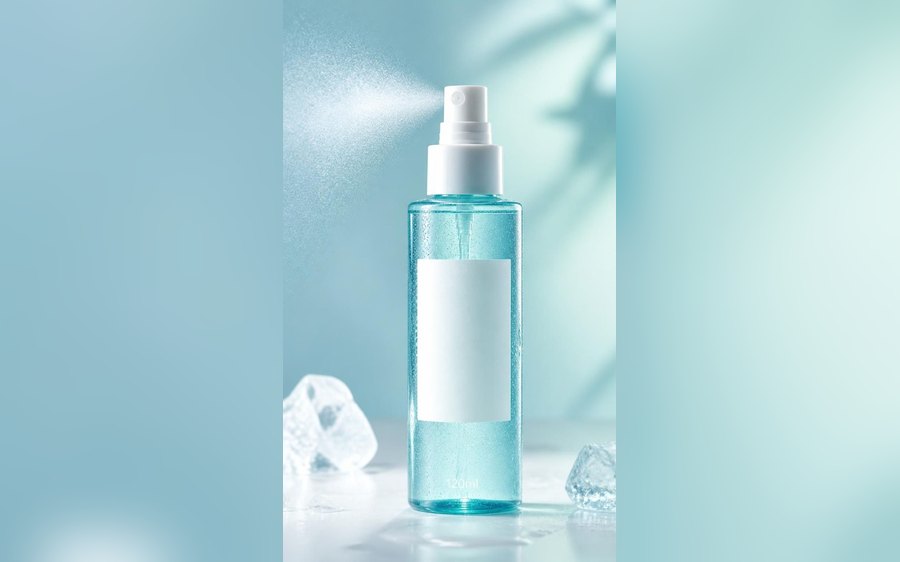
The category workhorse. A fine mist for arms, neck, chest and the back of the knees that dries fast and does not leave clothing damp. Scented or fragrance-free.
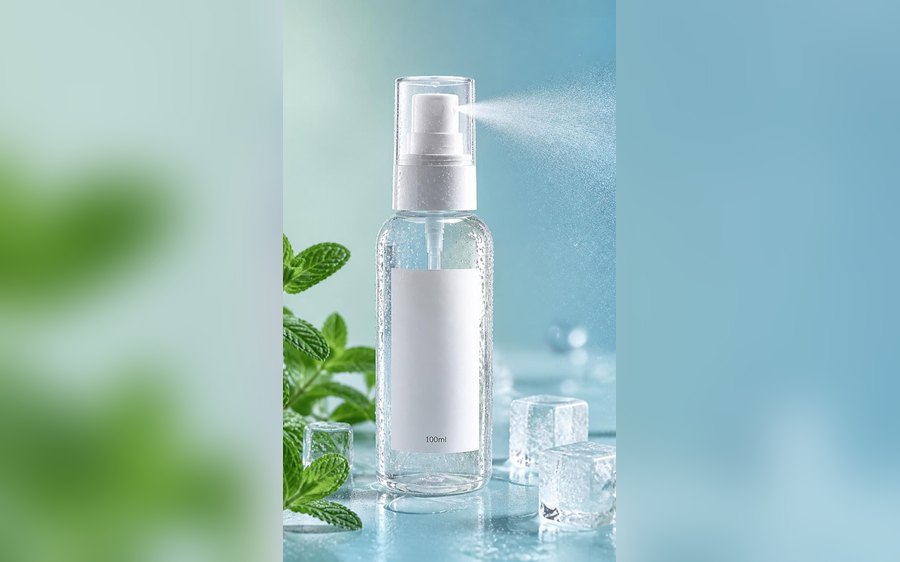
A water-based system with no ethanol, built for Halal-conscious and alcohol-sensitive consumers. Full cooling sensation, rebuilt without the alcohol carrier.
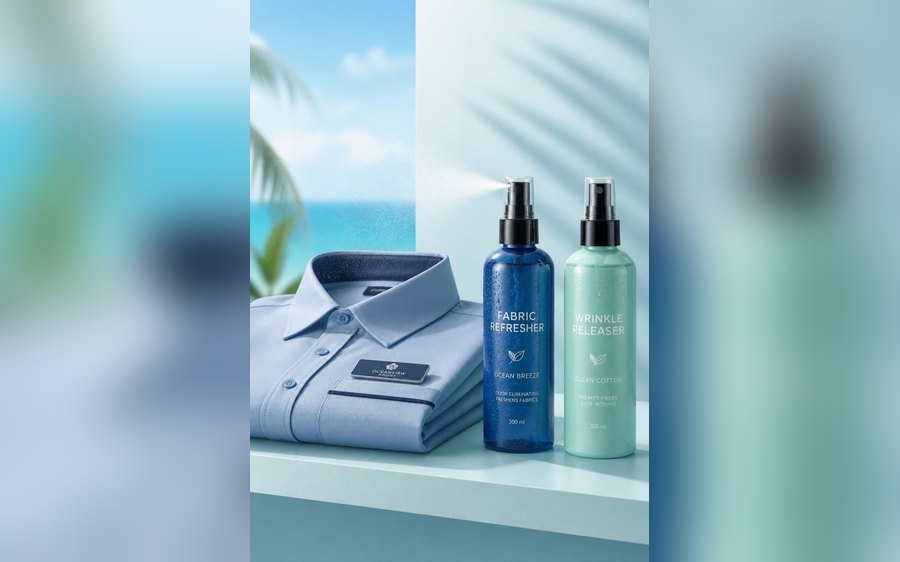
Applied to a shirt, a uniform or a helmet lining rather than to skin. Designed to read coolest when the wearer perspires. A strong fit for riders, fleets, uniforms and outdoor work.
Sun protection in a format people are willing to reapply. Cooling turns reapplication from a chore into the reward, which is the main compliance problem in sun care.
A targeted refresh for long shifts, travel and standing work. Pairs naturally with a foot-care or pharmacy range.
A light scalp refresh for hot and humid days, and for consumers who cover their hair. Formulated to avoid heaviness and residue.
These are production-ready formulations in related formats. They can be launched close to as-is, or used as the starting point for your own cooling brief.
The four cooling concepts are presented page by page, with the market read behind them, in the cooling spray concept catalogue in our Innovation & Trend Hub.
We produce cooling sprays as fine-mist and continuous-spray pump formats, in PET bottles with clear, frosted or opaque finishes.
Pack choice is a positioning decision as much as a cost one. The 100ml to 120ml size matches what the category leaders sell and fits a handbag or a toolbag, which is what drives repeat use. The 30ml to 50ml size moves fastest in hotel amenity, corporate gifting, event sampling and social-commerce bundles.
Both halves of this market are growing, and they sell to different people.
Pure function, with nothing to clash with a perfume, a deodorant or a workplace policy. Built on odourless cooling agents so there is genuinely nothing to smell. This is a serious segment, not an afterthought — in independent Japanese consumer-magazine testing, the unscented version of the leading brand placed at the top of the ranking.
Cooling gives a scented mist a functional reason to exist beyond the fragrance itself. We work across clean soap, citrus, marine, eucalyptus, tropical and gourmand directions. If the fragrance is the hero, we build the cooling on non-menthol agents so the scent is not fighting a mint note.
If your brief is primarily a fragrance product, see OEM Fragrance Mist & Body Mist; if it is primarily odour control, see OEM Deodorant.
Sensory cooling keeps you on the cosmetic notification route. A pain-relief claim does not. This single decision sets your registration, your timeline and your packaging copy, so make it before anything else.
If your market is Halal-conscious, say so at briefing. An alcohol-free formula is not a late substitution — the solvent system is designed differently from the start.
Fragrance-free, lightly scented or fully perfumed. This decides which cooling agents we can use, so it is a formulation decision, not a marketing one.
Skin, fabric, feet or scalp. Each changes the carrier, the actuator and the testing.
The rules on this page come from the Malaysian regulators directly. Cosmetic products are controlled by the National Pharmaceutical Regulatory Agency (NPRA) under the Guidelines for Control of Cosmetic Products in Malaysia, which are adapted from the ASEAN Cosmetic Directive and updated by circular. Products working by physical means fall under the Medical Device Authority (MDA). Halal certification in Malaysia is issued by JAKIM and cannot be self-declared. Ingredient restrictions should always be checked against the current annexes rather than an older copy.
Tell us the sensation you want, whether your market needs alcohol-free, and how the product should smell — we will come back with a formulation brief and a sample timeline.