A kit is not a discount bundle. Done properly it is a protocol — and protocols carry a price premium that loose SKUs sold together never do.
Written & researched by Creaton Poh, industry researcher · Technical input by ORIZI Group R&D Team · Fact-checked by ORIZI Group Editorial · Published by ORIZI Group · Last reviewed September 2026
Disclosure: This article is published by ORIZI Group and refers to our own manufacturing experience and capabilities.
Quick answer: what makes a home treatment kit different from a bundle?
A bundle is several existing products shrink-wrapped together and discounted. A home treatment kit is a set designed as one protocol — products sized to a defined course, sequenced in a specific order, with instructions that make the sequence followable at home. Kits built this way support a price premium over the same products bought individually, because the consumer is buying a result and a schedule rather than packaging.
Key takeaways
- Design the protocol first, then the products. A kit assembled from existing SKUs reads as a discount pack.
- Sizes should match the course, not the standard retail fill. Running out of step two halfway through breaks the protocol.
- Clinical-language positioning and clear instructions support a premium over equivalent individual SKUs.
- Gifting is a second demand curve — kits sell in festive and gifting seasons in a way single products do not.
- Kit assembly is a manufacturing decision. Component minimums, tray tooling and pack-out capacity decide whether the concept is viable at your volume.
Four kit concepts that work in this market
| Kit | Typical contents | Why it holds together |
|---|---|---|
| Acne course | BHA cleanser, salicylic serum, clarifying cream, spot treatment | The consumer already thinks in courses, not products |
| Brightening course | Gentle cleanser, vitamin C or tranexamic serum, night cream, daily SPF | SPF inside the kit prevents the most common failure of the routine |
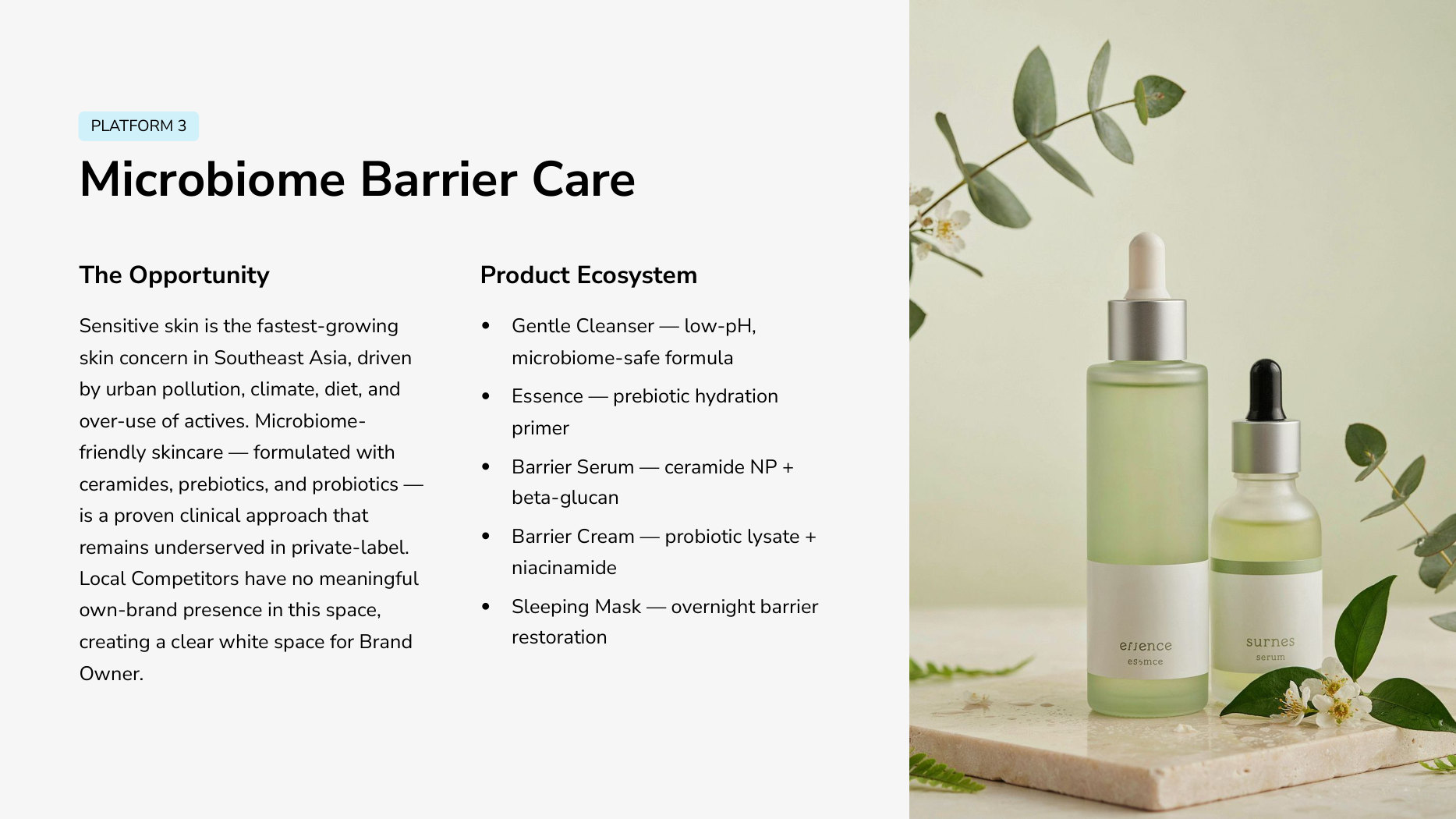
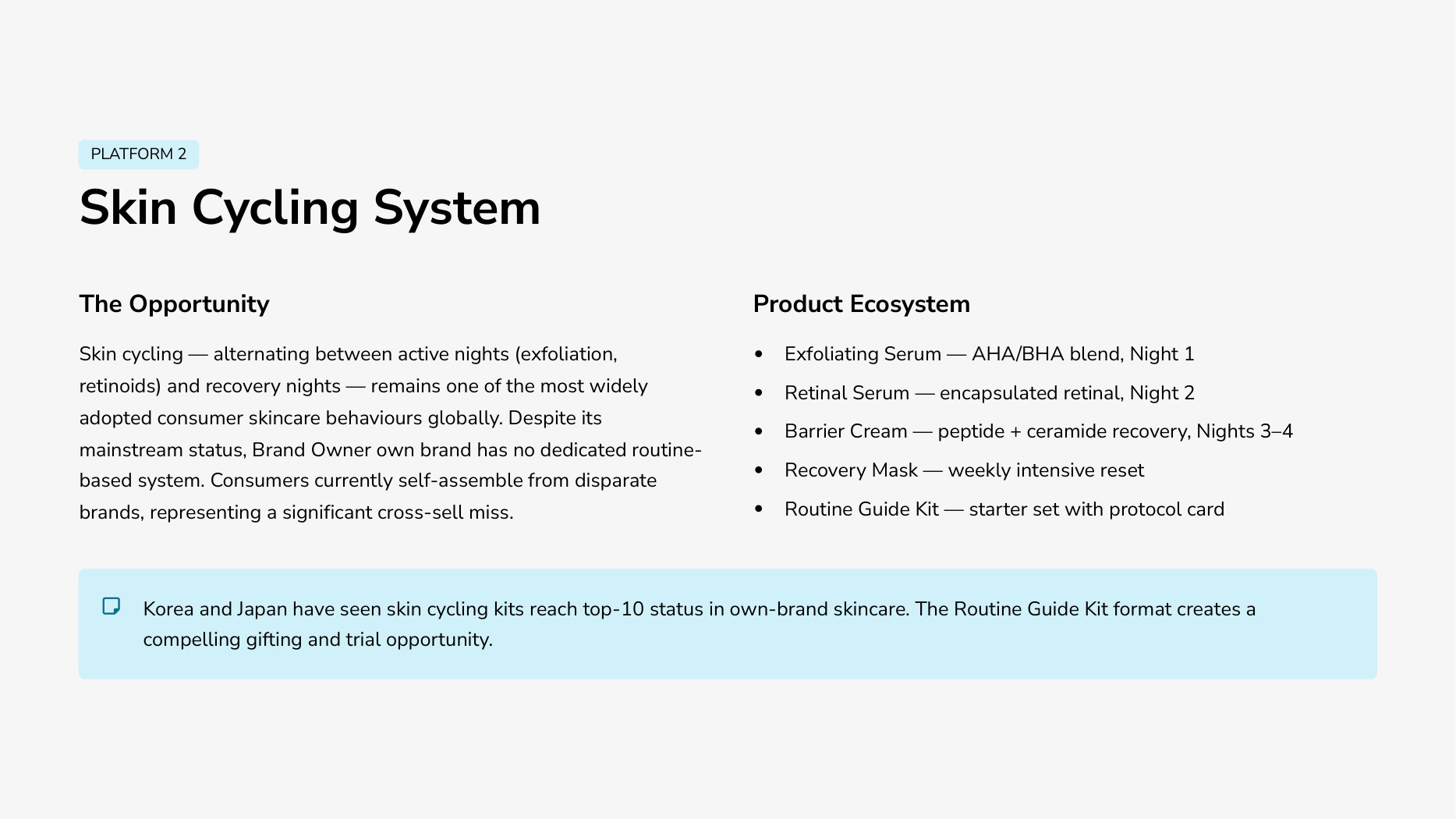
| Barrier reset | Low-pH cleanser, essence, ceramide cream, recovery mask | Sold as a recovery from over-exfoliation — a clear, time-bound need |
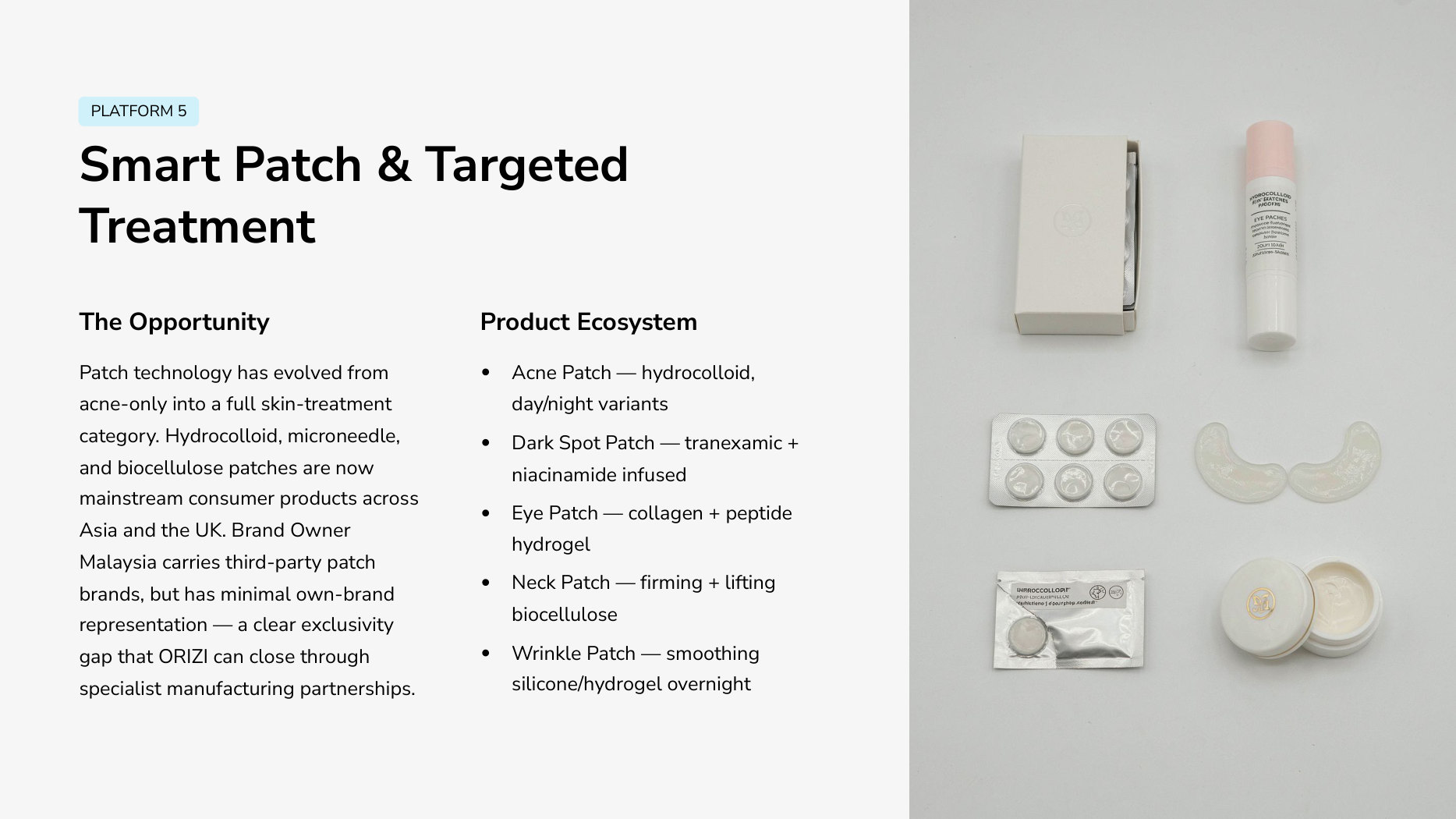
| Starter or trial set | Travel sizes of a full routine plus a protocol card | Lowest-risk entry to the brand; doubles as a gifting product |
Why the pricing works — when it works
A kit earns its premium from three things: the sequencing is decided for the consumer, the sizes are matched to the course, and the outcome is described in specific language. Remove any one and the product collapses back into a bundle, where the shopper compares it against the sum of the parts and expects a discount.
The practical test we use: if a consumer could rebuild the kit from your own shelf for less money, the kit has no reason to exist. Either the sizes, the sequence or a kit-only component has to be genuinely different.
What makes kits harder to manufacture than they look
- Four minimums, not one. Every component carries its own MOQ, and the smallest component often sets the economics.
- Tray and carton tooling. A fitted insert is what makes a kit feel like a product; it also adds tooling cost and lead time.
- Fill-size changes are formulation work. A 30ml version of a 100ml product is not always a straight scale-down — preservation and stability are re-checked.
- Pack-out capacity. Kit assembly is manual or semi-automatic; it has to be scheduled, not squeezed in.
- Every SKU in the kit needs its own regulatory status. A kit does not notify as a single product in Malaysia.
The ORIZI perspective
Based on ORIZI Group’s manufacturing experience, the kits that succeed are specified backwards: start from the course length — four weeks, eight weeks — then set the fill sizes so all components run out at roughly the same time. It sounds obvious and it is routinely missed, because fill sizes are usually inherited from the standard range.
The second thing we push for is one kit-only element: a size, a sachet, a tool or a component that is not available separately. It removes the rebuild-it-cheaper comparison entirely and gives the buyer a reason to list the kit alongside the individual products rather than instead of them. Kit development, component sourcing and pack-out run through our private label OEM service.
Treatment kits are the lowest technical barrier among the five own-brand skincare platforms in our 2027–2029 analysis, because most of the work is sizing and components rather than new formulation.
Limitations
- Kits raise working capital: you hold stock of every component before a single kit ships.
- Forecasting is harder. An imbalance between components leaves unusable inventory.
- Gifting demand is seasonal and can distort the sales picture for the underlying range.
Frequently asked questions
Does a kit need separate cosmetic notification in Malaysia?
The individual cosmetic products inside the kit each require notification. The kit is a pack format, not a product that replaces those requirements. Confirm the structure before printing outer packaging.
What is a realistic minimum order for a four-product kit?
Plan for the minimum of every component plus the packaging components. Ready-formula routes start from 50 units per SKU, but tray and carton tooling usually push the practical kit minimum higher than the formula minimums suggest.
Can I use travel sizes to keep the kit affordable?
Yes, and it is the usual route for starter sets — but confirm stability at the smaller fill, since surface-to-volume changes affect some formats.
How long does kit development take compared with a single product?
Longer, and the driver is rarely the formulas. Tooling for the tray, component lead times and pack-out scheduling usually determine the launch date.
Sources
- National Pharmaceutical Regulatory Agency (NPRA), Ministry of Health Malaysia — cosmetic notification requirements per product.
- ORIZI Group internal product-platform analysis, 2026 — kit structure and pack-out considerations.
Related reading: marketplace bundles and starter kits.
Update history
16 September 2026 — first publication.
Thinking about a kit?
Tell us the course length you have in mind and we will work the fill sizes, component minimums and pack-out back from it. Talk to ORIZI Group.