Skin cycling turned a dermatologist’s scheduling advice into a mass consumer habit. Most shoppers still assemble the routine from four different brands, because almost nobody sells it as one system.
Written & researched by Creaton Poh, industry researcher · Technical input by ORIZI Group R&D Team · Fact-checked by ORIZI Group Editorial · Published by ORIZI Group · Last reviewed September 2026
Disclosure: This article is published by ORIZI Group and refers to our own manufacturing experience and capabilities.
Quick answer: what is a skin cycling system?
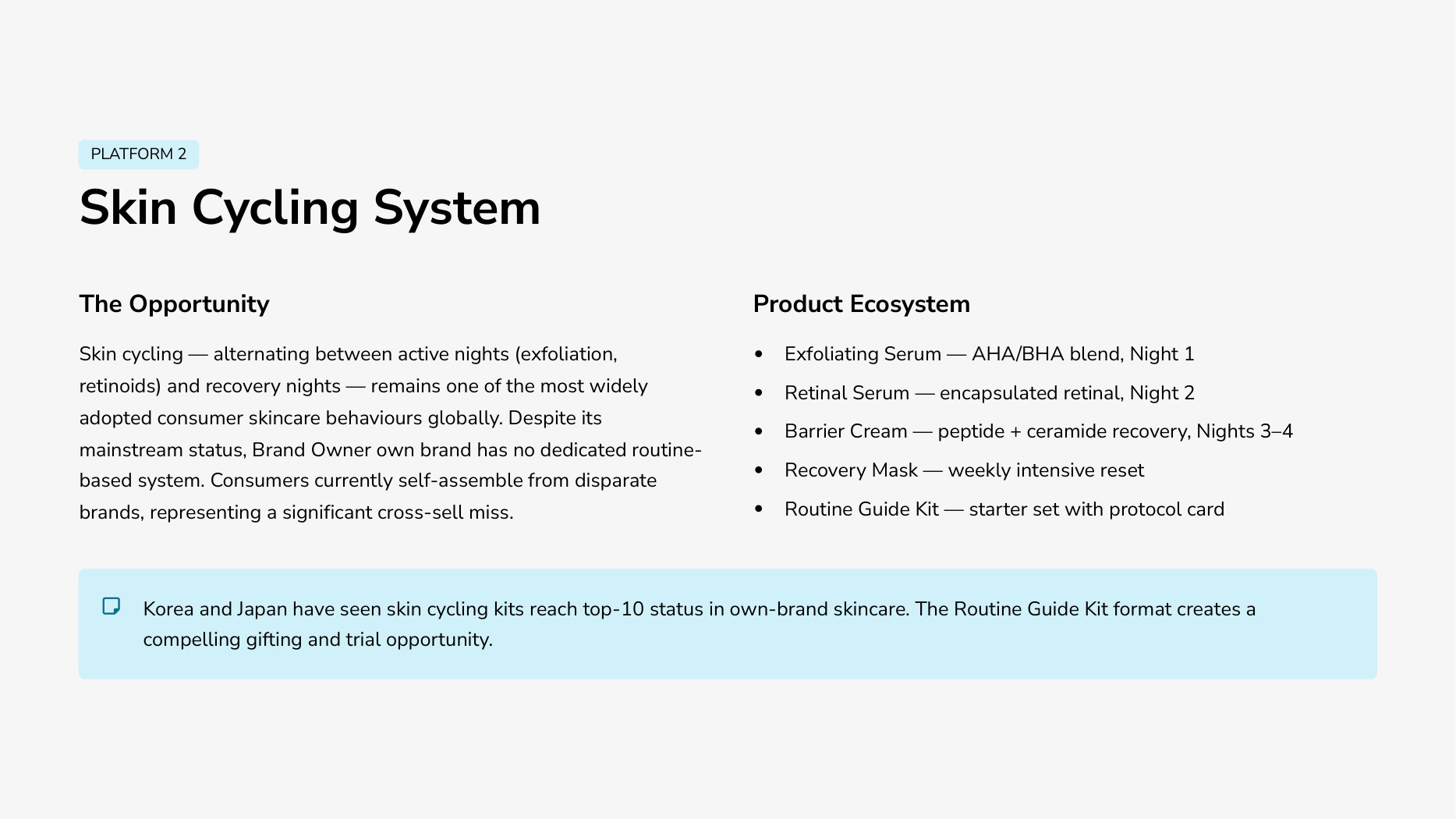
Skin cycling is a four-night routine that alternates active nights with recovery nights: exfoliation on night one, a retinoid on night two, then two nights of barrier repair. A skin cycling system packages that schedule as one range — typically an exfoliating serum, a retinal serum, a barrier cream, a weekly recovery mask and a protocol card. The behaviour is already mainstream in Malaysia; the packaged system is not, so consumers buy the four steps from four unrelated brands.
Key takeaways
- The demand exists before the product does. You are not teaching a new behaviour, only removing the assembly work.
- Four to five SKUs move together, which is the cross-sell most single-serum brands never capture.
- Encapsulated retinal is the technical centre of the range — stability and irritation control decide whether the routine survives repeat use.
- The protocol card is part of the product. If the consumer cannot follow the schedule, the range under-performs regardless of formulation quality.
- Kit format doubles as a gifting and trial pack, which is how the category reached top-10 own-brand status in Korea and Japan.
The routine, and what each night needs from the formula
| Night | Product | What the formulation has to get right |
|---|---|---|
| Night 1 — exfoliation | AHA/BHA serum | Effective acid level with a pH that stays in range through shelf life |
| Night 2 — retinoid | Encapsulated retinal serum | Stability and controlled release; oxidation is the usual failure mode |
| Nights 3–4 — recovery | Peptide and ceramide barrier cream | Substantial enough to repair, light enough for humid weather |
| Weekly reset | Recovery mask | Comfort and immediacy; this is the step consumers judge fastest |
| Onboarding | Routine guide kit | Clear protocol card; the schedule has to survive being explained in 30 seconds |
Why retinal is the decision point
Retinal (retinaldehyde) sits between retinol and prescription retinoic acid: more active than retinol, gentler than prescription strength. It is also less forgiving to formulate. Unencapsulated, it oxidises and loses potency; poorly encapsulated, it releases unevenly and irritates.
That is why encapsulation is a cost decision as much as a technical one. A cheaper retinal serum that browns in month four takes the whole routine down with it, because the consumer blames the system rather than the SKU. If the budget will not carry a properly encapsulated retinal, a retinol-based version is the honest alternative — and the claim set must change with it.
Where brands get this wrong
- Launching the serums without the barrier cream. Half a cycle is not a system; it is two products that make skin more reactive.
- Copying Korean pack sizes. Malaysian humidity changes the texture expectation, particularly for night-three creams.
- Burying the schedule. If the protocol is only on the website, the routine breaks at home.
- Over-claiming on the exfoliant. Acid products attract regulatory attention; the claim set has to match the actual concentration and route.
The ORIZI perspective
Based on ORIZI Group’s manufacturing experience, a skin cycling range lives or dies on two things that have nothing to do with marketing: retinal stability and the texture of the night-three cream in a tropical climate. Everything else can be adjusted after launch.
We also see a pattern in briefs: brands ask for the strongest possible actives on nights one and two, then under-specify the recovery nights because those steps feel unglamorous. In use, the recovery cream is what determines whether the consumer sticks with the routine past week three. When we develop these ranges through our OEM serum manufacturing line, we specify the recovery steps first.
Skin cycling sits alongside four other routes in our 2027–2029 map of own-brand skincare platforms — it has the widest consumer awareness of the five.
Limitations
- Skin cycling is a consumer routine, not a clinical protocol. Individual tolerance varies, and products should be positioned accordingly.
- Encapsulated retinal raises unit cost; the range may not suit the lowest retail price tiers.
- Acid and retinoid products require claim review against Malaysian cosmetic notification requirements before launch.
Frequently asked questions
Is skin cycling still relevant in 2026, or has the trend passed?
The name may fade but the behaviour has stuck: alternating active and recovery nights is now standard advice, which is what makes it a durable platform rather than a seasonal trend. Products built around the schedule outlive the hashtag.
Can I launch a skin cycling kit with ready formulas?
Yes. The exfoliating serum, barrier cream and mask are commonly available as proven ready formulas; the retinal serum is where most brands choose customisation. A mixed approach — ready formulas plus one customised hero — is the usual route for a first launch.
What MOQ does a four-step kit require?
Each SKU carries its own minimum, so plan for four. Ready-formula routes start from 50 units per SKU; custom formulation and custom packaging typically start at 500 to 1,000 units per SKU.
Retinol or retinal for an own-brand range?
Retinal delivers faster visible results but costs more to stabilise. Retinol is cheaper and better understood by suppliers. Choose based on the retail price you need to hit, then write the claims to match — not the other way round.
Sources
- National Pharmaceutical Regulatory Agency (NPRA), Ministry of Health Malaysia — cosmetic notification and claim requirements for acid and retinoid products.
- ORIZI Group internal product-platform analysis, 2026.
Related reading: the preservation challenge in clean and natural formulation.
Update history
16 September 2026 — first publication.
Planning a routine-based range?
Tell us the retail price you need to hit and we will tell you which steps can run on ready formulas and which need custom work. Talk to ORIZI Group.