Aesthetic treatments are now mainstream in Malaysia, but the products people use for the week afterwards are still mostly clinic-dispensed. That gap is one of the clearest own-brand opportunities in skincare right now.
Written & researched by Creaton Poh, industry researcher · Technical input by ORIZI Group R&D Team · Fact-checked by ORIZI Group Editorial · Published by ORIZI Group · Last reviewed September 2026
Disclosure: This article is published by ORIZI Group and refers to our own manufacturing experience and capabilities. It describes a product concept, not a clinical protocol.
Quick answer: what is a post-procedure recovery system?
A post-procedure recovery system is a set of fragrance-free, barrier-repair products designed for skin in the days after an aesthetic treatment such as laser, microneedling or a chemical peel. A complete system typically runs to five products — cleanser, mist, repair cream, balm and hydrogel mask — built around cica, panthenol and ceramides. In Malaysia these are still sold mainly by clinics, which leaves retail and pharmacy own-brand ranges with almost no presence in a repeat-purchase category.
Key takeaways
- The need is recurring, not one-off. Treatment courses repeat, so recovery products are repurchased rather than trialled once.
- It sells as a system, not a SKU. A consumer following the full protocol buys five products, not one.
- Formulation discipline is the barrier to entry — fragrance-free, low-irritant, pH-controlled — which is exactly why the shelf is empty.
- Claims must stay cosmetic. Wound healing and medical claims move a product into a different regulatory category in Malaysia.
- The channel fit is pharmacy and clinic-adjacent retail, where shoppers already trust ingredient-led positioning.
Why post-procedure care is an own-brand white space
Laser, microneedling, chemical peels and injectables have moved from specialist clinics into mainstream aesthetic practice across Malaysian cities. The aftercare that follows has not moved with it. Most consumers leave a clinic with a dispensed product or with nothing at all, then improvise with whatever gentle cream is on the shelf.
That improvisation is the opportunity. The consumer already knows what she needs — something soothing, fragrance-free and barrier-repairing — and cannot reliably find it under a brand she recognises at retail.
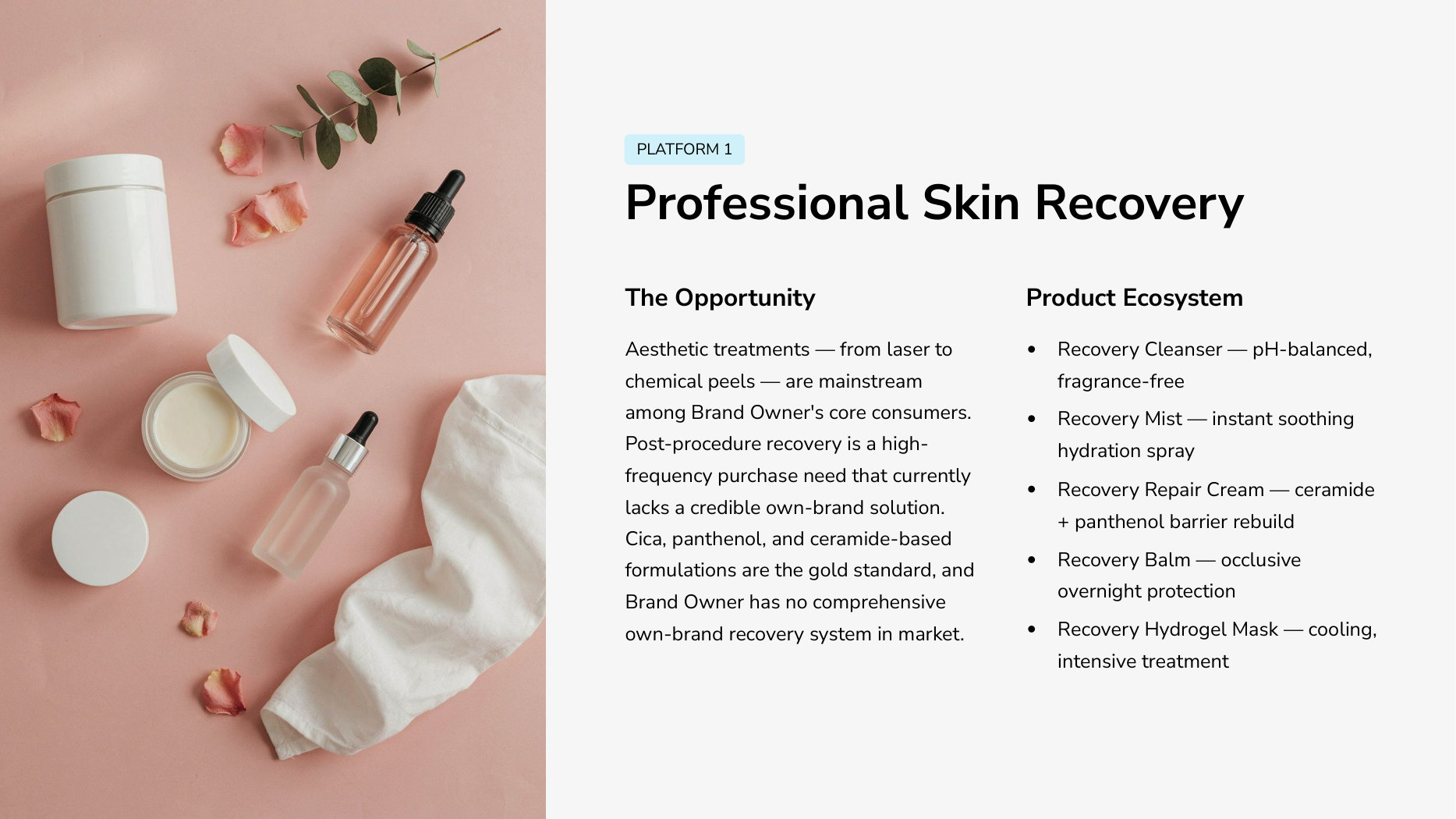
What goes into a recovery system
| Product | Job in the routine | Formulation priority |
|---|---|---|
| Recovery cleanser | Cleanses without stripping compromised skin | pH-balanced, fragrance-free, minimal surfactant load |
| Recovery mist | Immediate soothing and hydration between steps | Low-irritant, preservative system suited to sensitised skin |
| Repair cream | Rebuilds the barrier over the following days | Ceramides plus panthenol; occlusivity balanced against comfort in a humid climate |
| Recovery balm | Overnight occlusive protection | Anhydrous or low-water system; texture that spreads without dragging |
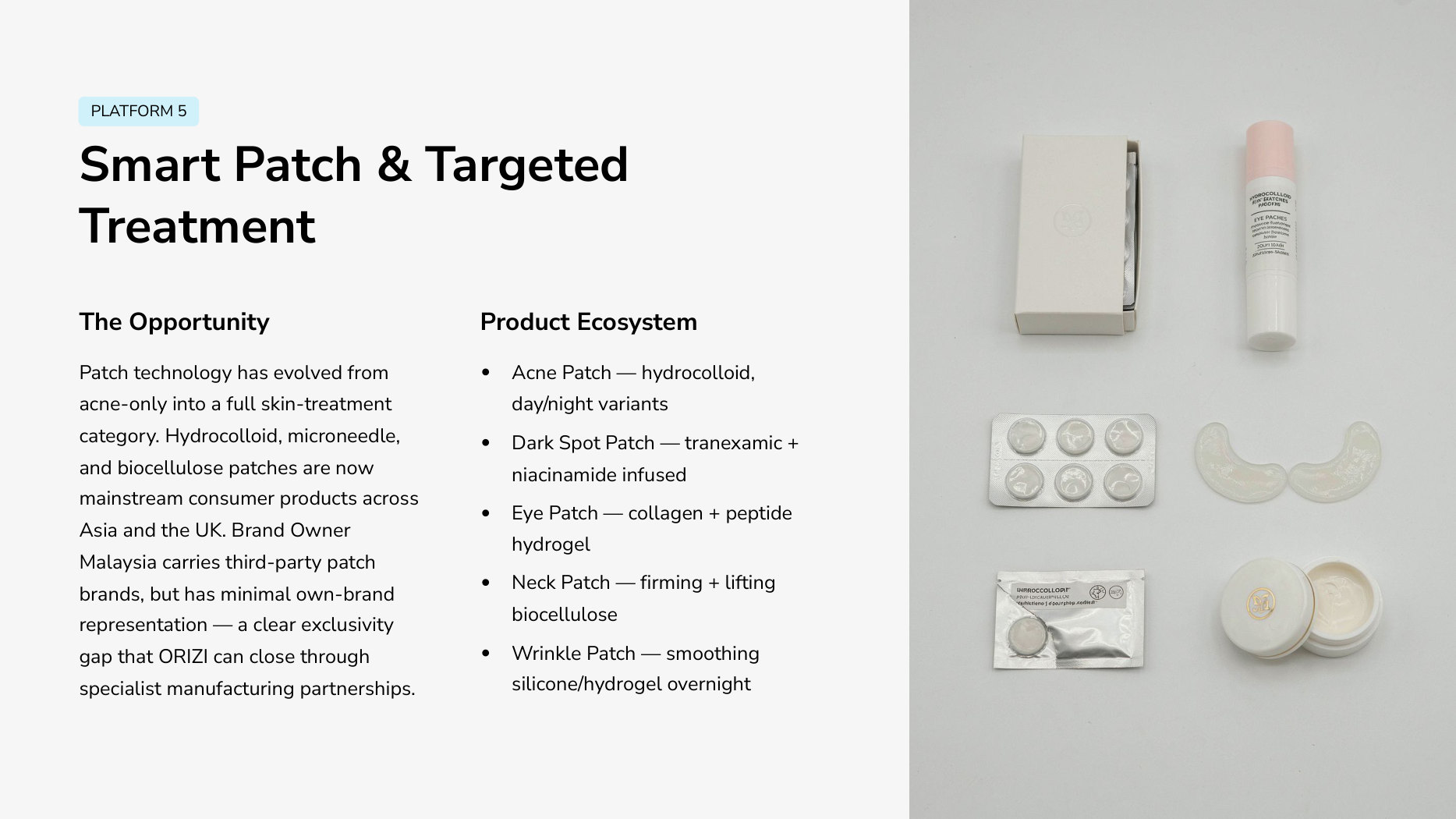
| Hydrogel mask | Cooling, intensive treatment on the first days | Specialist hydrogel manufacturing; cooling sensory without alcohol |
The commercial case
The basket economics are what make this platform different from launching a single soothing cream. A consumer following a full protocol buys five products in one visit. At an illustrative RM 36 per unit that is an RM 180 basket, against RM 36 for a single-product purchase.
Repeat behaviour is the second half of the case. Post-treatment consumers repurchase cleansers and barrier creams at high frequency because the treatment cycle itself repeats. Products bought for a reason come back; products bought on impulse often do not.
Where brands get this wrong
- Claiming too much. “Heals”, “repairs wounds” or “post-surgical” language pushes a cosmetic product towards a medical classification. Malaysian cosmetic products are notified with the National Pharmaceutical Regulatory Agency (NPRA); claims that imply treatment of a medical condition do not belong on that route. We set the claim set before the formula is locked, not after.
- Adding fragrance late. A fragrance added for shelf appeal undermines the entire proposition for sensitised skin.
- Treating the mask as an accessory. Hydrogel masks need specialist manufacturing; they are not a line extension you add in the last month before launch.
- Launching two products. A partial system removes the basket advantage that justifies the platform.
The ORIZI perspective
Based on ORIZI Group’s manufacturing experience, the hard part of a recovery range is not the hero cream — it is keeping the whole set consistent. Five products developed at different times, by different suppliers, drift: the cleanser ends up with a different fragrance-free standard from the balm, and the consumer notices before the buyer does.
Developing the system as one brief is slower at the start and faster overall. It also makes the regulatory work coherent, because the claim set and the ingredient rationale are written once for the range rather than five times. Our dermatology and aesthetic skincare OEM line was built for exactly this kind of sensitive-skin discipline.
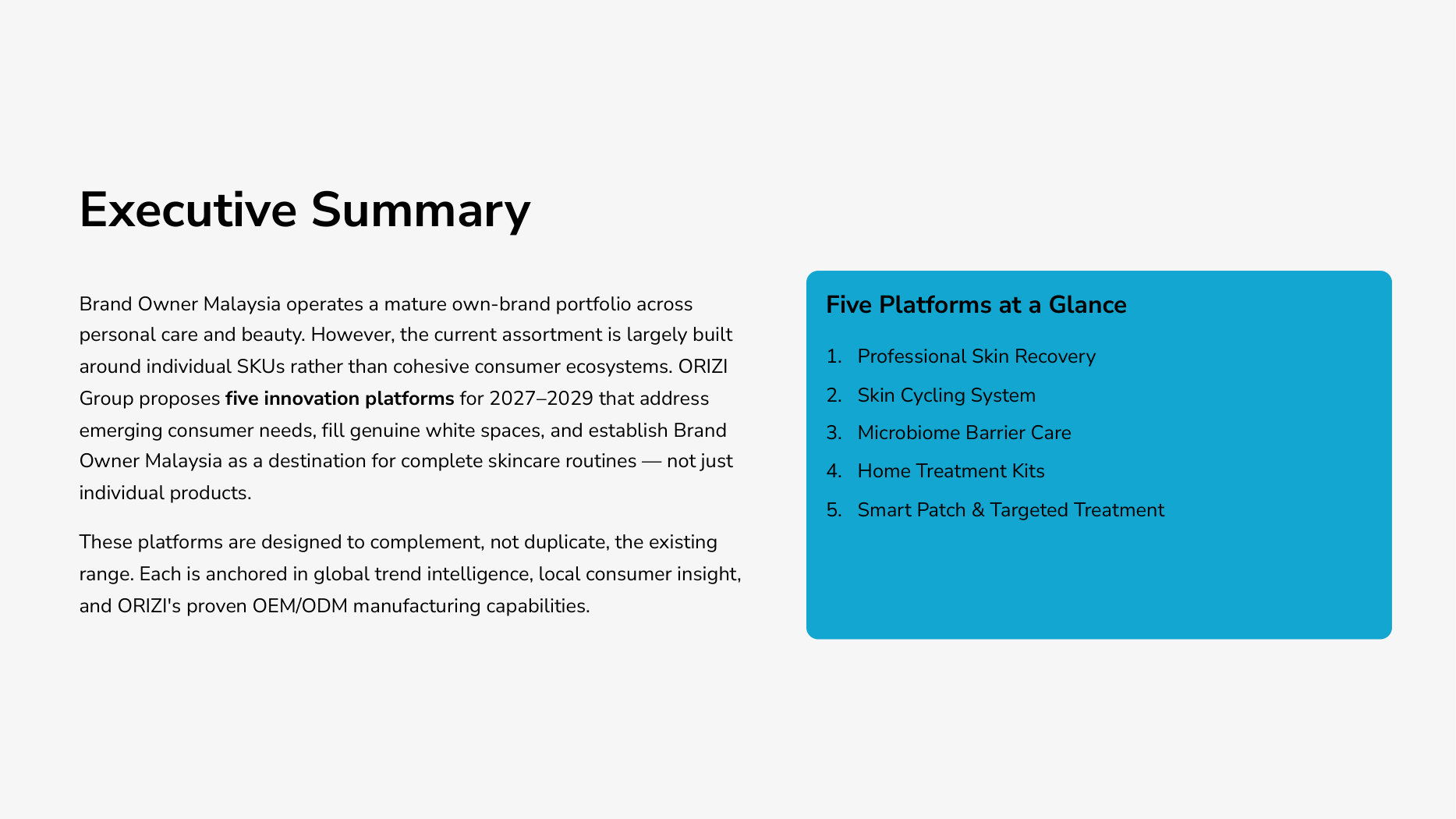
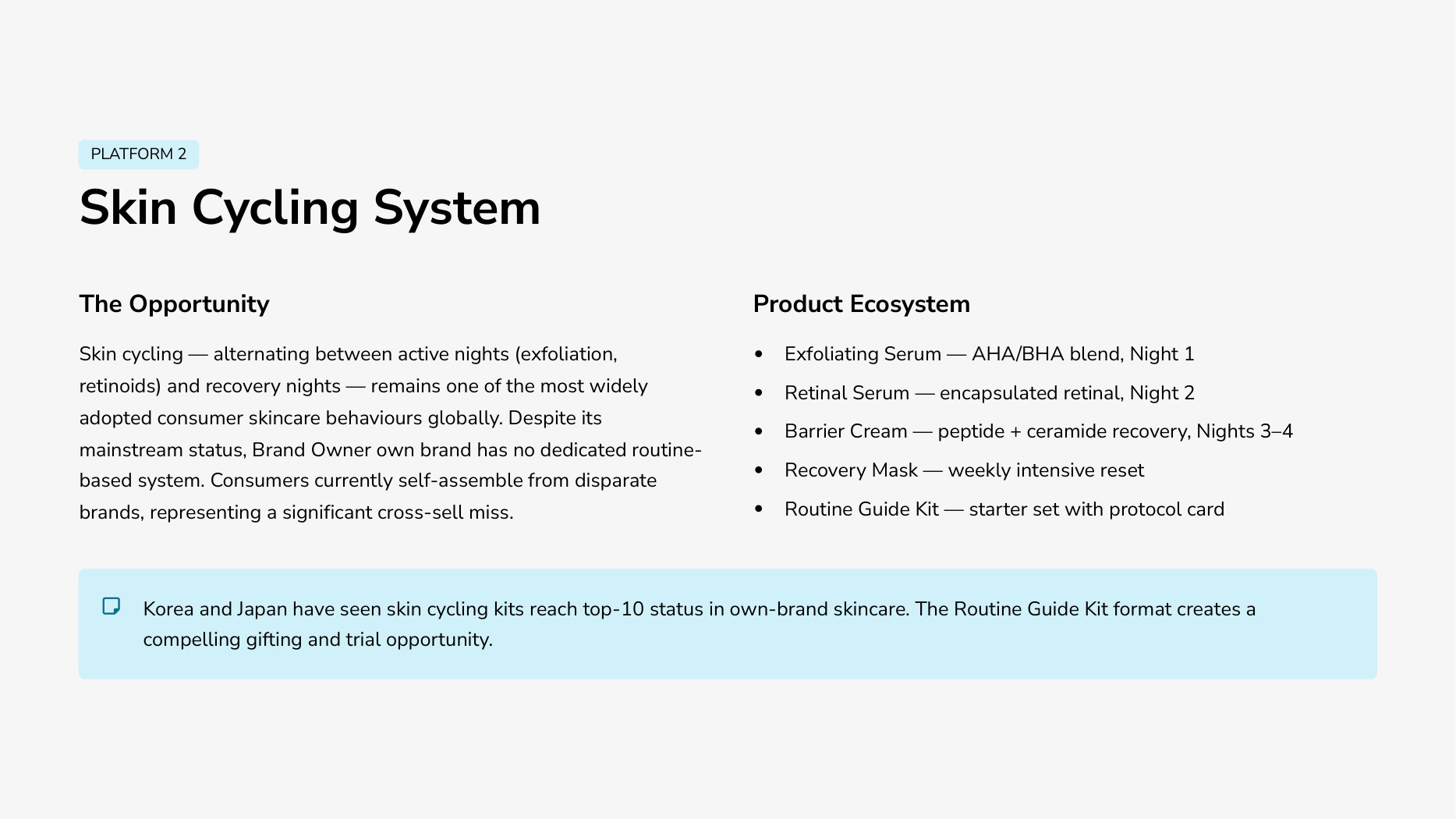
Post-procedure recovery is one of five own-brand skincare platforms we mapped for 2027–2029; it scores high on both category gap and differentiation.
Limitations
- Basket and repeat figures above are illustrative modelling for planning, not measured retail results.
- Aftercare suitability depends on the procedure. A product range cannot substitute for the treating clinician’s instructions.
- Hydrogel and biocellulose formats have longer development lead times than creams and require specialist production.
Frequently asked questions
Can a cosmetic brand sell post-procedure products in Malaysia?
Yes, provided the products are positioned and notified as cosmetics. They are marketed for comfort, hydration and barrier support — not for treating a medical condition. Claims that imply healing or medical treatment fall outside the cosmetic notification route.
What minimum order quantity does a five-product recovery range need?
Each product carries its own minimum, so a five-SKU range is five minimums. Ready-formula routes start from 50 units per SKU; custom formulation with custom packaging typically starts at 500 to 1,000 units per SKU because of component minimums.
Which ingredients define this category?
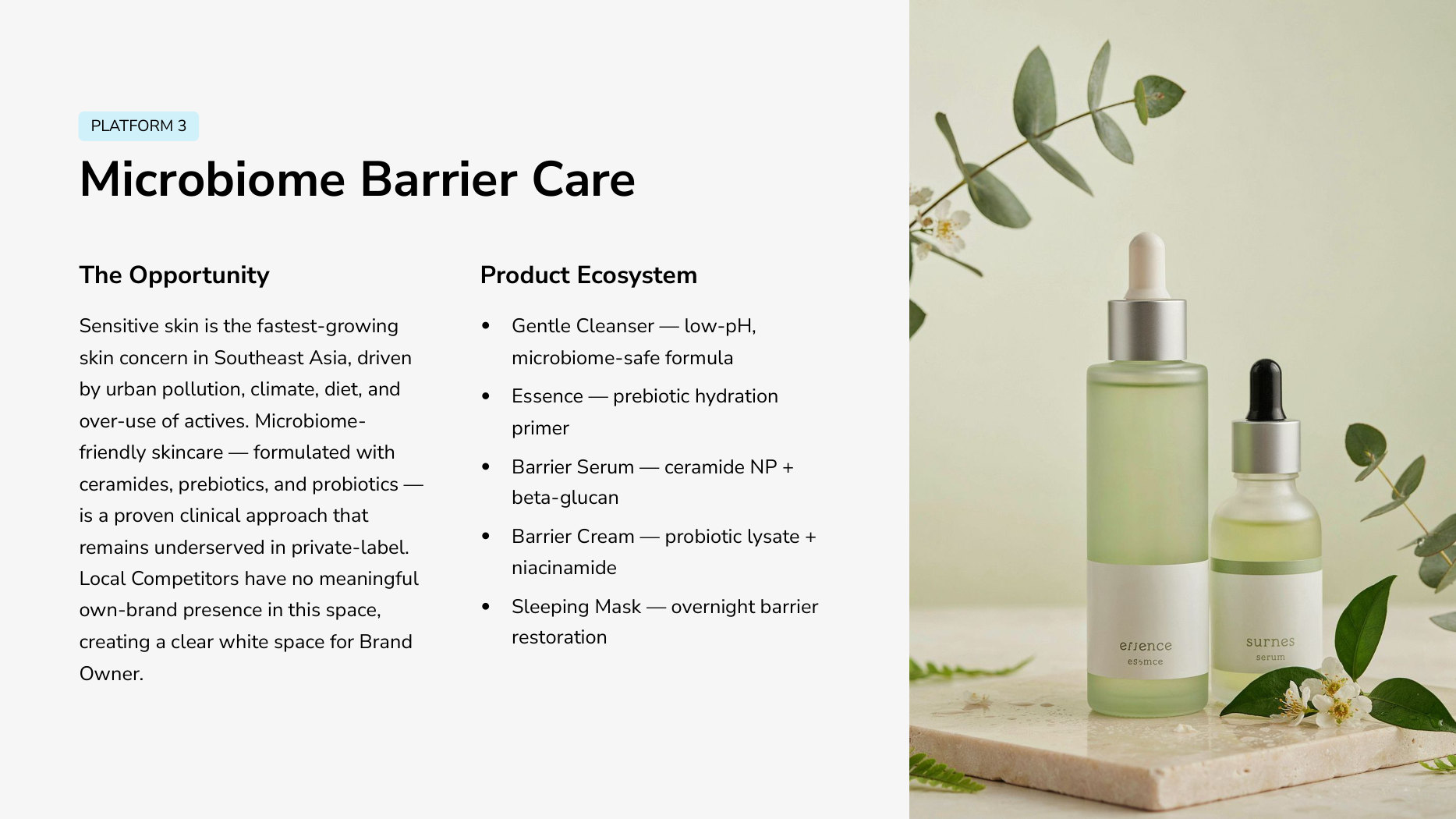
Centella asiatica (cica), panthenol and ceramides are the recognised base, usually with a gentle humectant system. The differentiation comes from texture, preservative choice and the fragrance-free standard rather than from an exotic active.
How long does a recovery range take to develop?
Creams, cleansers and mists follow normal cosmetic development timelines; the hydrogel mask is the long pole. Plan the mask first and the rest of the range around it.
Sources
- National Pharmaceutical Regulatory Agency (NPRA), Ministry of Health Malaysia — cosmetic notification scope and claim requirements.
- ORIZI Group internal product-platform analysis, 2026 — category structure and system design.
Related reading: what changes in formulation when a product is made for sensitive skin.
Update history
16 September 2026 — first publication.
Considering a recovery range?
Send us the concept and the channel you are targeting, and our team will map the formulation, claim set and packaging route before you commit to a brief. Talk to ORIZI Group.