A brand asked us about a plant-made protein active this month. Our answer was not about the science — it was about the seven process questions we have to close before we can quote it.
Written & researched by Kok Toong Hoi, Contributing Writer & Manufacturing Industry Practitioner · Technical input by ORIZI Group R&D Team · Fact-checked by Creaton Poh · Published by ORIZI Group · Last reviewed August 2026
Disclosure: This article is published by ORIZI Group and may refer to our own manufacturing experience, services and capabilities. ORIZI Group has no commercial or supply relationship with Vytrus Biotech in connection with this ingredient, and has not manufactured with it. External factual claims are supported by cited sources.
Quick answer
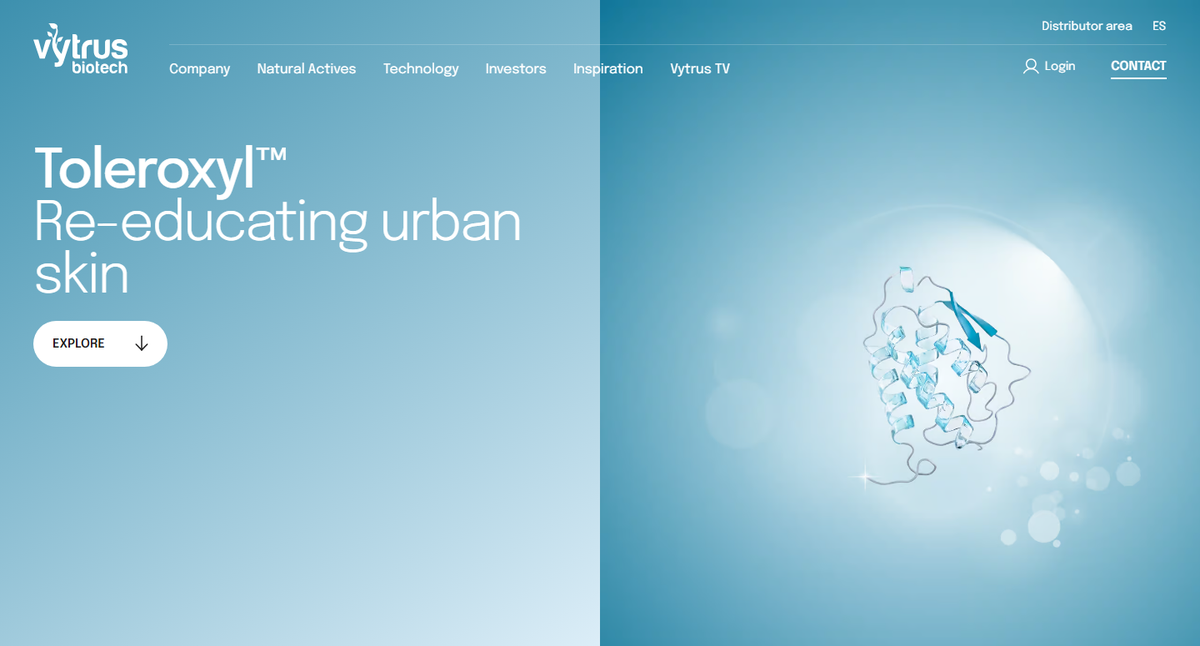
Toleroxyl™ is a biotechnological cosmetic active launched by Vytrus Biotech in July 2026 that is designed to act on Langerhans cells in the epidermis to restore immune tolerance in hyperreactive skin. Our R&D team is evaluating it as a formulation option; we have not produced with it. What makes it a manufacturing conversation rather than a marketing one is that it is described as a protein, and protein actives constrain process temperature, shear, preservation and stability testing in ways that peptide and botanical actives generally do not.
Key takeaways
- Vytrus Biotech, a Spanish plant-cell-culture actives company, launched Toleroxyl™ at in-cosmetics Korea in Seoul on 1–3 July 2026.
- The supplier describes it as a plant-derived human protein that acts at GM‑CSF receptors on Langerhans cells, holding them in a tolerance-supporting state instead of suppressing inflammation after it starts.
- ORIZI Group has not manufactured with this ingredient. We are reading publicly available supplier material and would require the full technical data sheet and safety documentation before quoting any formula containing it.
- From our production experience, the risk with a protein active is silent loss of activity: the batch passes every physical stability check while the molecule that justified the price is no longer doing anything.
- As of 24 August 2026, Vytrus has not published an INCI name, a use level, a pH window or quantified clinical results, so no brand can build a claim file from public information alone.
What actually lands on our desk
When a brand owner sends us a new active, it is almost never a technical data sheet. It is a link to a launch article, sometimes a trade-show photo, and a question that amounts to: can we put this in our serum, and how much will it cost? Toleroxyl™ arrived that way, and it is a good example of why the honest first answer is usually “not yet.”
The public story is genuinely interesting. Most sensitive-skin actives work after the fact — they calm a response that has already been triggered. Vytrus positions this one earlier in the chain, at the Langerhans cell, which is the antigen-presenting cell of the epidermis and effectively decides whether an ordinary stimulus gets treated as a threat. The company calls the resulting category a “tolerogen” and reports, in cell models, restored tolerogenic signalling (RELB, SOX4, TGF‑β), normalised immunogenic markers (CCR7, CD80, CD86) and higher barrier proteins including filaggrin, loricrin and claudin‑4, alongside a study in volunteers with hyperreactive skin reporting reduced redness and relief of stinging, itching and tightness. The full positioning is on Vytrus Biotech’s official Toleroxyl™ page, and the launch was reported by Personal Care Insights and Cosmetics Business.
Why “it is a protein” changes the whole quotation
A protein active is a different manufacturing object from a peptide or a plant extract, and the difference is structural. A peptide is short and behaves much like a small molecule — it tolerates a reasonable amount of heat and shear and it survives most standard processes. A protein is large and folded, and in a folded molecule the shape is the function. Denature it and nothing visible happens: the emulsion is still stable, the viscosity is on spec, the colour is unchanged. Only the biology is gone.
That is the specific failure mode we plan against, and it drives a different production sequence. In practice, a protein-containing formula tends to mean a cool-down addition well below the emulsification temperature, gentler mixing at the addition step, a narrower pH window, a preservative system chosen with the protein in mind rather than by habit, and a stability protocol that has to answer a harder question than “did it separate?”
| Parameter | Typical peptide active | Protein active |
|---|---|---|
| Addition point | Often flexible; commonly during cool-down | Late cool-down only, with a supplier-confirmed temperature ceiling |
| Shear tolerance | Generally robust to homogenisation | Limited; high shear after addition is avoided |
| pH sensitivity | Usually a broad working range | Narrow; must be confirmed before the base is fixed |
| Preservation | Standard system usually sufficient | Protein in water is a nutrient source; system chosen deliberately and challenge-tested |
| Stability evidence | Physical and chemical stability normally adequate | Physical stability is not enough; an activity or integrity assay is needed |
| Scale-up risk | Lab-to-production transfer usually predictable | Larger vessels hold heat longer; the pilot batch is where this is caught |
This is the same lesson we drew from a very different ingredient earlier this year. When we looked at Croda’s encapsulated Matrixyl® Neolide™, the conclusion was that an encapsulated active is a process decision rather than an ingredient decision. A protein active is the same argument with less margin for error, because a broken capsule at least leaves you with a working peptide, while a denatured protein leaves you with nothing.
The seven questions we would send Vytrus first
None of the following is published, and none of it is unusual to ask. This is the list our R&D team would send before any costing work started:
- Full INCI declaration and carrier system. It determines label copy and often constrains the base formula more than the active itself does.
- Recommended use level, and the level used in the studies. These are frequently different numbers, and only the study level supports the claim.
- Maximum addition temperature and shear guidance. The single most important number for a protein, and the one most likely to be exceeded at production scale.
- pH window and electrolyte tolerance. This decides whether the active can sit in the same formula as acids, high-electrolyte systems or certain gelling agents.
- Preservative compatibility, with challenge-test evidence. Aqueous protein systems deserve a preservation decision, not a default.
- An activity or integrity assay across shelf life. We want a method that shows the protein is still functional at month 24, not only that the cream has not separated.
- Regulatory status in our clients’ destination markets. Confirmation that the material is acceptable as a cosmetic ingredient in each target market, obtained before development spend, not after.
If those answers are complete and consistent, this becomes a normal development project. If several come back vague, that is not a reason to reject the ingredient — it usually means the launch is ahead of the dossier, which is common in the months after a trade show — but it is a reason to delay a launch calendar rather than build one.
Our position, stated plainly
Based on ORIZI Group’s manufacturing experience in skincare, our view is that ingredients like this one belong on a watchlist before they belong in a quotation. Concretely, that means: we have read the supplier’s public material; we have not received a technical data sheet; we have not run a trial batch; we have no stability data of our own; and we have no relationship with Vytrus Biotech. Anything we say about how it would behave in a formula is drawn from our experience with protein and encapsulated actives generally, not from work with this material.
What we would tell a brand owner who is excited about it is that the interesting part is also the risky part. A tolerance-training positioning supports a course of use and a regimen price, which is commercially attractive, but it also demands a durability endpoint, and durability is a much harder thing to demonstrate than immediate comfort. The formulation-side implications are the ones we set out in our note on what actually changes when a brief says “make it for sensitive skin”, and they apply here with more weight, not less.
For brands developing in this space, the relevant capability on our side is dermatology and aesthetic skincare OEM manufacturing, where reactive-skin formats, post-procedure products and clinic-channel briefs already sit. Novel actives of this type are assessed through our product R&D process and their claims supported through finished-product testing.
Risks and limitations
- No quantified data is public. The reported effects have no published effect sizes, sample sizes, durations or controls as of 24 August 2026. Treat the mechanism as a hypothesis with supportive evidence, not a proven consumer outcome.
- The material’s exact identity is not fully clear in public communications. The supplier’s English page describes a plant-derived human protein while its Spanish announcement describes the active as inspired by GM‑CSF. That distinction matters for regulatory classification and should be confirmed in writing.
- Mechanism claims are not marketing claims. Language about re-educating the immune system belongs in a technical discussion. On pack, claims must stay within cosmetic scope and be substantiated on the finished product for the market where it is sold.
- Cost is unknown to us. We have no pricing, no minimum order quantity and no lead-time information for this ingredient, and we would not estimate any of them.
Frequently asked questions
Has ORIZI Group used Toleroxyl in production?
No. We have not manufactured any product containing this ingredient and we have not run a trial batch. We are evaluating publicly available supplier information as part of our routine review of new actives.
Can we put it into an existing sensitive-skin formula?
Not without reworking the base. A protein active typically needs a confirmed maximum addition temperature, a narrower pH window and a preservation system selected around it, so it is usually a reformulation rather than a drop-in addition. The starting point is the supplier’s technical data sheet.
What would the development timeline look like?
We would not commit to one before seeing the dossier. Realistically, a novel protein active adds time at two points: an extra bench stage to establish the addition window, and a longer stability programme because physical stability alone does not demonstrate retained activity. Both are quantifiable once the supplier’s data is in hand.
Is a plant-produced protein suitable for vegan or naturals positioning?
Production in plant cells rather than animal or microbial systems is generally compatible with vegan positioning, but a naturals claim depends on the specific standard your retailer or market applies, and on the full ingredient declaration including the carrier. Confirm against the standard being used before putting it on pack.
Where can we read the technical background?
Start with the supplier’s own page, linked in the sources below. For an independent market-side view of the launch and the evidence gaps, OEMHallmark published a detailed analysis of Toleroxyl and the tolerogen category.
Sources
- Vytrus Biotech — Toleroxyl™ official product page (principal’s page; product positioning and mechanism)
- Vytrus Biotech — Plant Cell Biofactories (production platform)
- Personal Care Insights — in-cosmetics Korea 2026 launch report
- Cosmetics Business — Vytrus launches Toleroxyl™ for urban skin
Update history
24 August 2026 — first published, based on supplier material available at that date.
If you are assessing a novel active for a sensitive-skin or post-procedure product and want a manufacturing feasibility view before you commit to it, talk to our team. We will tell you what we know, what we would need from the supplier, and what we cannot promise yet.
The same first-pass discipline applies even when a supplier publishes a great deal. In September 2026 we looked at Ashland’s eternight™ biofunctional and found the decisive detail sitting in the ingredient declaration rather than the dossier — see what an INCI tells us before the data sheet does.
Toleroxyl™ changed the questions because the active was a protein. A different 2026 launch changes them because of what the supplier took out: see our first look at Gatuline® Link n Lift PF, where removing the preservative from the drum moves the preservation problem, and its cost, onto the manufacturer.