A supplier removing a preservative from a raw material does not remove the preservation problem. It moves it down the chain, to the people who receive the drum and make the batch. That is us, so we read this launch as a handling question first.
Disclosure: This article is published by ORIZI Group and may refer to our own manufacturing experience, services and capabilities. External factual claims are supported by cited sources. We have not purchased, trialled or manufactured with the ingredient discussed below — this is an evaluation of published supplier information.
Quick answer: what is Gatuline® Link n Lift PF, and what does it change for a manufacturer?
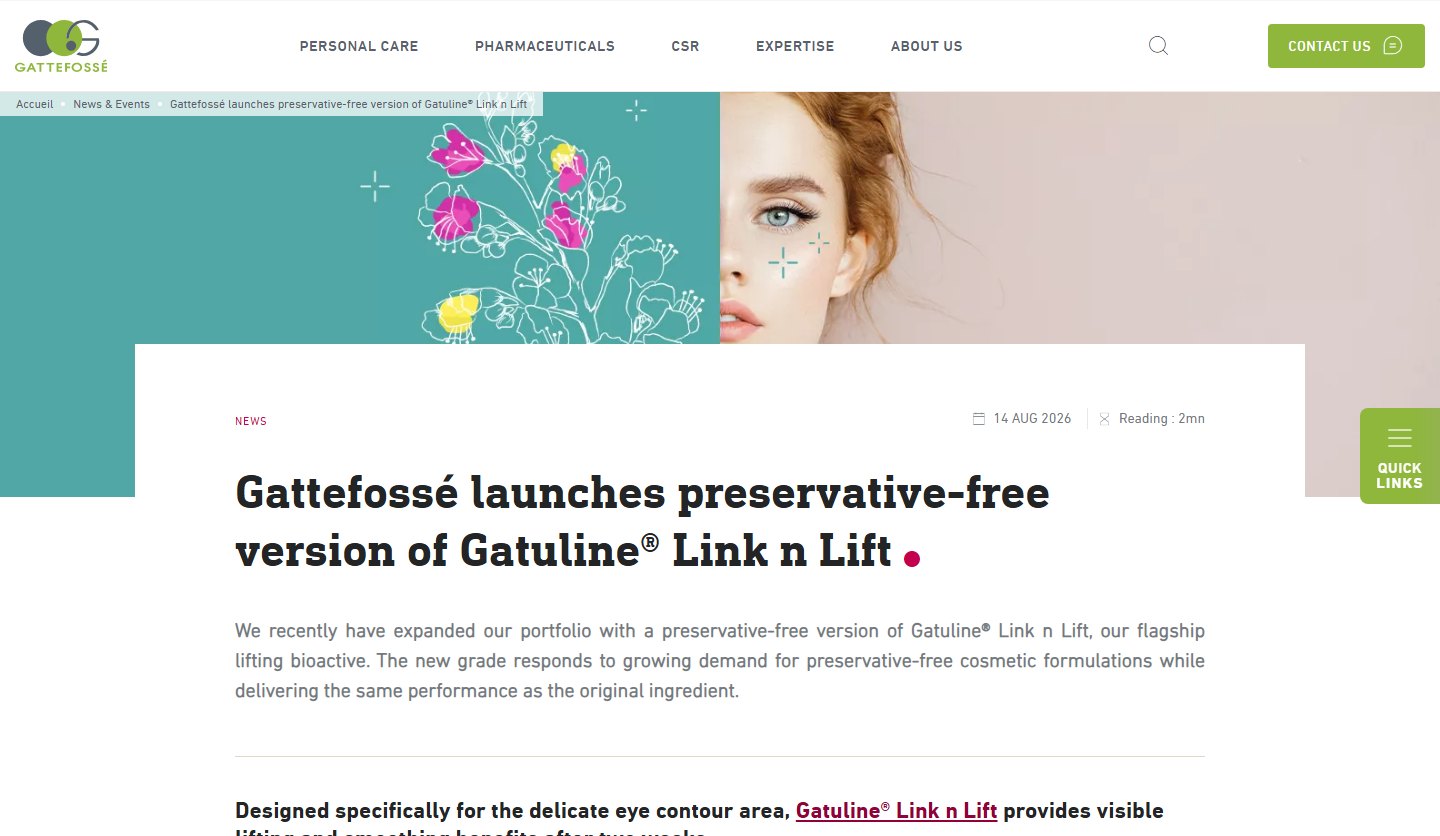
Gatuline® Link n Lift PF is the preservative-free grade of Gattefossé’s eye-contour cosmetic active, announced on 14 August 2026. For a contract manufacturer the meaningful change is not in the formula but in goods-in: a raw material supplied without a preservative generally needs tighter incoming microbiological control, a defined opened-container life and a handling rule that differs from the preserved grade. The finished product still requires its own preservation strategy, justified by risk assessment or demonstrated by challenge testing.
Key takeaways
- Gattefossé states the PF grade has the same chemical composition, technical specifications and performance as the original; only the preservative has been removed.
- The INCI is Fructose (and) Glycerin (and) Water (and) Aesculus Hippocastanum (Horse Chestnut) Extract, used at 2%.
- A preservative-free raw material is a drum specification. A preservative-free product is a finished-goods claim. They are not the same thing and they are not tested the same way.
- Most of the new work sits in warehouse and QC procedure, not in the mixing vessel.
- We are watching this ingredient, not running it. Nothing below is a trial result.
Scope: what we are and are not discussing
This article covers one specific raw material and the receiving, storage and batching decisions a contract manufacturer would make around it. It is written from ORIZI Group’s position as a Malaysian OEM manufacturer working to cosmetic Good Manufacturing Practice, and it assumes a water-based eye-contour product.
Three definitions, stated so they stand on their own:
- A cosmetic preservative is an ingredient included primarily to inhibit the growth of micro-organisms in a product. In the European Union these are controlled by a positive list in Annex V of Regulation (EC) No 1223/2009.
- A challenge test is a laboratory method in which a finished cosmetic product is deliberately inoculated with specified micro-organisms to show that it controls them over time. The reference method is ISO 11930.
- NaDES (natural deep eutectic solvents) are liquid mixtures of common plant metabolites such as sugars, polyols and organic acids that dissolve plant compounds without petrochemical solvents. A 2024 review in Gels, NaDES Application in Cosmetic and Pharmaceutical Fields (Villa et al., 2024;10(2):107), sets out their properties and limits.
What Gattefossé has published
Gattefossé is a French ingredient principal, and Gatuline® Link n Lift has been in its catalogue since 2017 as the first active it derived from the horse chestnut flower rather than the seed. The flowers are organically cultivated and hand-harvested in the Ardèche in southern France, which the company states is under 200 km from its manufacturing site, and the extract is produced using NaDES technology.
On efficacy, Gattefossé reports that the active mobilises fibroblasts and reinforces the dermal-epidermal junction by stimulating integrins, laminins, collagens and fibronectin, and that a double-blind, placebo-controlled study at 2% showed visible reduction of crow’s feet, under-eye wrinkles and tear troughs with toning within two weeks. The company states the material is COSMOS certified, 99.8% natural origin under ISO 16128, and notified with China’s National Medical Products Administration (NMPA). Gatuline® Link n Lift PF received a 2026 Ringier Technology Innovation Award in China. All of these are the supplier’s own statements, published on the launch announcement and the product page.
What is not published is equally relevant to us: no pH window, no microbiological specification for the PF grade, no stated opened-container life, and no explanation of the mechanism by which the PF grade remains stable without a preservative.
Why a preservative-free active is a goods-in question before it is a formulation question
When we read an ingredient launch, the first thing we ask is not “what will it do in the emulsion” but “what will it do to the batch record.” On that test, a preservative-free grade is unusual, because the formula barely moves and the procedures around it do.
The reason is simple. A preserved raw material is protected from the moment it is packed until the drum is empty, including the period after a technician has opened it, taken 400 g for a trial, and resealed it. Remove the preservative and that protection has to come from somewhere else: the packaging, the intrinsic properties of the material, the storage conditions, or a shorter opened-container life. Gattefossé has not said which, so a manufacturer cannot assume.
This is where a concentrated sugar-and-polyol system invites a comfortable assumption that should be resisted. A NaDES matrix plausibly has low water activity, and the Gels review notes that some NaDES compositions show antimicrobial activity. But that review does not establish NaDES as self-preserving, and a plausible mechanism is not a specification. The correct response is to ask Gattefossé for the microbiological spec and the opened-container life in writing, and to treat the material conservatively until it arrives.
Note also what the PF grade does not do. At 2%, the other 98% of an aqueous eye cream is unchanged and still needs preserving. That decision does not disappear; it simply stops being partly inherited from a raw material and becomes entirely the formulator’s. Whether the finished product then qualifies as microbiologically low-risk is a separate judgement under ISO 29621, and for a water-based cream carrying added carbohydrate it is not an easy one to argue.
Five checks we would add before this active entered a batch
- Get the microbiological specification in writing. Total viable count and specified organism limits for the PF grade, plus the test method. Without it there is no acceptance criterion at goods-in.
- Get the opened-container life and put it on the label. A drum that has been opened once has a different status from a sealed one. If the supplier gives a figure, the warehouse needs it printed on the container, not filed in a folder.
- Decide the sampling rule before the first delivery. Whether incoming micro testing is per-lot or periodic is a risk decision, and it is cheaper to make it once at qualification than repeatedly under time pressure.
- Design the finished-product preservation independently. Then run ISO 11930 challenge testing on the final formula in its final packaging, not on the base.
- Put colour and odour on the stability protocol and read them at three months. Fructose is a reducing sugar and the formula will also contain a polyol; browning chemistry is a known possibility with amine-bearing ingredients at elevated temperature. We would verify on the actual formula rather than assume it either way.
What it does to a quotation
Brand owners usually expect “preservative-free” to reduce a quotation, because it sounds like a subtraction. In our experience it is normally an addition, and the additions land in predictable places.
| Line item | Preserved grade | Preservative-free grade |
|---|---|---|
| Incoming QC | Standard identity and appearance checks | Identity plus a microbiological acceptance criterion, at least at qualification |
| Warehouse handling | Normal opened-container practice | Defined opened-container life; tighter storage conditions possible |
| Formulation work | Preservation partly inherited | Preservation designed from zero for the whole formula |
| Microbiological testing | Routine challenge test | Challenge test plus likely repeat work if the first system fails |
| Packaging | Open jar acceptable in many cases | Airless or single-dose often needed to protect the product in use |
| Period after opening | Conventional | Shorter, or more carefully substantiated |
| Eye-area safety | Ophthalmological testing as standard | Unchanged, but must be budgeted, not assumed |
None of these is a reason to avoid a preservative-free grade. They are the reason to price it honestly at the brief stage rather than discovering it at pilot. For brands weighing this against other routes, our OEM eye care product manufacturing page sets out the formats we work in, and our anti-ageing treatment manufacturing page covers the adjacent categories where a DEJ-targeting active would usually sit.
The ORIZI perspective
Based on ORIZI Group’s manufacturing experience, the raw material that causes a deviation is rarely the one with the complicated data sheet. It is the one whose handling rules changed quietly between grades, while the purchase order, the goods-in checklist and the batch record were all copied forward from the previous version. A second grade of a familiar ingredient is exactly the shape of change that slips through, because everyone on the floor already “knows” the material.
That is the specific risk we see in this launch, and it is a procedural risk rather than a chemical one. Our practice when a supplier introduces a new grade of an existing material is to treat it as a new raw material code with its own qualification, not as a substitution under the old code. It is administratively annoying and it is much cheaper than a contaminated pilot batch.
The limitation on all of this is important: we have not bought Gatuline® Link n Lift PF, have not seen its technical data sheet, and have not made anything with it. What is written above is how we would approach it, based on the supplier’s published information and our general practice with preservative-free raw materials. It is not a trial report and there are no results to share.
Risks, limitations and common mistakes
- Assuming the claim transfers. The most common mistake is a brief that says “preservative-free” because one raw material is. The claim belongs to the finished product and has to be earned there.
- Assuming the sugar preserves it. Plausible is not specified. Ask for the number.
- Dropping below 2%. The published clinical work is tied to 2%. Reducing the level to protect a cost target quietly detaches the product from the dossier the claim rests on.
- Forgetting the carrier. 2% of a fructose and glycerin system adds humectant to a formula whose sensory balance was already set. Rebalance rather than add on top.
- Leaving packaging until last. If the preservation strategy depends on protecting the product in use, the pack is part of the safety case, not a later marketing decision.
- Market scope. The regulatory references above are European. Malaysian cosmetic notification requirements through the National Pharmaceutical Regulatory Agency (NPRA) are separate and should be confirmed for the target market.
Frequently asked questions
Can we label our product preservative-free if we use this active?
Not on that basis alone. A preservative-free claim describes the finished product, so it requires that the product contains no ingredient acting as a preservative and that its safety assessment still demonstrates microbiological control for the shelf life and period after opening. Using a preservative-free grade of one active removes an inherited preservative from the ingredient list; the rest of the formula still has to be dealt with.
Is the preservative-free grade less effective?
Gattefossé states it is not, describing the PF grade as having the same chemical composition and technical specifications as the original with equivalent performance in formulations. That is the supplier’s position and we have no independent data either way. If efficacy equivalence matters to your claim, ask whether it is supported by comparative testing or by compositional identity.
Does a preservative-free raw material shorten our development time?
Usually the opposite. Removing an inherited preservative can simplify a label screen, but it adds qualification work at goods-in and shifts the whole preservation design onto the finished formula, which is where the challenge testing and any repeat testing happen. Plan for a longer microbiological path, not a shorter one.
What should we ask the supplier before specifying it?
Four things, in writing: the microbiological specification for the PF grade, the recommended opened-container life, the pH window and known incompatibilities, and the full efficacy dossier including subject numbers and effect sizes. The first two determine whether your warehouse can handle the material; the last two determine whether your formula and your claim can.
Is this suitable for a Malaysian-manufactured eye product?
There is no obvious barrier in the published information, but suitability depends on your target markets and your own testing plan rather than on the ingredient alone. Cosmetic products manufactured in Malaysia require notification with the NPRA, and any claim made on the pack must be substantiated for the markets where it is sold. The practical route is a feasibility review of the formula, the pack and the claim together.
Are you formulating with it?
No. We are evaluating it as part of our routine review of new actives, which is why this article contains questions rather than results. If we do trial it, we will say so and describe what we found, including anything that did not work.
Sources and references
- Gattefossé, Gattefossé launches preservative-free version of Gatuline® Link n Lift, 14 August 2026 — the principal’s official launch announcement.
- Gattefossé, Gatuline® Link n Lift product page — INCI, 2% use level, mechanism, clinical design, COSMOS and ISO 16128 status, NMPA notification.
- European Union, Regulation (EC) No 1223/2009 on cosmetic products — safety assessment and the Annex V preservatives list.
- ISO, ISO 11930:2019 (challenge testing) and ISO 29621:2010 (microbiological risk assessment).
- Villa C, Caviglia D, Robustelli della Cuna FS, Zuccari G, Russo E. NaDES Application in Cosmetic and Pharmaceutical Fields: An Overview. Gels 2024;10(2):107.
- Malaysia, National Pharmaceutical Regulatory Agency (NPRA) — cosmetic notification requirements.
- Trade coverage: Premium Beauty News and Personal Care Insights.
This is the fourth entry in our running review of 2026 actives. Earlier ones looked at what an INCI tells us before the data sheet arrives, why a protein active changes every question we ask, and encapsulated peptides as a process decision. A market-level analysis of this same launch, written independently of us, is available at OEMHallmark.
Update history
20 September 2026 — first published, based on Gattefossé’s published information as of that date.
If you are planning an eye product
If a preservative-free eye treatment is on your roadmap, the useful next step is a feasibility review that looks at the formula, the packaging and the claim together, because with this category they are one decision rather than three. You can send us a project brief and we will tell you honestly where the testing cost sits before anything is formulated.