Quick answer
Switzerland has a genuine but small cosmetic contract-manufacturing sector, concentrated in Vaud, Bern, Zürich, Valais and St. Gallen, with roughly sixty manufacturers represented by the national industry association. Ten companies with verified live operations are profiled below. Switzerland competes on formulation depth, small-batch flexibility and the legally protected “Swiss Made” indication of source — not on unit price. Brands sourcing for price, halal-certified supply or ASEAN market access will generally find better economics in Southeast Asia.
Key takeaways
- Switzerland is a premium-positioning sourcing decision, not a cost-reduction one.
- The “Swiss Made” claim for cosmetics is legally defined by cost thresholds and by where the quality-determining manufacturing steps happen — assembly alone does not qualify.
- Switzerland sits outside the EU but adopts the EU ingredient annexes by dynamic reference; there is no CPNP-equivalent pre-market notification.
- Stated batch capacities across the ten range from around 100 units for a private-label programme to 15,000 kg per production batch.
- Halal certification infrastructure is minimal in Switzerland, which is a material constraint for brands targeting Muslim-majority markets.
Table of Contents
- Why the Swiss market matters to brand owners
- What the “Swiss Made” claim legally requires
- How Switzerland regulates cosmetic products
- Ten Swiss cosmetic manufacturers
- What to compare when evaluating any manufacturer
- Looking beyond Switzerland for a manufacturing partner?
Why the Swiss market matters to brand owners
Switzerland is not a large cosmetics producer by volume, but it holds a disproportionate share of the premium tier. The Swiss Cosmetic and Detergent Association represents around sixty manufacturers that it estimates account for roughly ninety per cent of the national industry and about CHF 2 billion in annual export turnover. A meaningful part of that capacity is third-party work: laboratories that formulate, fill and pack under another company’s brand.
For a brand owner, the appeal is specific rather than general. Swiss contract manufacturers tend to be small to mid-size, formulation-led, and comfortable with batch sizes that a large multinational contract manufacturer would decline. Several of the companies below have been formulating on the same site for fifty to a hundred years. That continuity produces a kind of technical depth that is hard to buy quickly elsewhere — particularly in emulsion stability, active delivery and sensorial finish.
The cost position is the counterweight and should be faced directly. Swiss labour, energy, packaging and compliance overheads sit at the top of the European range, and the franc has been persistently strong. A product competing on price in a crowded category will not survive a Swiss cost base. The brands for whom this sourcing decision works are those selling at a premium where country of origin is part of what the customer is paying for.
What the “Swiss Made” claim legally requires
The Swiss indication of source is regulated, not conventional. Under the Swissness framework administered by the Swiss Federal Institute of Intellectual Property, and in force since January 2017, a cosmetic product may carry a Swiss indication of source only if at least sixty per cent of manufacturing costs and at least eighty per cent of research, development and production costs arise in Switzerland — and if the activities that particularly determine the product’s quality take place there.
The practical implication for brand owners is that manufacturing location and marketing claim are not automatically the same thing. Filling imported bulk into packaging in Switzerland does not earn the claim. Any brand paying a Swiss premium specifically to make the claim should obtain written confirmation from the manufacturer, before development begins, that the intended formulation and packaging plan clears the thresholds. A manufacturer that answers that question precisely is also demonstrating something about the quality of its wider documentation.
How Switzerland regulates cosmetic products
Switzerland is not a member of the European Union or the EEA, so its cosmetics framework is national. Cosmetic products fall under the Federal Act on Foodstuffs and Utility Articles and, specifically, the FDHA Ordinance on Cosmetic Products (VKos) of 16 December 2016. The Federal Food Safety and Veterinary Office (FSVO) carries federal responsibility, while day-to-day market surveillance is performed by the cantonal laboratories, which sample and inspect products already on sale.
Three features distinguish the Swiss system from the EU one. There is no pre-market notification portal equivalent to the CPNP; Switzerland operates a self-monitoring model in which the burden falls on the manufacturer’s documentation rather than on a submission. A full product information file and safety assessment remain mandatory. And the responsible person for the Swiss market must be a natural person reachable by Swiss authorities — a role that cannot be delegated to a representative established abroad, including an EU responsible person.
On ingredients, Swiss law adopts the annexes of EU Regulation (EC) No 1223/2009 by dynamic reference, so prohibited and restricted substance lists track EU changes automatically. The FDHA amended VKos with effect from 1 January 2026 to tighten limits on certain furocoumarins. Brand owners exporting Swiss-made product into ASEAN markets should note that the ASEAN Cosmetic Directive annexes overlap heavily with the EU lists but are not identical — a screening step worth completing before formulation is locked, not after.
Ten Swiss cosmetic manufacturers
Listed alphabetically. Each company’s website was reviewed on 4 September 2026 and details are as published by the companies themselves. This is a market overview, not a ranking or an endorsement.
alpinacos AG
A full-service contract manufacturer headquartered in Kägiswil, Obwalden, with production in Büron, Lucerne. It covers recipe development, production, filling, labelling, assembly and dispatch for natural and functional care products. Website: alpinacos.ch
Cosmetolab SA
A Wädenswil laboratory operating since 1949, working with a stated library of more than 250 natural active ingredients across formulation, production, packaging, quality control and logistics, with vegan and cruelty-free positioning. Website: cosmetolab.ch
Cosmotec
Based in Vouvry, Valais and operating since 1988, Cosmotec cites ISO 22716 GMP certification and specialises in face and body care formulated with Alpine spring water, offering private label, custom formulation, R&D and regulatory assistance. Website: cosmotec.ch
Frike Group
A Mönchaltorf contract manufacturer and filler with unusually broad format capability — aerosols as foams, sprays and gels alongside creams, emulsions, oils, powders and serums, in containers from 50 ml to 3 litres. It publishes ISO 9001, ISO 22716, COSMOS and EcoCert certification. Website: frike-group.com
Intercosmetica Neuchâtel SA
A Neuchâtel skincare OEM and full-service ODM stating more than sixty years in the industry, holding ISO 22716:2007 and ISO 9001:2015, and operating as part of the Zepter International group. Website: intercosmetica.ch
M. Opitz & Co. AG
A third-generation family company in St. Gallen, founded in 1965, developing, producing and filling both cosmetic and pharmaceutical products and stating ISO 9001, ISO 22716 and Swissmedic pharmaceutical GMP. Website: m-opitz.ch
MySwissLab+
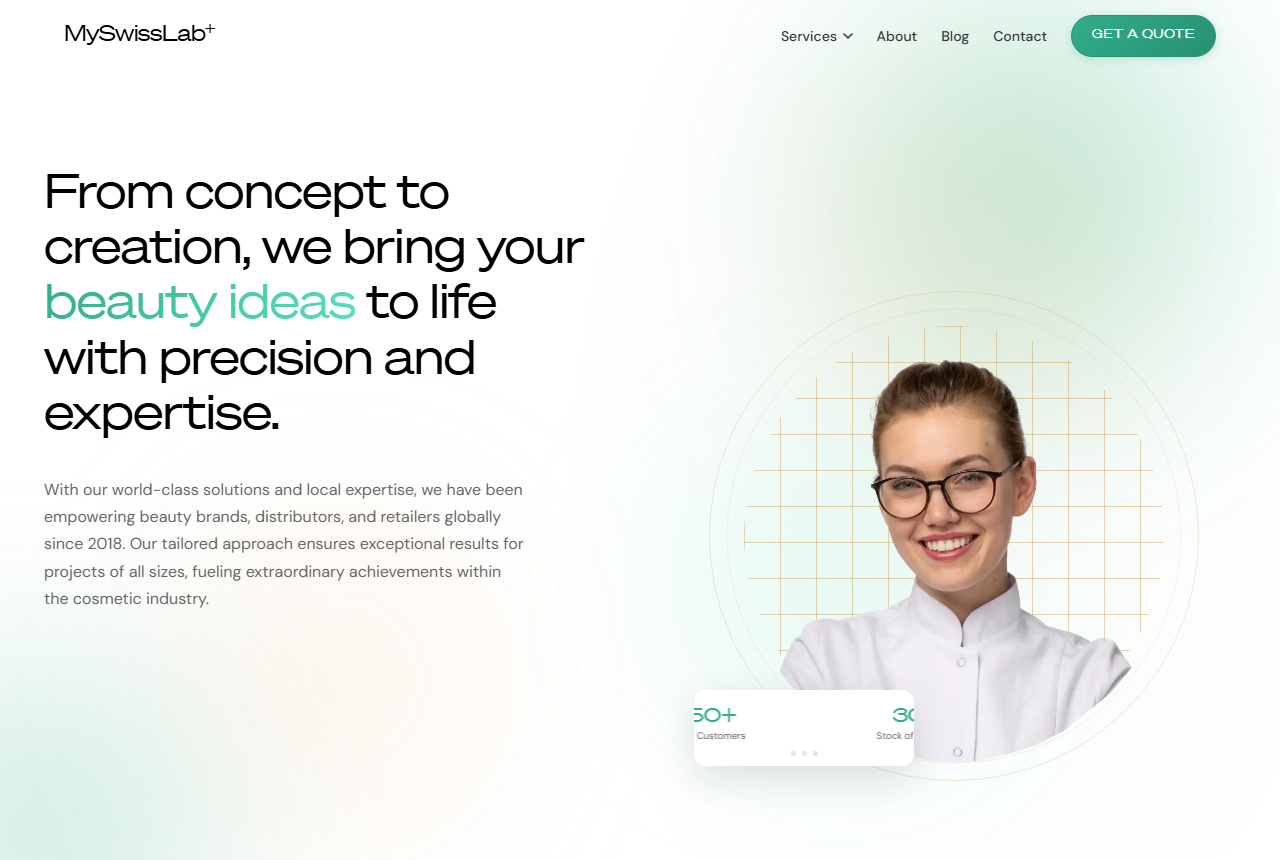
A Forel-based private label, white label and custom formulation house stating ISO 9001:2015 accreditation and ISO 22716 cGMP adherence, with a published private-label starting point around 100 units and in-house microbiology, stability and safety-report capability. Website: myswisslab.com
Swiss Cosmetic Technology (SCT)
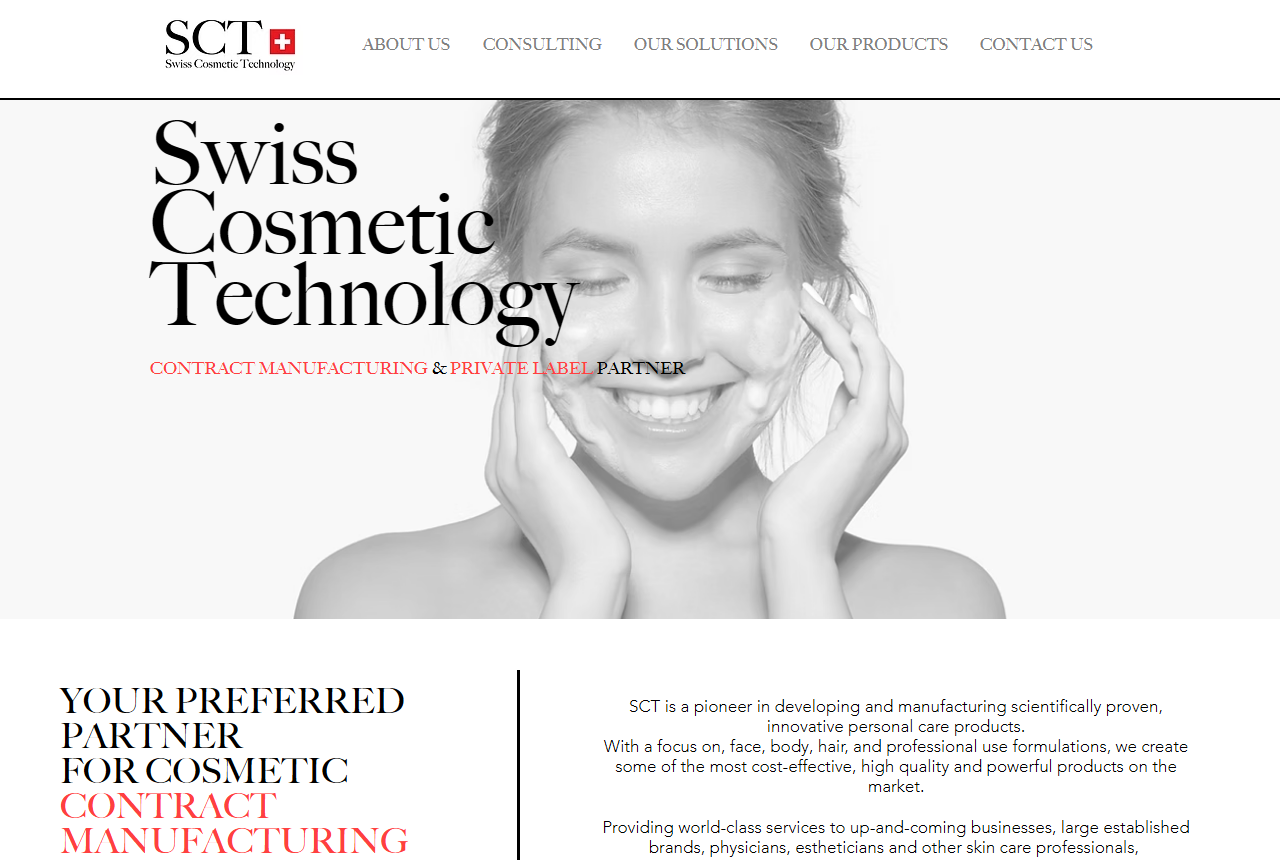
A St-Prex contract manufacturer stating over thirty years in the industry with pharmacists and physicians on staff, producing serums, creams, gels, oils, lotions, soaps and shampoos for consumer and professional-use channels. Website: swisscostec.com
Swiss VitalCare GmbH
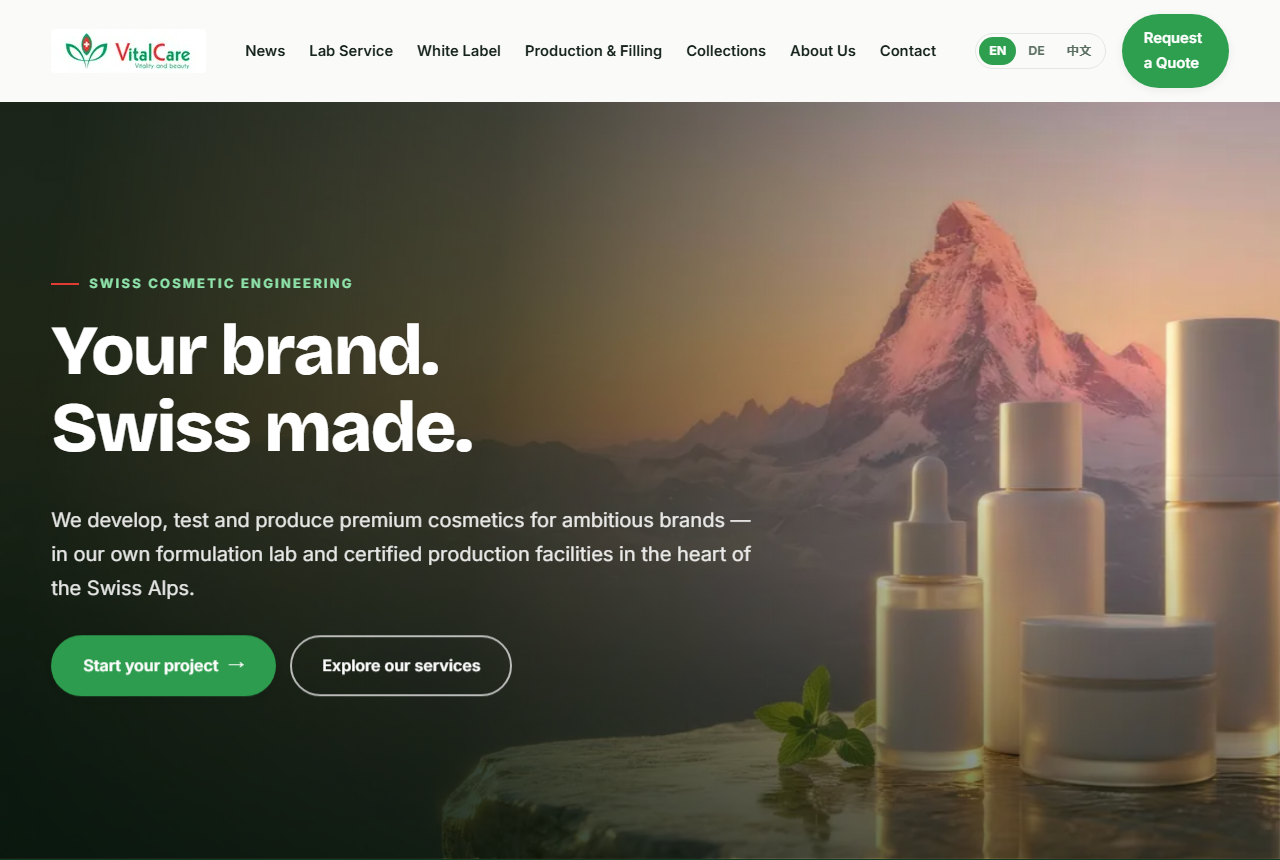
A Heimberg formulation laboratory and OEM/ODM manufacturer stating over twenty years of operation, ISO 22716 cGMP, SQS ISO 9001:2015, COSMOS Organic/BDIH and cruelty-free certification, with batch capacity given as 100 kg to 15,000 kg and twelve licensable ready-to-launch collections. Website: swiss-vitalcare.com
Temmentec AG
A Sumiswald OEM/ODM manufacturer of skin care cosmetics on a site in operation since 1916, offering development, manufacturing, packaging, quality assurance and logistics either bundled or as individual steps, with an EcoVadis Bronze rating from 2023. Website: temmentec.ch
What to compare when evaluating any manufacturer
The criteria that separate contract manufacturers are broadly the same whether the factory is in Bern or in Perak. Four are worth applying consistently.
Certification scope, not just certification. An ISO 22716 certificate covers a defined scope of products and processes at a named site. A manufacturer certified for emulsions is not automatically certified for the aerosol line in the next building. Ask for the certificate itself, check the scope statement and the expiry date, and confirm which site it covers.
The binding minimum, line by line. A headline minimum order quantity almost never applies uniformly. Bulk may be flexible while decorated bottles, printed cartons and custom closures carry independent minimums, often an order of magnitude higher. Request a minimum against every line of the bill of materials before modelling your first order.
Formula and dossier ownership. A house formula adapted for a client is usually not transferable. If the ability to move production later matters, settle ownership of both the formulation and the product information file in writing before development starts, along with what happens to the dossier if the relationship ends.
Regulatory fit for the destination market, not the origin market. A formulation that is fully compliant where it is made may still fail in the market where it is sold, because ingredient annexes and permitted claims differ between the EU, ASEAN, the United States and the Gulf. That screening belongs at the formulation stage; discovering it at notification is expensive.
For a contrasting non-EU base where halal certification is well established, see our overview of cosmetic OEM/ODM suppliers in South Africa.
Looking Beyond Switzerland for a Manufacturing Partner?
Swiss manufacturing suits a particular profile: premium price point, small volumes, origin as part of the proposition. For brands whose priorities are different — competitive unit economics, halal certification, ASEAN market access, or a manufacturing partner in the same time zone as their team — Southeast Asia is generally the stronger base, and that is where ORIZI Group operates.
ORIZI Group is a Malaysia-based OEM and ODM manufacturer of cosmetics, skincare and personal care products, operating to ISO 22716 cosmetics GMP and holding halal certification. For brand owners, that combination addresses the two constraints Swiss sourcing does not: a cost base built for regional and export volume, and halal supply that is credible in Muslim-majority markets rather than difficult to arrange after the fact. Our OEM cosmetics manufacturing service covers production from an existing or newly developed formulation, while private label and ODM gives brands access to developed formulations they can bring to market under their own name without funding a full development cycle.
Regulatory work is the part most brands underestimate, in Switzerland or anywhere else. Our regulatory affairs consulting team handles product notification, ingredient screening against the applicable annexes, and labelling review, so that compliance is designed into the formulation rather than discovered at submission. If you are weighing a European contract manufacturer against a regional one and want the comparison done on landed cost and market access rather than on unit price alone, contact our team and we will work through the specifics of your product with you.
Conclusion
Switzerland offers a small, technically deep contract-manufacturing sector with a genuinely valuable and legally protected origin claim attached to it. For premium brands with the margin to absorb the cost base and the patience for a longer supply chain, the ten companies profiled here are a credible starting shortlist. For everyone else, the honest conclusion is that the same product can usually be made to the same standard, closer to the market it is sold in, for materially less — and that the right question is not which country sounds best on a carton, but which manufacturing base fits the product, the price point and the markets the brand actually intends to enter.
Sources: the ten manufacturers’ published websites (reviewed 4 September 2026); the FDHA Ordinance on Cosmetic Products (VKos); the Swiss Cosmetic and Detergent Association; the Swiss Federal Institute of Intellectual Property Swiss Made ordinance for cosmetics; EU Regulation (EC) No 1223/2009. Limitations: this is desk research based on companies’ own published material. No factory was audited, no quality system was inspected and no samples were produced. Certifications, capacities and service scopes change — verify current documents directly with any manufacturer before contracting. Regulatory summaries are general information and not legal advice.