Quick answer
South Africa has Africa’s most developed cosmetic contract-manufacturing sector, concentrated in Gauteng with further capacity in Durban, the Western Cape and the North West. The ten suppliers profiled below range from 5 kg pilot-batch laboratories to ISO 22716-certified plants approved by national retail chains. Cosmetics are governed by the Foodstuffs, Cosmetics and Disinfectants Act 54 of 1972 with no pre-market registration, so industry standards from the CTFA and SABS carry most of the compliance load. South Africa suits brands selling into Africa and the Gulf, or needing textured-hair, depilatory or high-UV sun-care expertise.
Key takeaways
- South Africa’s contract base covers a wider size range than most: published minimums start around 5 kg of bulk, while the largest plants supply national pharmacy and supermarket chains.
- There is no pre-market cosmetic registration in South Africa. The draft cosmetics regulations first published in 2016 remain unfinalised as far as we could establish, so manufacturer documentation matters more than a government filing.
- Sunscreen performance and labelling follow a dedicated national standard, SANS 1557, and prepackaged quantities are governed by trade-metrology rules.
- South Africa has halal certifiers recognised by Malaysia’s JAKIM, but only a minority of contract labs publicly claim halal-certified production.
- A product compliant in South Africa still needs screening and notification in each destination market, including ASEAN, the EU and the Gulf.
Table of Contents
- Why the South African market matters to brand owners
- How South Africa regulates cosmetic products
- Halal certification in South Africa
- Ten South African cosmetic OEM/ODM suppliers
- What to compare when evaluating any manufacturer
- Looking beyond South Africa for a manufacturing partner?
- Frequently asked questions
Why the South African market matters to brand owners
South Africa is the largest and most industrialised cosmetics market in sub-Saharan Africa, and it acts as a regional hub for neighbouring markets in the Southern African Development Community. Behind the pharmacy chains and supermarket own-labels is an established layer of contract manufacturers that formulate, fill and pack for other companies’ brands. Most of them sit in the industrial districts east and north of Johannesburg and around Pretoria.
What makes the sector distinctive is its category depth. South African manufacturers have spent decades serving consumers with textured hair and intense UV exposure. As a result, relaxers, curl-care products, depilatory creams, waxes and high-SPF sun care are core competencies, not specialist add-ons. A second strength is documentation. Larger suppliers routinely meet the technical and ethical-audit requirements of national retail chains, and most work in English.
The constraints are equally clear. South Africa is a long way from Asian and European consumer markets. Its currency is volatile, and the domestic regulatory framework is lighter than the EU’s or ASEAN’s. For a brand selling mainly in Southeast Asia, those factors usually outweigh the category advantages. For a brand building distribution in Africa or the Middle East, they may not.
How South Africa regulates cosmetic products
The Foodstuffs, Cosmetics and Disinfectants Act 54 of 1972 is the governing law. It gives the Minister of Health power to make cosmetics regulations and places oversight with the National Department of Health. Unlike the EU, which requires a CPNP notification, or ASEAN member states, which require national product notification, South Africa has no pre-market registration for cosmetics. Draft Regulations Relating to the Labelling, Advertising and Composition of Cosmetics were published for comment in 2016 and revised in 2017. As far as we could establish, they had not been finalised by September 2026.
The gap is filled largely by industry self-regulation. The Cosmetic, Toiletry & Fragrance Association of South Africa (CTFA) maintains a Cosmetic Compendium for its members, modelled substantially on the EU’s Regulation (EC) No 1223/2009 and its ingredient annexes. Advertising claims fall under a Cosmetic Advertising Code of Practice administered by the Advertising Regulatory Board. Sunscreens must meet SANS 1557, the national standard for sunscreen testing, labelling and permitted UV filters. Declared pack quantities are enforced under legal metrology by the National Regulator for Compulsory Specifications. A product that makes medicinal claims can move outside the cosmetics framework altogether, into medicines regulation under SAHPRA.
For a brand owner, the consequence is straightforward. A South African compliance position is a sound technical starting point, but it is not an export file. The product information file, safety assessment and GMP evidence still have to be assembled to the standard of each destination market.
Halal certification in South Africa
South Africa has a mature halal certification system. The South African National Halaal Authority (SANHA) states that it has been recognised by JAKIM since its inception, and lists recognition from authorities in Singapore, Indonesia, the Gulf states and Turkey. The Muslim Judicial Council Halaal Trust and the National Independent Halaal Trust also hold international recognitions, including from JAKIM.
Certifier recognition does not make every South African factory halal-capable. Halal certification is issued per facility and per product. Among the ten suppliers profiled below, only one publicly describes its facility as halal-certified. Brands that need halal supply should confirm the certifying body, the certificate scope and its current recognition status in each target market before development begins.
Ten South African cosmetic OEM/ODM suppliers
Listed alphabetically. Each company’s website was reviewed on 11 September 2026, and details are as published by the companies themselves. This is a market overview, not a ranking.
Alchem Labs
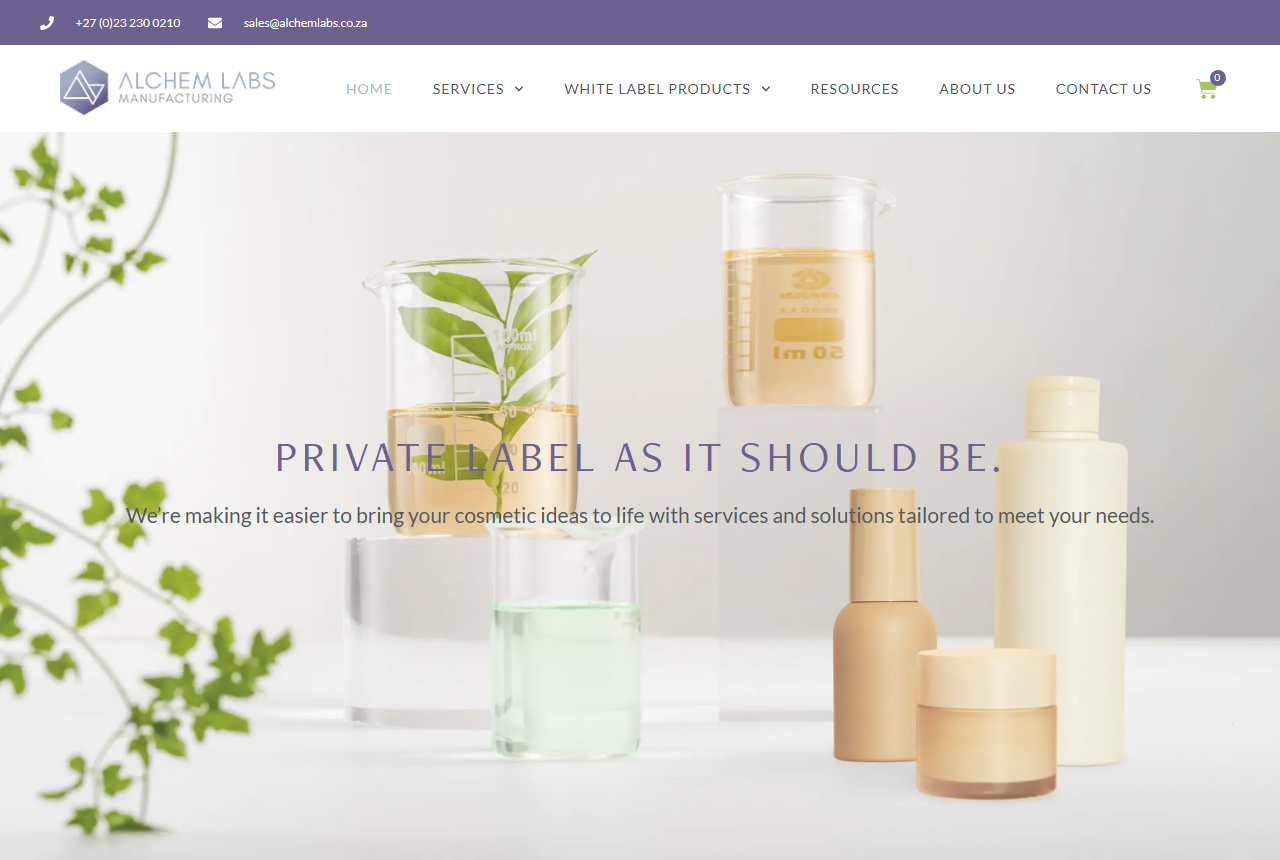
A Western Cape manufacturer in Tulbagh offering contract manufacturing, white label, formulation, filling and labelling. It publishes production runs of 5 kg to 250 kg and describes its facility as halal-certified. Website: alchemlabs.co.za
Brunational
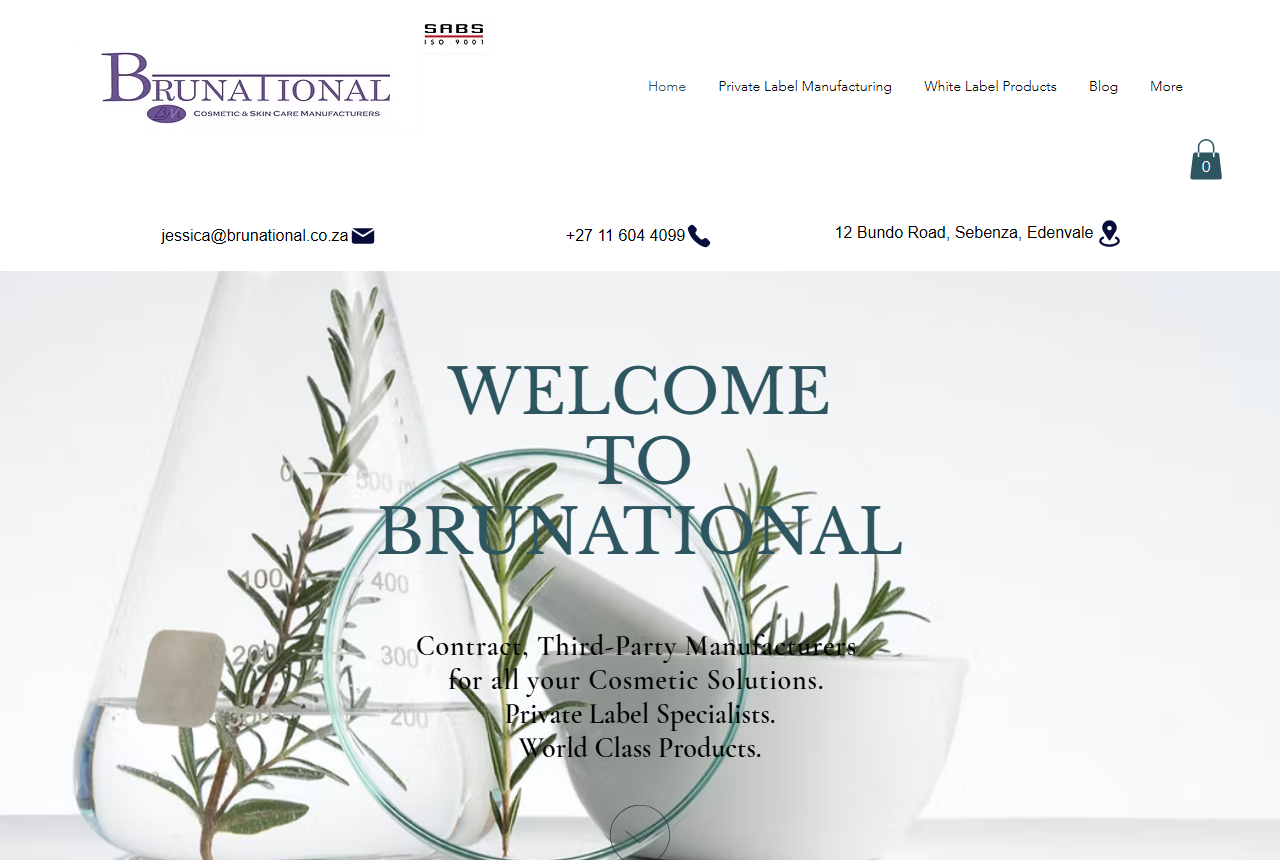
A contract and private-label manufacturer in Sebenza, Edenvale, with more than 20 years in cosmetic manufacture and SABS and ISO 9001 approval. It offers skin, hair and bath products with in-house filling, labelling, cartoning and barcoding. Website: brunational-manufacturing.co.za
Customised Cosmetics
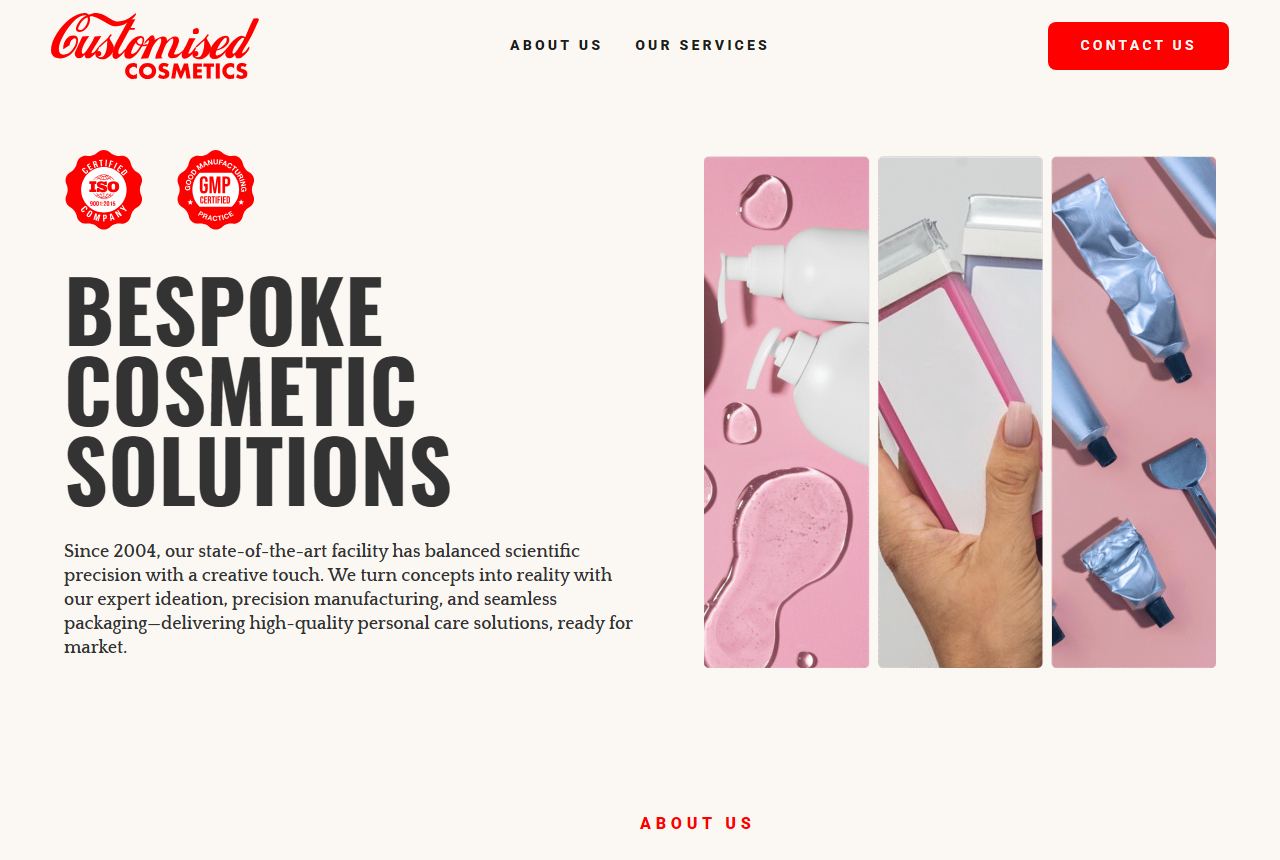
Operating since 2004 from a stated 2,000 m² Edenvale facility, with ISO 9001:2015 and GMP marks. It specialises in depilatories, waxes, ethnic hair care and skincare, and quotes capacity of up to 50 tonnes a month per product. Website: customisedcosmetics.co.za
DC Laboratories
A family-owned boutique manufacturer in Wallmansthal, Pretoria, covering skin, body, hair care and perfumery. It states that it follows ISO 22716 GMP guidelines and produces more than 72,000 units a month. Website: dclabs.co.za
Emulcfy
A Roodepoort skincare, body-care and hair-care manufacturer offering private label, white label and custom formulation through to filling and labelling. It states ISO 9001:2015 and ISO 22716 certification. Website: emulcfy.com
Lee-Chem Laboratories
A Durban personal-care manufacturer founded in 1962, focused on skin care, hair removal and grooming. It offers contract, private-label and white-label production and states ISO 22716 compliance and CTFA membership. Website: leechem.co.za
Prime Product Manufacturing
An independent cosmetics contract manufacturer and packer at the NECSA Eco-Industrial Estate in Pelindaba. It makes liquids, creams, powders, hot-fill products, lip balms and perfumes, and states ISO 22716 GMP and SANS 1841 compliance. Website: primeproductmanufacturing.com
Proficos
Founded in 1991 in Sebenza, Edenvale, and now operating from a stated 4,124 m² site with clean-room technology. It offers colour cosmetics, cosmeceuticals, sun care and fine fragrance, with in-house colour matching and a vegan-certified plant. Website: proficos.co.za
SDK Laboratories
A turnkey contract manufacturer running a 30,000 sq ft facility in Midrand. It covers skincare, hair, fragrance, colour cosmetics, children’s and intimate-care products, and states ISO 22716 accreditation plus a SAHPRA medical-device certification. Website: sdklaboratories.co.za
Serendipity Toiletries
A Pretoria contract manufacturer and packer of bath, body, sun and anti-ageing products, naming major South African retailers among its approved-supplier relationships. It lists ISO 22716:2007, a SMETA 2-Pillar audit and SANS 1841 certification. Website: serendipitytoiletries.co.za
What to compare when evaluating any manufacturer
The questions that separate a sound contract manufacturer from a risky one are the same in Gauteng as anywhere else. The table below sets out the checks we would apply to any shortlist, and what a satisfactory answer looks like.
| Check | What to ask for | Why it matters |
|---|---|---|
| GMP evidence | The ISO 22716 certificate, issuing body, site, scope and expiry | “Follows GMP guidelines” and ISO 9001 are not the same as certified cosmetics GMP |
| Destination-market fit | Written confirmation of every ingredient against the destination market’s annexes | EU-style and ASEAN lists overlap but differ, especially for preservatives, UV filters and colourants |
| Minimum order | A minimum for every component, not only the bulk | Printed cartons and decorated packs often carry the binding minimum |
| Ownership | Formula and product-file ownership terms in writing | House formulas and dossiers are often not transferable if you change supplier |
| Halal status | Certifier name, certificate scope and recognition in your target market | Halal certification is issued per facility and product, not per country |
The same approach runs through our overview of Swiss cosmetic factories, which makes a useful contrast: a premium, small-batch European base with no halal infrastructure to speak of.
Looking Beyond South Africa for a Manufacturing Partner?
South African manufacturing fits a particular brief: distribution in Africa or the Gulf, or a product that depends on South Africa’s strengths in textured hair care, depilatories and high-UV sun care. For brands whose main markets are in Southeast Asia, or who need halal-certified supply without arranging it factory by factory, a regional manufacturer is usually the more practical base. That is where ORIZI Group operates.
ORIZI Group is a Malaysia-based OEM and ODM manufacturer of cosmetics, skincare and personal care products, operating to ISO 22716 cosmetics GMP and holding halal certification. Our OEM cosmetics manufacturing service produces from an existing or newly developed formulation. Our private label and ODM route gives brands access to developed formulations they can launch under their own name.
From our own project work, the step brands most often leave too late when sourcing abroad is destination-market screening. A formula approved in its country of manufacture reaches notification in another market and fails on a single preservative limit or UV filter, and the redesign costs more time than the original development. Our regulatory affairs consulting team screens ingredients against the applicable annexes and prepares notifications and label reviews, so compliance is built into the formula from the start. This observation comes from our own client projects, not a market survey, and the right sequence varies by product and market. To compare a South African supplier with a regional one on landed cost and market access, contact our team and we will work through your product with you.
Frequently asked questions
Do cosmetics need to be registered in South Africa before sale?
No. South Africa has no pre-market registration or notification for cosmetics. Products are governed by the Foodstuffs, Cosmetics and Disinfectants Act 54 of 1972 under the National Department of Health. Industry follows the CTFA’s Cosmetic Compendium, SANS standards and the Cosmetic Advertising Code of Practice while the draft cosmetics regulations remain unfinalised. Products making medicinal claims may fall under SAHPRA instead.
Are South African halal certificates recognised in Malaysia?
Certificates from JAKIM-recognised foreign bodies, including SANHA, can support a halal claim on products sold in Malaysia. The certificate must cover the specific product and the facility that makes it, and recognition should be checked against JAKIM’s current list before import. A foreign certificate does not authorise use of the Malaysian JAKIM halal logo.
What is the smallest batch a South African contract manufacturer will make?
Some small laboratories publish minimums of around 4–5 kg of bulk, enough for roughly 100 jars of 50 ml. Larger plants serving national retailers work at much higher volumes and rarely publish minimums. Packaging components usually carry their own minimums, often in the thousands, so confirm the minimum for every item on the bill of materials.
How are sunscreens regulated in South Africa?
Sunscreens are cosmetics under the Foodstuffs, Cosmetics and Disinfectants Act, but their SPF testing, labelling and permitted UV filters follow the national standard SANS 1557. Brands exporting a South African sunscreen must also check the UV filters and claims against the rules of each destination market, such as the ASEAN Cosmetic Directive.
Conclusion
South Africa offers a capable, English-speaking contract-manufacturing sector with genuine depth in categories other bases treat as niche, and a halal certification system with international standing. For brands building distribution across Africa and the Middle East, the ten suppliers profiled here are a credible starting shortlist. For brands whose customers are mainly in Southeast Asia, the more useful question is not where a product can be made, but where it can be made, certified and notified most efficiently for the markets it will actually be sold in.
Sources: the ten manufacturers’ published websites (reviewed 11 September 2026); the Foodstuffs, Cosmetics and Disinfectants Act 54 of 1972; the CTFA and its SANS 1557 guidance; the NRCS; SANHA and the MJC Halaal Trust accreditation pages; the Society of Cosmetic Chemists of South Africa contract-manufacturer directory. Limitations: this is desk research based on the companies’ own published material. No factory was audited, no quality system inspected and no samples produced. Certifications, capacities and service scopes change, so verify current documents directly with any manufacturer before contracting. Regulatory summaries are general information, not legal advice. Update history: September 2026, first published.