
Encapsulated actives look like an ingredient decision. In our experience they are usually a process decision, and that is why Croda’s newest peptide is on our watchlist.
Written & researched by Fenny Yip, Contributing Writer & Manufacturing Industry Practitioner · Technical input by ORIZI Group R&D Team · Fact-checked by Creaton Poh · Published by ORIZI Group · Last reviewed August 2026
Disclosure: This article is published by ORIZI Group and may refer to our own manufacturing experience, services and capabilities. ORIZI Group has no commercial or supply relationship with Croda in connection with this ingredient. External factual claims are supported by cited sources.
Quick answer
Matrixyl® Neolide™ is Croda Beauty’s encapsulated version of Palmitoyl Pentapeptide-4, in which the peptide sits inside a submicron lipid capsule that Croda says releases it into skin over up to 15 days. Our R&D team is evaluating it as a formulation option, not using it in production. The reason it interests us is not the peptide, which is well established, but the manufacturing discipline an encapsulated active demands from an OEM.
Key takeaways
- The active is Palmitoyl Pentapeptide-4 — the same peptide behind Croda’s long-running Matrixyl® range. The carrier is what is new.
- Croda reports up to 15 days of prolonged peptide release, a 25% firmness improvement at two weeks, and a 31% collagen III increase when combined with microneedling.
- ORIZI Group has not manufactured with this ingredient. We are reviewing publicly available supplier data and would need the technical data sheet before quoting any formula containing it.
- From our production experience, encapsulated actives most often fail on process, not chemistry: addition temperature, shear and filling steps decide whether the capsule survives to the bottle.
- Brands asking for an encapsulated active should budget for a longer stability programme, because bulk stability and capsule integrity are two separate questions.
Scope of this article
This is a formulation and manufacturing perspective on a newly launched cosmetic raw material, written for brand owners and product developers considering peptide-based anti-ageing ranges. It covers leave-on facial skincare in the Malaysian and ASEAN OEM context. It is not a safety assessment, not a clinical review, and not a purchasing recommendation. All efficacy figures quoted are Croda’s own published figures and have not been independently verified by ORIZI Group.
What is an encapsulated active, and why does it change the brief?
An encapsulated active is a cosmetic ingredient enclosed in a carrier shell — commonly a lipid or polymer capsule — so that it is protected inside the formulation and released gradually once applied to skin. The purpose is to raise how much of the active actually reaches its site of action, rather than to increase how much active is dosed.
Croda describes Matrixyl® Neolide™ on its official product page as “an advanced skin delivery technology based on a submicron-sized lipid capsule with the iconic collagen peptide Matrixyl® at its core.” The published INCI listing tells you how that capsule is built: Water (Aqua) (and) Caprylic/Capric Triglyceride (and) Propanediol (and) Cetyl Palmitate (and) Lauryl Glucoside (and) Hydrogenated Phosphatidylcholine (and) Caprylyl Glycol (and) Palmitoyl Pentapeptide-4. The phosphatidylcholine and cetyl palmitate form the shell; the triglyceride is the lipid core; the peptide is the payload.
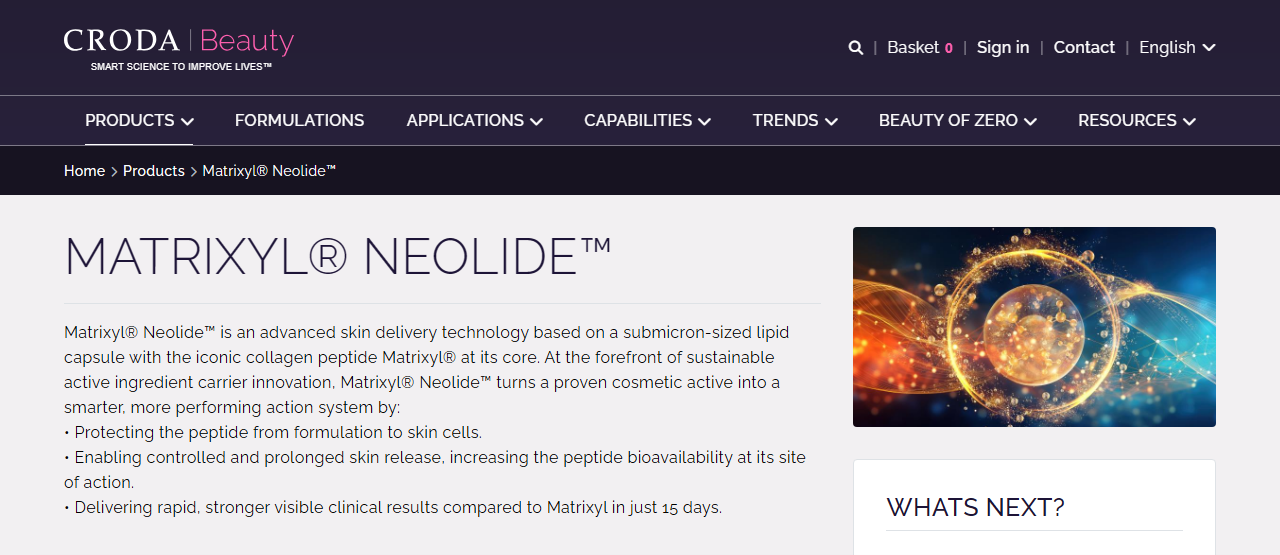
That composition is exactly why the brief changes. When a client asks us for “a peptide serum,” a conventional peptide is a soluble ingredient we can add at a wide range of points in the process. A capsule system is a physical structure, and physical structures can be destroyed by the same equipment that makes a good emulsion.
What has Croda published, and what has it not?
| Published by Croda | Not published (must come from the TDS) |
|---|---|
| Up to 15 days of prolonged peptide release | Recommended use level |
| +25% firmness at two weeks (p<0.01 vs baseline) | Working pH range |
| Twice the effect of standard Matrixyl® on fine lines | Maximum addition temperature and shear limits |
| +31% collagen III with microneedling (p<0.01 vs placebo + microneedling) | Full study protocols (panel size, duration, controls) |
| 99.79% natural origin (ISO 16128), vegan suitable, RSPO compliant, 43% lower carbon footprint than the original Matrixyl® | Compatibility data with common actives and preservative systems |
The right-hand column is not a criticism of Croda — suppliers routinely hold that detail behind a registered technical data sheet. It is a note about what a brand cannot yet cost. Anyone who tells you a launch price for a Neolide™ serum without the TDS is guessing at the single number that drives the formula cost.
The ORIZI perspective: what we would check before quoting it
ORIZI Group has not manufactured with Matrixyl® Neolide™, and we are not making any claim about how it performs in a finished product. What we can speak to is the process pattern, because encapsulated and liposomal actives are a recurring request in our cosmetics line.
Our team has observed that the failure point with capsule-based actives is almost never the chemistry. It is the point in the process where the material is added. A capsule dispersion added before or during hot emulsification, or passed through a high-shear homogeniser at production settings, can be substantially degraded before the batch is even cooled — and the resulting bulk will still look, smell and test normal on a standard release panel. The brand pays a premium ingredient price and receives ordinary peptide performance.
So before we would quote a formula containing an encapsulated active, we work through four questions:
- What is the maximum addition temperature? This determines whether the material goes into the main batch or into a separate cool-down phase, which affects cycle time and therefore price.
- What shear can it tolerate? Lab-scale mixing is gentle; production homogenisers are not. An ingredient that survives a 2 kg trial can fail at 200 kg on the same recipe.
- How will capsule integrity be evidenced over shelf life? Standard stability testing checks appearance, pH, viscosity and microbiology. None of those detect ruptured capsules. This needs to be agreed as a separate test with the supplier before the stability programme starts, not after.
- Does the packaging and filling line suit it? Filling pumps apply shear too, and a viscosity-thin serum through a high-speed filler is a different stress than a cream through a piston filler.
These are the same questions we work through for any structured delivery system, and they are the practical reason our anti-ageing treatment development conversations usually start with process feasibility rather than with the ingredient list. It is also why we normally recommend a client confirm the process window during development rather than discover it at scale-up — a point we make in more detail when discussing how a brief for serum formats translates into an actual production route.
Where we think this ingredient fits
The most interesting of Croda’s published results, from our point of view, is the microneedling one — a 31% collagen III increase measured against placebo plus microneedling. That is the only figure of the four measured against a real control rather than a baseline, and it points the ingredient at the professional and post-procedure segment rather than at mass retail. That segment is a genuine growth area in dermatology and aesthetic skincare manufacturing, and it also carries a higher evidence burden: a practitioner will ask questions about protocol that a retail shopper never will.
For a mainstream retail serum, we would be more cautious. The two-week firmness figure is measured against baseline rather than placebo, and a brand cannot transfer a raw-material study onto a finished product claim in any case — finished-product substantiation is a separate exercise in every market ORIZI ships to.
Risks and common mistakes
- Treating “15 days of release” as a consumer claim. It describes carrier behaviour, not a 15-day dosing schedule and not a 15-day visible result. Marketing copy that implies otherwise is a regulatory exposure, not a clever angle.
- Assuming the use level matches an older Matrixyl® grade. The peptide is a minor fraction of this dispersion. Dosing logic differs, and getting it wrong changes the formula cost materially in both directions.
- Running a standard stability protocol. Bulk stability passing is not evidence that the capsules survived. Agree the integrity test up front.
- Locking artwork before process trials. If the process window forces a reformulation, claims and ingredient listings move with it.
- Skipping the scale-up trial. With capsule systems this is the step that most often reveals the problem, and it is the step most often cut when a launch date slips.
Related reading: how we opened the ORIZI ingredient library.
Frequently asked questions
Has ORIZI Group used Matrixyl Neolide in a product?
No. We are evaluating it from publicly available supplier information and have not run it in any trial or production batch. If that changes we will update this article. We have worked with other encapsulated and liposomal actives, which is the basis for the process observations above.
Is Matrixyl Neolide a new peptide?
No. The active is Palmitoyl Pentapeptide-4, which has been used in cosmetics for many years as part of Croda’s Matrixyl® range. What Croda launched in April 2026 is a new patented lipid-capsule carrier for that existing peptide.
Will an encapsulated active make my product more expensive to manufacture?
Usually yes, on two counts. The raw material typically carries a premium over the unencapsulated equivalent, and the process constraints — a separate cool-down addition phase, gentler mixing, an extended stability programme — add cycle time and testing cost. Whether that is worthwhile depends on your positioning and price point; it is generally easier to justify in a premium or clinic-channel product than in a mass-market one.
Can we notify a product containing this ingredient in Malaysia?
Cosmetic products in Malaysia are notified with the National Pharmaceutical Regulatory Agency (NPRA) through the Quest system, and notification is based on the finished product formulation rather than on any single ingredient’s brand name. Palmitoyl Pentapeptide-4 and the other INCI components listed are conventional cosmetic ingredients. As with any formulation, the specific composition and intended claims should be confirmed against current NPRA guidelines before submission.
Does the sustainability data help a clean-beauty positioning?
Partly. Croda states 99.79% natural origin under ISO 16128, vegan suitability and RSPO compliance. ISO 16128 defines a natural-origin index; it is not organic certification and it is not the same as any particular retailer’s clean-beauty list. Check which standard your retail partner actually applies before putting the claim on pack.
Sources
- Croda Beauty — Matrixyl® Neolide™ product page (INCI, form, applications, clinical figures)
- Croda — launch announcement, 11 April 2026
- Personal Care Insights — Croda unveils evolution to Matrixyl peptide technology
- Global Cosmetics News — reported significance values
- National Pharmaceutical Regulatory Agency (NPRA), Malaysia
Related ORIZI reading: our earlier notes on BASF’s AI-designed collagen III active and on Croda’s Malvallin™ structural skin active cover two other 2026 launches we have been following, and what actually changes in the lab when a brief says “for sensitive skin” deals with the same gap between a marketing instruction and a production reality.
Update history
6 August 2026 — First published. Based on Croda Beauty’s public product and launch pages as at this date.
Talk to us about it
If you are weighing an encapsulated or delivery-system active for a skincare launch and want a realistic view of the process window, testing and cost before you commit to it, send us the brief and our R&D team will work through the feasibility with you.
A different 2026 launch makes the same point from the other direction: with Vytrus Biotech’s Toleroxyl™, the novelty is the biological target rather than the delivery system, but the manufacturing questions we would ask first are almost identical.
Where an encapsulated peptide is a process decision, a humectant-carried aqueous extract is a base-design decision. We worked through that contrast on Ashland’s night-repair active in our first look at eternight™.