Long before a supplier’s technical data sheet reaches our bench, we already have one document: the ingredient declaration. With Ashland’s eternight™ biofunctional, that single line told our team more about the formulation work ahead than the entire launch narrative did.
Written & researched by Norpadilah Abd Latif, Chemist & Cosmetic Formulation Contributor · Technical input by ORIZI Group R&D Team · Fact-checked by Creaton Poh · Published by ORIZI Group · Last reviewed September 2026
Disclosure: This article is published by ORIZI Group and may refer to our own manufacturing experience, services and capabilities. ORIZI Group has no commercial or supply relationship with Ashland in connection with this ingredient, and has not manufactured with it. External factual claims are supported by cited sources.
Quick answer
eternight™ biofunctional is a cosmetic active launched by Ashland in April 2026, supplied as an Iris pallida root extract in a water, propanediol and glycerin carrier, and positioned around night-time skin repair. Our R&D team is evaluating it as a formulation option; we have not produced with it. The reason it is a manufacturing conversation and not only a marketing one is the carrier: an aqueous, humectant-carried active changes the humectant budget, the water-phase preservation load and the sensory target of a night cream before anyone has discussed efficacy.
Key takeaways
- Ashland launched eternight™ biofunctional in April 2026 and took Bronze in the Green Ingredient Award at in-cosmetics Global 2026 in Paris.
- The declaration is water (and) propanediol (and) glycerin (and) Iris pallida root extract — a water-phase botanical extract carried in two humectants, with no peptide, polymer or encapsulate named.
- ORIZI Group has not manufactured with this ingredient and has not seen its technical data sheet. We are reading publicly available supplier material as part of our routine review of new actives.
- In our experience the carrier of an active is where the reformulation work hides: a humectant-heavy addition at a meaningful percentage has to be subtracted from the base, not added on top of it.
- Ashland reports an average 1.2-year reduction in perceived skin age after one month, measured by an AI facial scan tool, with a maximum of four years. A brand cannot inherit that claim by using the ingredient — the claim belongs to the tested formula at the tested level.
What actually happens when a launch like this reaches us
A brand owner rarely sends us a dossier. They send a link, a screenshot from a trade show, or a line from a competitor’s pack, and the question underneath is always the same: can you put this in our night cream, and what will it cost?
Our first pass is deliberately narrow. We do not start with whether the science is convincing — that assessment belongs later, and it needs the study report. We start with what the ingredient declaration commits us to, because that is the part we can read today and it determines whether the answer is “we can slot this into your existing base” or “this is a reformulation.”
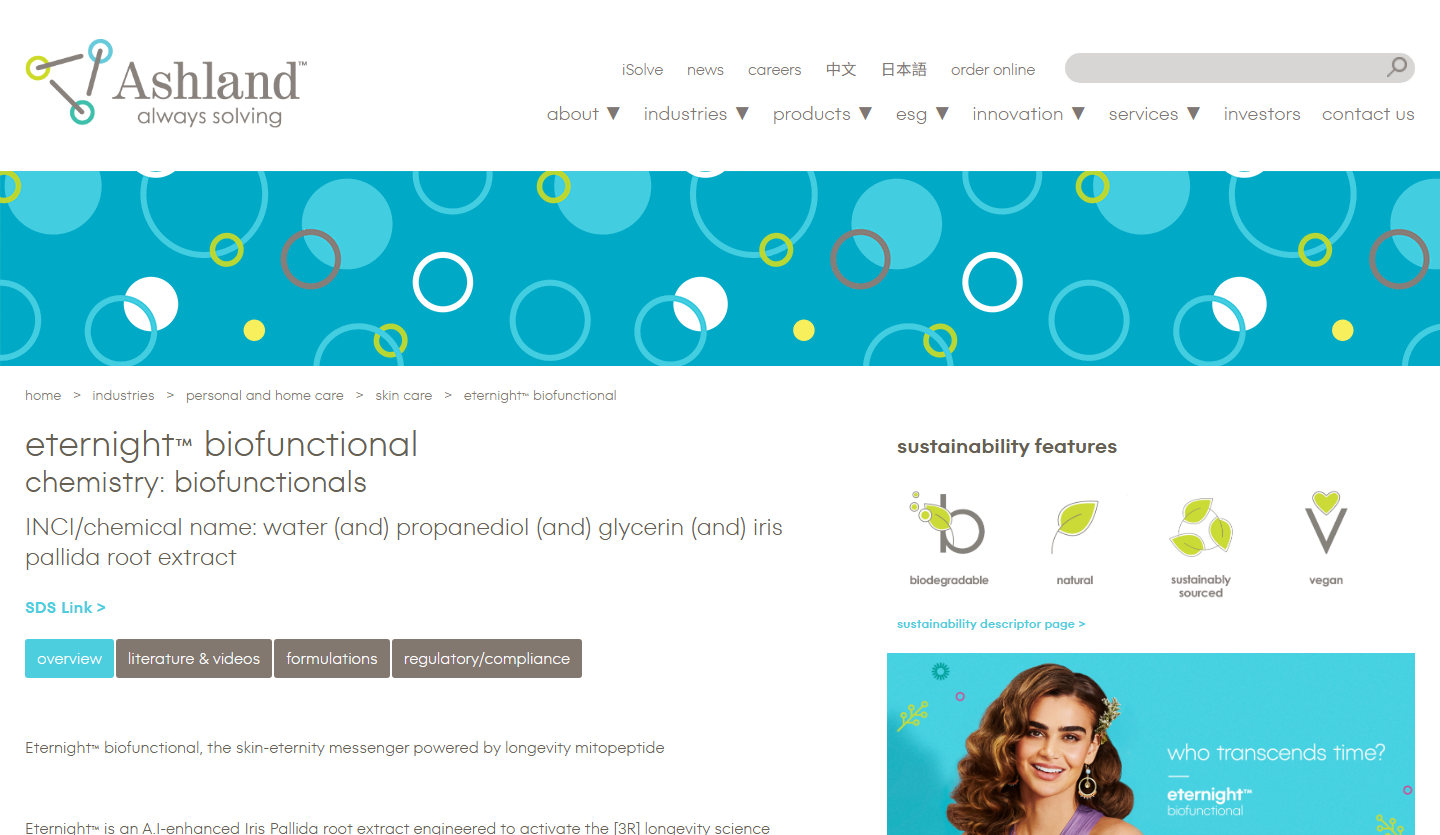
For eternight™, the declaration published on Ashland’s own product page is: water (and) propanediol (and) glycerin (and) Iris pallida root extract. Four items, and each one is an instruction.
Reading an INCI before the data sheet arrives
An INCI declaration is a composition statement in descending order, and for a formulator it functions as a first specification. Here is how our team reads this one, and what each reading turns into a question for the supplier.
| What the declaration says | What we infer | What we must confirm |
|---|---|---|
| Water is first | Water-phase material, high water activity, not oil-dispersible | Whether it can be added to the water phase before emulsification or only at cool-down |
| Propanediol and glycerin follow | Two humectant solvents present at meaningful levels — they arrive as part of the dose | The approximate ratio, so we can subtract them from the base humectant load |
| Iris pallida root extract is last | The active fraction is a minor part of the supplied liquid, as is normal for a botanical extract | The extract-to-carrier ratio, and the level used in the clinical study |
| No preservative is listed | The material is likely self-preserved by its solvent system, or preserved in the finished product only | Preservative compatibility and challenge-test behaviour in our base |
| No polymer, peptide or encapsulate is listed | No delivery system to protect — the extract is exposed to the formula environment directly | pH window, maximum processing temperature, and light and oxidation sensitivity |
Two of those confirmations are the ones we cannot resolve from public material. As of 6 September 2026, Ashland has not published a recommended use level or a pH window on its public page. That is entirely normal at this stage — both usually sit in the technical data sheet behind a registration — but it means any timeline or price we quoted today would be a guess, and we do not quote guesses.
The humectant budget: the part brands do not expect
This is the specific point we would raise with a brand owner first, and it is the reason we treat this as a formulation project rather than a substitution.
A night cream already carries humectants. Glycerin is usually in there, often propanediol or butylene glycol alongside it, and the level has been tuned to a sensory target — enough to hold water in the stratum corneum overnight, not so much that the product feels tacky against a pillow. When an active arrives carried in water, propanediol and glycerin and is dosed at a meaningful percentage, a proportion of that dose is humectant, and it lands directly on top of a budget that was already balanced.
In our production experience, this is a routine and quietly expensive discovery. The bench sample is approved, the pilot batch is made, and the feedback that comes back is about feel, not function: it is stickier, it takes longer to absorb, it pills under a moisturiser. Nothing has failed a specification. The formula simply now contains more humectant than the approved sensory profile allowed, and the correction is a rebalance of the base, revalidated for stability. Caught at bench, it costs a week. Caught at pilot, it costs the pilot.
So our practical rule for any humectant-carried active is to treat the carrier as part of the formula from the first bench trial, not as a solvent that disappears. In an overnight emulsion — the format this ingredient is built for — that means the base is redesigned around the active’s dose rather than the active being dropped into an existing base. Brands developing specialised treatment creams with us hear this early, because it is the difference between a four-week and a ten-week development.
What we tell a brand owner about the “four years younger” line
Ashland states that eternight™ is clinically shown to deliver skin that looks up to four years younger in one month, and qualifies it on the same page as an average of 1.2 years measured with an AI facial scan tool. The disclosure is more transparent than many launches offer, and we treat it as such.
Our position when a brand asks to carry that line is consistent across every active we have evaluated, and it is not a judgement about this supplier: a claim is a property of a tested formula at a tested level, not a property of an ingredient. A supplier’s study demonstrates what their test formula did in their panel. Unless a brand runs its own study on its own finished product, the honest position is to describe the ingredient and its research context, not to repeat a performance figure as if it belonged to the new product.
That is also the practical answer to why we ask for the tested use level before anything else. If the clinical result came from a formula at one concentration, and cost pressure later pushes the finished product below it, the claim and the formula have quietly separated — and that is the kind of gap that surfaces during a regulatory or retailer review rather than during development. Where a claim needs to be substantiated on the finished product, our product testing stage is where that work is planned, not an afterthought at launch.
The ORIZI perspective, and its limits
Based on ORIZI Group’s manufacturing experience, the actives that create the most rework are rarely the technically difficult ones. They are the ones that look like a drop-in and are not — an aqueous extract with a heavy carrier, a pH-sensitive material added into a base that was set at the wrong pH years ago, or an active whose approved sensory profile was built before the active existed. eternight™ falls into the first category on the public evidence available to us: nothing about it is exotic to handle, and everything about it changes the base it enters.
The limits of what we are saying should be explicit. We have not manufactured any product containing this ingredient, we have not run a trial batch, and we have not seen Ashland’s technical data sheet, safety documentation or clinical study report. Everything above is a reading of a published ingredient declaration plus general formulation experience with humectant-carried botanical extracts. It is a starting position for a conversation with a supplier, not a substitute for one.
We also make no assessment here of the mitochondrial biology Ashland uses to frame the ingredient. Humanin is a genuinely well-documented mitochondria-derived peptide in the ageing literature, but it does not appear in this product’s declaration, and whether a topical botanical extract engages that biology in human skin is a question for the study report, not for us to infer.
What we would need before quoting a formula with it
- Recommended and clinically tested use levels, stated separately.
- The stability-verified pH window, and behaviour outside it.
- Maximum processing temperature and the required addition point.
- Extract-to-carrier ratio, so the humectant contribution can be calculated.
- Preservative compatibility data and challenge-test guidance for an aqueous botanical extract.
- The clinical study design: panel size, duration, comparator, and per-endpoint results.
- The ISO 16128 natural-origin figure, if the brand is pursuing a naturals positioning.
None of these are unusual requests, and a supplier of Ashland’s scale will have all of them. The point is that the answer to “can we use this?” is contained in that list, not in the launch announcement — the same pattern we described when we looked at Vytrus Biotech’s Toleroxyl™ protein active and at Croda’s encapsulated Matrixyl® Neolide™. Our next review in the series covers RAHN’s award-winning chicory root active for skin sensation.
Frequently asked questions
Has ORIZI Group used eternight™ biofunctional in production?
No. We have not manufactured any product containing this ingredient and we have not run a trial batch. We are evaluating publicly available supplier information as part of our routine review of new actives.
Can it be added to our existing night cream?
Possibly, but not as a drop-in at a meaningful dose. Because the active is carried in water, propanediol and glycerin, adding it changes the humectant load of the finished product and therefore its sensory profile. In practice we would expect to rebalance the base and revalidate stability rather than simply raise the actives line.
Which product formats suit it best?
Water-containing formats: night creams, overnight sleeping masks, night serums and gel-creams. An aqueous extract is not a natural fit for anhydrous balms or oil-based serums, and the supplier’s own night positioning aligns with moisturiser and serum formats rather than with cleansers or rinse-off products.
Can our brand use the “up to four years younger” claim?
Not on the basis of the ingredient alone. That result belongs to the supplier’s test formula at its tested level and panel. A brand wanting a performance claim on its own product generally needs its own substantiation study on the finished formula, and the wording must reflect the average result and the measurement method rather than the maximum.
Does it contain the peptide the marketing refers to?
No. The declaration lists water, propanediol, glycerin and Iris pallida root extract, with no peptide. Humanin is presented by the supplier as the biological mechanism the extract is designed to engage, not as a component of the material, so “contains humanin” would misdescribe the ingredient.
How long would development take?
We would not commit to a timeline before seeing the dossier. Realistically, a humectant-carried aqueous active adds work at two points: a bench stage to rebalance the base around the active’s dose, and a preservation and stability programme appropriate to an added botanical extract in the water phase. Both become estimable once the supplier’s data is in hand.
Where can we read an independent view of this launch?
The supplier’s own page is linked in the sources below. For a market-side analysis of the launch, the award and how to read the efficacy figure, OEMHallmark published a detailed assessment of eternight™ and its mitopeptide positioning.
Sources
- Ashland — eternight™ biofunctional official product page (principal’s page: INCI declaration, positioning, compliance library)
- Ashland — launch announcement for eternight™ biofunctional
- in-cosmetics Global 2026 award winners (RX Global) — Green Ingredient Award, Bronze
- Cosmetics Business — Ashland targets skin longevity with mitochondria-inspired innovation
- Journal of Clinical Investigation — mitochondria-derived peptides in aging and healthspan (background on humanin biology)
Update history
6 September 2026 — first published, based on supplier material available at that date.
If you are evaluating a new active for a night cream or overnight treatment and want a manufacturing feasibility view before you commit to it, talk to our team. We will tell you what we can read from the specification today, what we would need from the supplier, and what we are not yet in a position to promise.